





































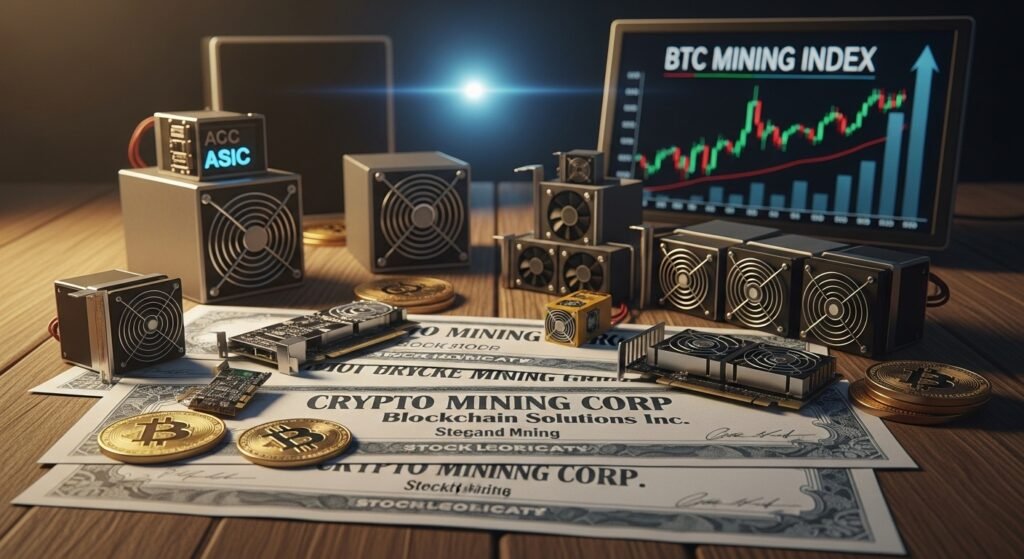
Bitcoin mining stocks sit at the intersection of two highly dynamic arenas: the world of traditional equities and the fast-moving landscape of digital assets. Their valuations are influenced not only by Bitcoin’s price, but also by stock market sentiment, liquidity cycles, regulatory direction, and broader economic forces. Because of this dual exposure, bitcoin mining stocks track broader market moves more closely than many expect, often rising during periods of optimism in tech and selling off when risk appetite weakens.
Yet while their movement frequently mirrors the wider market, bitcoin mining equities also possess unique drivers of volatility that can cause them to decouple dramatically from both Bitcoin and traditional stocks. Increasing mining difficulty, shifting energy costs, halving cycles, supply expansions, balance-sheet choices, and the industry’s growing pivot toward AI infrastructure can all reshape their trajectories. Over the past several years, the idea of miners simply acting as leveraged Bitcoin proxies has given way to a more complex reality in which their strategies, partnerships, and operational decisions play as much of a role as Bitcoin’s price itself.
What Bitcoin Mining Stocks Represent
Bitcoin mining stocks represent ownership in companies built to secure the Bitcoin network through massive computational power. These firms invest heavily in specialized ASIC hardware, large-scale data centers, and long-term energy agreements to mine Bitcoin profitably. Their ability to generate revenue depends on the amount of Bitcoin they produce, the price at which they can sell that Bitcoin, and the costs they incur while running their industrial operations.
Unlike holding Bitcoin directly, which gives investors exposure solely to its market price, buying shares of mining companies introduces additional layers of operational and financial complexity. The performance of these firms hinges on decisions made by management, the cost-effectiveness of their energy strategies, the durability of their facilities, and their ability to scale efficiently without overextending themselves through debt or equity dilution. This blend of crypto exposure with traditional corporate fundamentals is one of the primary reasons bitcoin mining equities tend to follow the broader stock market as much as they follow Bitcoin’s price.
Mining companies earn revenue through block rewards and transaction fees, but their profitability can swing dramatically depending on network difficulty and market conditions. When Bitcoin’s price rises faster than mining costs, miners often enjoy powerful surges in earnings. When energy costs rise or halving cycles cut block rewards, their revenue can shrink even when Bitcoin itself performs reasonably well. This operational leverage helps explain why investors view mining stocks as high-beta assets tied not only to Bitcoin, but to the same forces that drive speculative growth stocks in traditional markets.
Why Bitcoin Mining Stocks Track Broader Market Moves

The tendency for bitcoin mining stocks to follow broader market movements is rooted in the growing correlation between Bitcoin and major stock indices. As institutional participation in Bitcoin increases, the asset increasingly behaves like a high-growth, risk-sensitive component of global markets. During periods of economic optimism, when investors rotate into technology, AI, and high-growth sectors, Bitcoin often rises alongside these assets. In such conditions, the share prices of mining companies tend to climb as well, lifted by both higher Bitcoin prices and positive market sentiment.
When markets turn risk-averse, the opposite pattern emerges. Investors often pull back from speculative sectors first, and publicly traded miners fall squarely into that category. They are seen as volatile companies whose profits depend on both commodity-like costs and the unpredictable trajectory of Bitcoin. As fear spreads across global markets or interest rates rise sharply, miners can experience deeper declines than many other categories of stocks, even when Bitcoin does not fall to the same extent. Their dual identity as both infrastructure businesses and crypto-sensitive equities makes them particularly responsive to shifts in liquidity and market appetite.
Another factor contributing to this connection is the investment behavior of funds and portfolios that group mining stocks with technology and digital asset themes. Many traders treat miners as part of a larger speculative basket, meaning their buying and selling often reflects macro-level flows rather than crypto-specific ones. As a result, mining shares frequently echo movements in indices such as the Nasdaq or Russell 2000, even when Bitcoin remains relatively stable.
When Bitcoin Mining Stocks Break From Bitcoin’s Path
Despite their frequent synchronicity with the broader market, miners are not permanently tethered to Bitcoin or to traditional equities. There are notable periods in which their performance diverges sharply. One striking example occurred in 2024, when Bitcoin reached new all-time highs while several publicly traded miners ended the year in negative territory. Rising energy prices, a post-halving drop in block rewards, balance-sheet pressures, and expansion-related overspending created conditions in which mining cost structures tightened even as Bitcoin continued advancing.
This decoupling reveals an important truth: Bitcoin mining stocks are not simply instruments that mirror Bitcoin’s movements. They are businesses with evolving strategies, operational risks, and competitive pressures. If a company fails to manage its energy contracts effectively, misses deployment deadlines, misjudges the timing of new ASIC purchases, or scales too rapidly during a bull cycle, its profitability can suffer regardless of how Bitcoin performs.
In other cases, mining stocks have outperformed Bitcoin even when the cryptocurrency has remained flat. This usually occurs when miners announce strategic pivots into adjacent sectors such as high-performance computing or AI data center hosting. As demand for GPU infrastructure and power-dense data facilities continues to surge, several miners have positioned themselves as hybrid platforms capable of allocating power toward AI workloads. When the market rewards these shifts, share prices can climb independently of Bitcoin’s momentum, reflecting investor enthusiasm for the broader AI boom rather than crypto-specific factors.
The Growing Influence of AI and Data Center Expansion
One of the most significant new trends driving mining stock valuations is the rapid convergence between bitcoin mining infrastructure and AI data center development. Many miners have discovered that the same power-rich facilities built for mining can be repurposed or expanded to support AI hosting, cloud computation, and high-performance workloads. This shift has introduced an entirely new catalyst for share prices, one that is rooted in technology adoption rather than Bitcoin’s price.
When miners announce long-term contracts with hyperscalers or AI infrastructure clients, investors often respond by valuing these companies through a different lens. Instead of treating them strictly as leveraged Bitcoin plays, the market begins assessing them as hybrid data center operators with potentially steadier revenue streams. This recalibration can cause bitcoin mining stocks to diverge from both Bitcoin and the broader crypto market, aligning them more closely with the performance of AI-driven tech sectors.
As AI demand grows and competition for power-dense data center space intensifies, miners that successfully reposition themselves as flexible computing platforms may continue to move in ways that do not always reflect Bitcoin’s short-term movements. This strategic evolution explains why, at times, bitcoin mining stocks correlate more closely with AI and cloud computing indices than with crypto markets.
The Operational and Economic Drivers Behind Mining Stock Volatility
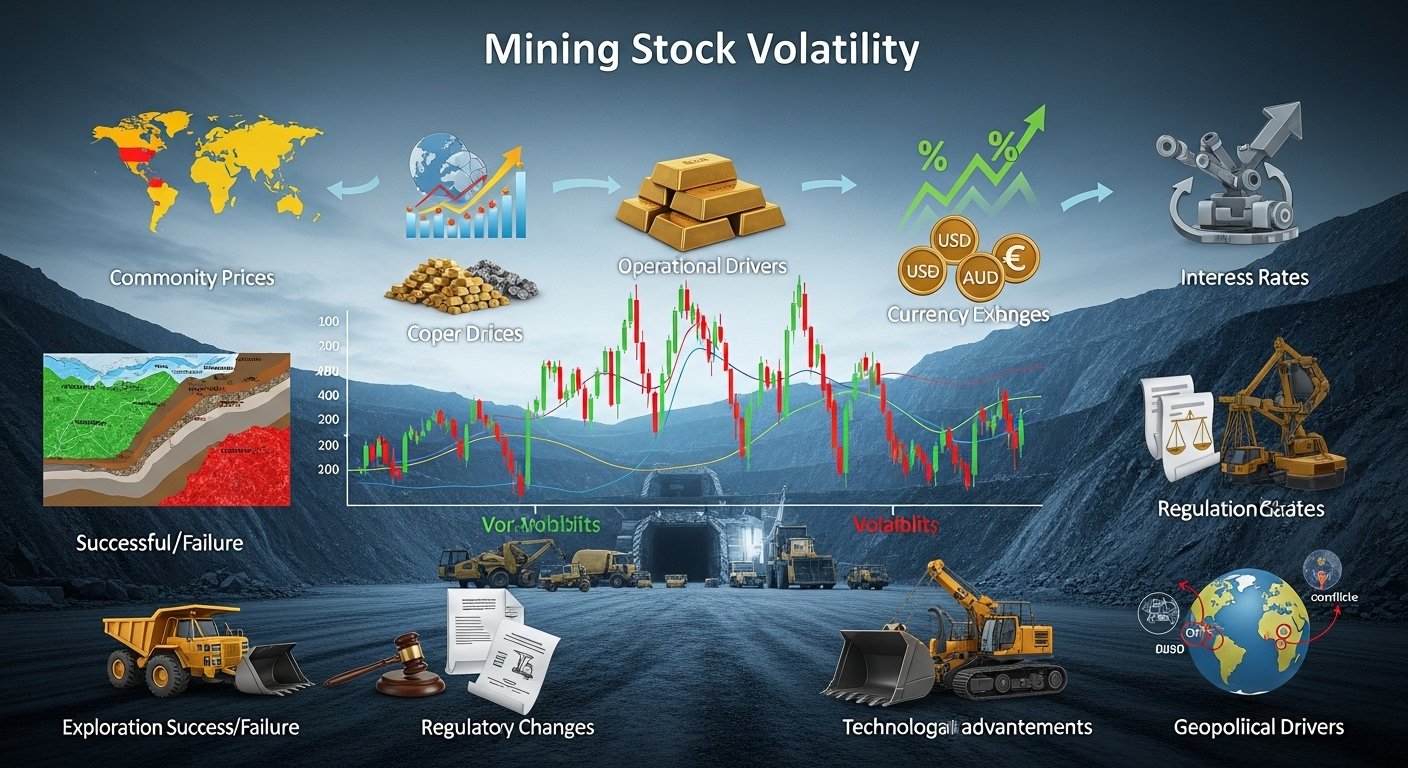
Although bitcoin mining stocks frequently track broader market moves. The internal economics of mining still exert enormous influence over its long-term performance. The halving cycle plays a particularly important role. Every four years, the Bitcoin block reward is cut in half, instantly reducing revenue for all miners. The 2024 halving, which decreased rewards from 6.25 BTC to 3.125 BTC, created a more competitive environment. Where only the most efficient operators could maintain healthy margins. As mining difficulty rose and energy costs fluctuated, weaker companies struggled even as Bitcoin’s price continued to strengthen.
Energy prices remain one of the dominant cost centers for miners. Companies with access to long-term, ultra-low-cost power contracts, renewable sources, or stranded energy have a clear advantage. Those facing rising energy costs or regulatory pressure often see their margins compress quickly. Environmental considerations add another layer of complexity. As global scrutiny of proof-of-work mining increases, companies are positioned as renewable-focused. ESG-aligned funds sometimes attract investment flows that their less efficient peers do not. This creates valuation gaps driven not by Bitcoin’s price, but by evolving perceptions of sustainability and compliance.
Financial structure is another element shaping mining stock performance. The aggressive expansions that characterized earlier cycles often left some miners with substantial debt or recurring equity dilution. When interest rates rise or capital markets tighten, these financing choices can weigh heavily on share prices. Conversely, miners with strong balance sheets and disciplined expansion strategies are better positioned. Outperform across cycles, even during periods when Bitcoin’s movements are muted.
See More: Bitcoin Miners Pivot to Powering AI Inside the New Compute Rush
Evaluating Bitcoin Mining Stocks Through a Strategic Lens
Investors evaluating mining stocks must look beyond Bitcoin’s headline price and analyze the operational efficiency, cost structure, and scaling strategy. And the technological adaptability of each company. Hash rate capacity reveals the competitive share a miner holds within the global network. The cost to mine one Bitcoin offers insight into how resilient a company will be. During periods of price compression or rising difficulty. Uptime, curtailment flexibility, and energy diversification provide additional clarity into how well a miner manages its infrastructure.
Comparing miners to other forms of Bitcoin exposure also helps contextualize their behavior. Holding Bitcoin directly removes operational risk but provides no upside beyond price appreciation. Purchasing a Bitcoin ETF offers convenience but lacks the potential outperformance mining equities can generate during favorable cycles.
At the same time, a miner’s operational failures, financing decisions. Energy miscalculations can undermine returns even when Bitcoin performs well. The risk–reward balance is therefore more complex, requiring investors to evaluate miners as. Multifaceted businesses rather than passive Bitcoin surrogates.
Bitcoin mining stocks remain among the most volatile instruments in public markets. Their sensitivity to Bitcoin’s price movements, energy costs, regulation, hardware cycles, and market sentiment makes them prone to sharp fluctuations. When combined with broader shifts in equity markets, these forces can produce amplified effects. Swings that move far beyond the changes seen in Bitcoin itself. In bear markets, miners have historically experienced deeper drawdowns than Bitcoin. In strong bull phases, they have sometimes achieved gains that far surpass Bitcoin’s returns.
This volatility requires acknowledging the overlapping risks miners face. They must navigate crypto-specific challenges, traditional market cyclicality, and operational uncertainties. All while maintaining competitiveness against a global network that grows more powerful each year. The companies that withstand these pressures tend to. Be those with disciplined energy strategies, strong balance sheets, efficient hardware fleets, and. A willingness to diversify into adjacent opportunities such as AI and high-performance computing.
Conclusion
Bitcoin mining stocks occupy a distinctive place within global markets. Their performance reflects Bitcoin’s trajectory, but also the health of equity markets and the cost of capital. The evolution of the energy landscape and the emerging demand for AI-driven infrastructure. Because of these intertwined influences, it is natural that bitcoin mining stocks track broader market moves much of the time. Yet the same multifaceted nature that drives this correlation also produces periods of decoupling, during which company-specific choices are made. Halving cycles, or technological pivots, reshape their direction.
For investors, mining equities can offer a powerful—albeit volatile—way to. Express views not only on Bitcoin but also on broader themes such as. As digital adoption, AI growth, and the transformation of global energy systems are. Evaluating them effectively requires a nuanced understanding of both macro trends and the operational realities of the mining business. Approached with careful analysis, they can serve as strategic, high-potential components within a diversified portfolio. Investment perspective, reflecting both the promise and the unpredictability of the digital age.