





































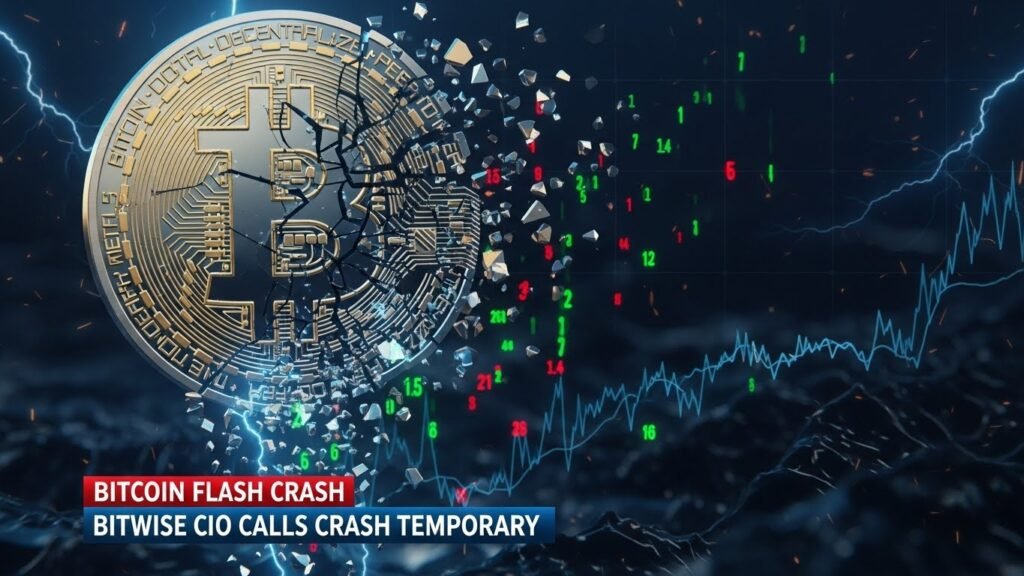
The cryptocurrency market is no stranger to extreme volatility, yet every sharp move still manages to shake investor confidence. Recently, Bitcoin experienced a sudden and aggressive price drop that wiped out billions in market value within minutes, a move widely described as a Bitcoin flash crash. Social media erupted with speculation, fear, and conflicting narratives, as traders rushed to understand whether this was the start of a deeper correction or merely another short-lived shock.
Amid this uncertainty, Bitwise Chief Investment Officer Matt Hougan stepped forward with a calming assessment, calling the Bitcoin flash crash temporary rather than structural. His remarks quickly gained traction, providing a counterbalance to the panic-driven commentary dominating online forums. For long-term investors and active traders alike, this perspective raises important questions about market structure, liquidity, macroeconomic pressures, and Bitcoin’s broader adoption trend.
This article explores why the Bitcoin flash crash occurred, why the Bitwise CIO believes it is temporary, and what this event means for Bitcoin’s long-term trajectory. By examining technical factors, institutional behavior, historical patterns, and market psychology, readers can gain a clearer, more balanced understanding of the situation without succumbing to fear or hype.
What Is a Bitcoin Flash Crash?
A Bitcoin flash crash refers to a sudden, sharp decline in price that occurs within a very short time frame, often followed by a partial or full recovery. Unlike prolonged bear markets, flash crashes are typically driven by short-term liquidity imbalances rather than fundamental weakness.
In this recent case, Bitcoin plunged rapidly as leveraged positions were unwound across major exchanges. Stop-loss orders cascaded, and thin order books during off-peak trading hours amplified the move. These events are not unique to crypto markets; traditional assets like equities and commodities have experienced similar flash crashes over the years.
What makes a Bitcoin flash crash particularly impactful is the 24/7 nature of crypto trading. With no market close to absorb shocks gradually, volatility can materialize instantly, catching both retail traders and institutions off guard.
Market Reaction to the Bitcoin Flash Crash
Panic Selling and Liquidations
The immediate aftermath of the Bitcoin flash crash was characterized by widespread panic selling. On-chain data revealed a spike in forced liquidations, particularly among highly leveraged traders. When prices fall rapidly, leveraged positions are automatically closed by exchanges, creating a feedback loop that accelerates the decline.
This phenomenon is a recurring feature of crypto markets, especially during periods of heightened speculation. While painful in the short term, these liquidation events often reset market leverage and reduce systemic risk.
Short-Term Sentiment Shift
Sentiment indicators turned sharply bearish in the hours following the crash. Fear-based metrics surged as traders questioned whether Bitcoin had reached a local top. However, sentiment-driven sell-offs often overshoot to the downside, creating opportunities for disciplined investors who understand the cyclical nature of the market.
Bitwise CIO’s Perspective on the Flash Crash
Why Bitwise Calls the Crash Temporary
According to Bitwise CIO Matt Hougan, the Bitcoin flash crash does not reflect a deterioration in Bitcoin’s underlying fundamentals. Instead, he attributes the move to technical factors such as leverage, liquidity gaps, and short-term macro uncertainty.
Hougan emphasized that Bitcoin’s network activity, institutional adoption, and long-term demand drivers remain intact. From his viewpoint, the crash resembles previous volatility events that ultimately strengthened the market by flushing out excess risk. This assessment aligns with Bitwise’s long-standing thesis that Bitcoin remains in a structural growth phase despite periodic drawdowns.
Institutional View vs Retail Fear
One key reason the Bitwise CIO’s comments resonated is the contrast between institutional analysis and retail emotion. While retail traders often react to price alone, institutional investors tend to focus on broader trends such as capital flows, regulatory clarity, and macroeconomic alignment.
From an institutional perspective, a Bitcoin flash crash can represent a temporary dislocation rather than a signal to exit the market entirely.
Historical Context: Flash Crashes in Bitcoin’s Past
Lessons From Previous Bitcoin Flash Crashes
Bitcoin has experienced numerous flash crashes throughout its history, each accompanied by claims that the asset was “finished.” Yet time and again, Bitcoin has recovered and gone on to reach new highs.
Notable examples include the sharp drops during the 2017 bull market, the March 2020 liquidity crisis, and several rapid corrections during the 2021 cycle. In each case, the underlying adoption narrative continued to strengthen despite short-term turbulence. These historical patterns support the argument that flash crashes are a feature of Bitcoin’s maturation process rather than an existential threat.
Market Maturity and Volatility
As Bitcoin’s market capitalization has grown, volatility has gradually decreased relative to its early years. However, leverage and derivatives trading have introduced new forms of short-term instability. Flash crashes, while dramatic, are increasingly absorbed by deeper liquidity pools and institutional participation.
Technical Factors Behind the Bitcoin Flash Crash

Leverage and Derivatives Markets
The expansion of Bitcoin futures and perpetual swaps has increased both liquidity and risk. When leverage builds excessively, even modest price moves can trigger large-scale liquidations. The recent Bitcoin flash crash highlights how derivatives markets can amplify volatility during periods of stress.
This does not necessarily imply weakness; rather, it underscores the importance of risk management in a maturing financial ecosystem.
Liquidity Gaps and Trading Hours
Liquidity conditions vary throughout the day, and sudden sell orders during low-liquidity periods can cause exaggerated price movements. The Bitcoin flash crash occurred during a window when order books were thinner, magnifying the impact of large trades.
Such dynamics are well understood by professional traders and reinforce the idea that timing and structure matter as much as sentiment.
Macro Environment and Its Role
Interest Rates and Risk Assets
Bitcoin continues to trade in correlation with broader risk assets during periods of macro uncertainty. Rising interest rates, inflation data, and central bank messaging all influence short-term price action. The flash crash coincided with renewed concerns about monetary tightening, which weighed on speculative assets across the board.
Bitwise CIO’s assertion that the crash is temporary reflects confidence that Bitcoin’s long-term narrative as a scarce, decentralized asset remains relevant regardless of short-term macro noise.
Global Liquidity Trends
Global liquidity cycles play a crucial role in crypto markets. When liquidity tightens, volatility increases. When it expands, risk assets tend to recover. Understanding these cycles helps contextualize why sudden crashes occur without signaling long-term decline.
Institutional Behavior During the Flash Crash
Accumulation vs Distribution
On-chain analysis following the Bitcoin flash crash suggested that long-term holders were largely inactive, while short-term traders bore the brunt of selling pressure. In some cases, institutional wallets appeared to accumulate during the dip, supporting the view that smart money saw value rather than danger. This behavior aligns with Bitwise’s broader investment philosophy, which emphasizes disciplined accumulation over reactive trading.
Confidence in Bitcoin’s Long-Term Thesis
Institutional confidence is not built on daily price fluctuations. Instead, it rests on factors such as network security, adoption trends, and regulatory progress. The Bitwise CIO’s comments reflect a belief that these fundamentals remain strong despite temporary dislocations.
What This Means for Retail Investors
Managing Emotions During Volatility
The Bitcoin flash crash serves as a reminder of the emotional challenges inherent in crypto investing. Panic selling often locks in losses, while patience has historically rewarded those who understand Bitcoin’s volatility profile. Retail investors can benefit from studying past market cycles and recognizing that sharp corrections are part of Bitcoin’s journey toward maturity.
Long-Term Strategy vs Short-Term Trading
For long-term holders, the Bitwise CIO’s assessment reinforces the importance of focusing on fundamentals rather than headlines. For active traders, flash crashes highlight the need for proper risk controls and realistic expectations.
Bitcoin’s Recovery Signals After the Crash
Price Stabilization and Volume Patterns
Following the initial drop, Bitcoin showed signs of stabilization as selling pressure eased and volume normalized. These recovery signals suggest that the flash crash may indeed have been a temporary liquidity event rather than the start of a prolonged downturn.
Historically, such stabilization phases often precede renewed upward momentum once market confidence returns.
Sentiment Reset and Market Health
A sharp correction can reset overly bullish sentiment, creating a healthier environment for sustainable growth. By reducing leverage and speculative excess, flash crashes may ultimately strengthen the market structure.
Long-Term Outlook According to Bitwise
Bitcoin’s Structural Growth Narrative
Bitwise maintains that Bitcoin’s long-term outlook is supported by increasing institutional adoption, improving infrastructure, and growing recognition as a macro asset. From this perspective, temporary volatility is a small price to pay for long-term opportunity.
The Bitwise CIO’s statement reflects confidence that Bitcoin’s role in global finance continues to expand despite short-term turbulence.
Adoption, Regulation, and Innovation
Developments in custody solutions, regulatory clarity, and blockchain innovation continue to enhance Bitcoin’s appeal. These trends provide a strong foundation that short-term price shocks cannot easily undermine.
Conclusion: A Temporary Shock, Not a Structural Breakdown
The recent Bitcoin flash crash was undeniably unsettling, but context matters. According to Bitwise CIO Matt Hougan, the event was driven by technical and liquidity factors rather than a collapse in fundamentals. History, market structure, and institutional behavior all support the view that this was a temporary disruption rather than a lasting reversal.
For investors willing to look beyond the noise, the flash crash may ultimately be remembered as another example of Bitcoin’s resilience. Volatility remains part of the journey, but the broader narrative of adoption and maturation continues to unfold.
FAQs
Q: What caused the recent Bitcoin flash crash?
The crash was primarily caused by leveraged liquidations, liquidity gaps, and short-term macro uncertainty rather than fundamental weakness in Bitcoin.
Q: Why did the Bitwise CIO call the crash temporary?
Bitwise CIO Matt Hougan believes Bitcoin’s long-term fundamentals remain strong and that the price drop was driven by technical factors, not structural issues.
Q: Do Bitcoin flash crashes indicate a bear market?
Not necessarily. Flash crashes are often short-lived events that occur even during bullish or neutral market phases.
Q: How do institutions typically react to Bitcoin flash crashes?
Institutions often view flash crashes as opportunities to accumulate rather than reasons to exit, focusing on long-term trends instead of short-term price moves.
Q: What should retail investors learn from this event?
Retail investors should recognize the importance of emotional discipline, risk management, and focusing on long-term fundamentals rather than reacting to sudden price swings.