




































Blockchain adoption is no longer a niche experiment living in proof-of-concept slide decks. It’s increasingly a business decision, a technology strategy, and—depending on the sector—a competitive necessity. Yet in the United States, the conversation around blockchain often gets pulled into a regulatory tug-of-war that blurs the line between the underlying technology and the broader crypto market. Analysts watching the space closely have pointed out a surprising reality: blockchain adoption keeps moving forward even when U.S. policy signals feel inconsistent, slow, or unclear.
That forward momentum comes from a practical shift. Many companies have stopped treating blockchain as a speculative bet and started treating it as infrastructure—particularly for workflows that demand tamper-evident records, automated settlement, traceability, or cross-party coordination. In other words, blockchain adoption is being driven less by hype and more by utility. The growth isn’t uniform across every category, and it certainly isn’t immune to regulatory shocks. But it has become resilient because it’s tied to measurable outcomes like faster reconciliation, reduced fraud, improved auditability, and streamlined compliance reporting.
At the same time, U.S. regulatory uncertainty still matters. It shapes where startups incorporate, how exchanges list assets, whether banks are comfortable touching digital assets, and how enterprises design blockchain projects so they don’t accidentally fall into risky classifications. The tension is real: blockchain adoption is scaling while the rulebook remains fragmented. Instead of stopping innovation, that uncertainty is pushing many teams toward safer architectures, clearer governance, permissioned deployments, and use cases that don’t depend on public token speculation.
This article explores why blockchain adoption continues to accelerate despite the murky U.S. environment, where real-world traction is emerging, how industries are adapting, and what readers should watch next as the U.S. tries to define its approach to crypto regulation without stifling technological progress.
Why Blockchain Adoption Keeps Rising
Blockchain adoption persists because the core value proposition has become easier to measure. When multiple parties need a shared source of truth, traditional systems can be slow, siloed, and expensive to reconcile. A distributed ledger can reduce friction by allowing participants to view the same synchronized record, with changes tracked in a way that is difficult to alter retroactively.
In practice, blockchain adoption tends to rise when it solves a coordination problem. Supply chains need traceability across vendors. Finance teams need faster settlement and fewer intermediaries. Healthcare needs verifiable data integrity across systems. Governments need transparent registries. When blockchain adoption is framed as a tool for multi-party coordination rather than a speculative asset story, it becomes easier to justify and easier to scale.
Another reason blockchain adoption is pushing ahead is the maturation of the ecosystem. Tools for identity, custody, key management, privacy-preserving computation, and interoperability are more robust than they were a few years ago. Enterprises can now implement smart contracts with better testing frameworks, clearer governance controls, and more predictable operational playbooks. Even when U.S. regulatory uncertainty limits certain token-based models, blockchain adoption can still thrive through enterprise-grade implementations, consortium networks, and regulated product structures.
The Difference Between Blockchain Adoption and Crypto Speculation
One of the biggest misunderstandings in public debate is the assumption that blockchain adoption equals crypto speculation. In reality, blockchain adoption spans a wide spectrum. On one end are public networks and open token markets. On the other end are private or permissioned ledgers used for internal audit trails, interbank settlement experiments, or B2B supply chain coordination.
This distinction matters because U.S. regulatory uncertainty is often focused on token issuance, exchange activity, retail trading, and custody rules. Those areas influence the crypto market strongly, but they don’t automatically stop blockchain adoption in enterprise settings where tokens may be absent or tightly controlled.
Many organizations pursuing blockchain adoption intentionally design systems that minimize regulatory exposure. They may avoid public token launches, focus on tokenization of real-world assets within compliant frameworks, or use permissioned access so that participant identity and governance are clear. This doesn’t mean public networks are irrelevant; it means blockchain adoption can continue in parallel tracks, with different risk profiles and different compliance demands.
How U.S. Regulatory Uncertainty Actually Impacts Adoption
U.S. regulatory uncertainty doesn’t affect every type of blockchain adoption equally. The impact is strongest where businesses rely on clear definitions: what counts as a security, what disclosures are required, which agency has jurisdiction, and how custody and market structure should be regulated. When those definitions are unclear, some companies pause product launches or limit U.S. exposure.
But uncertainty can also produce an unexpected result: it encourages blockchain adoption in “low-ambiguity” use cases. Teams gravitate toward implementations with obvious business value and limited consumer token risk. This includes internal recordkeeping, B2B settlements, traceability systems, and permissioned networks where participants are known entities. 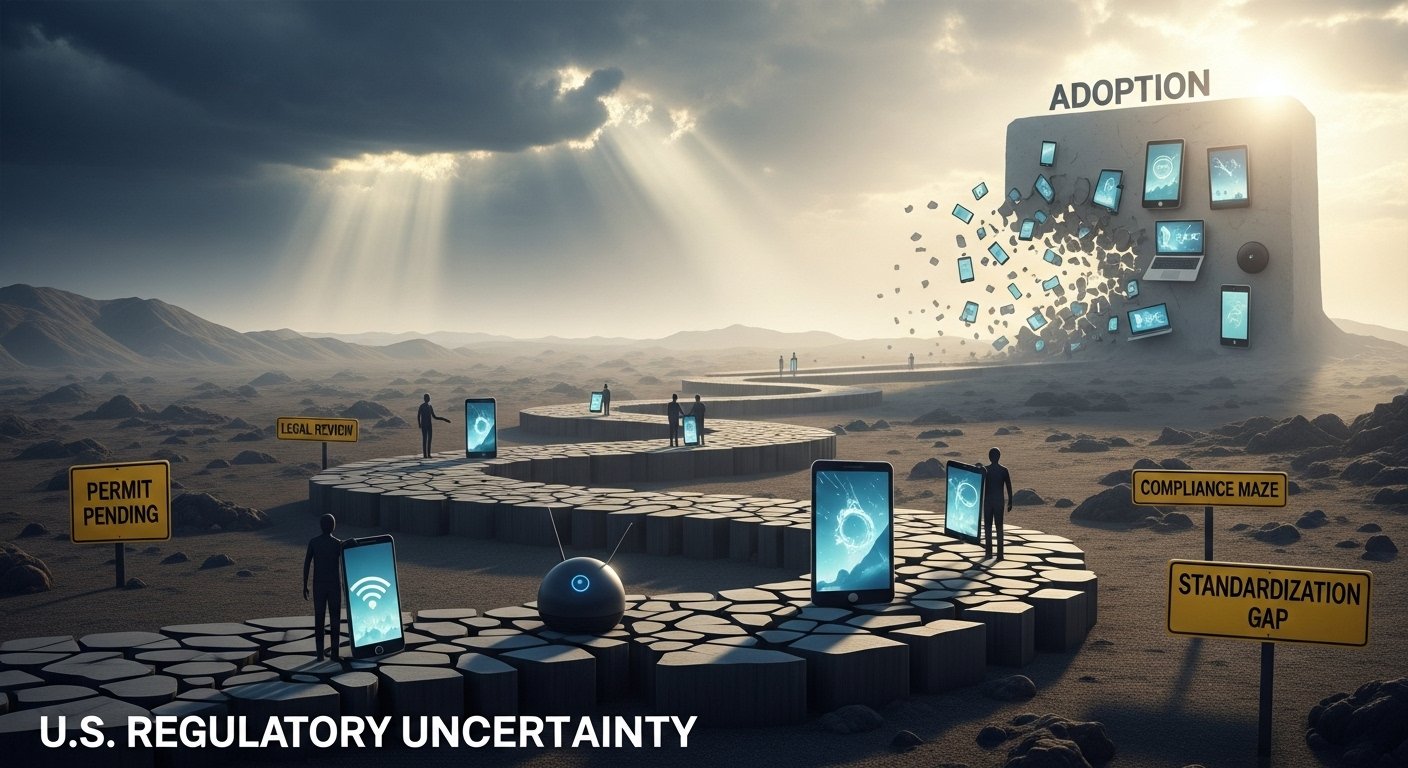
Regulatory uncertainty also shapes how businesses communicate. Many firms emphasize “blockchain” and “distributed ledger technology” rather than “crypto,” not just for marketing reasons but to clarify intent: the goal is operational efficiency and integrity, not speculative trading. As analysts often note, blockchain adoption thrives when it is positioned as infrastructure.
Regulatory Fragmentation and Compliance Design
The U.S. regulatory landscape can feel fragmented because different agencies may interpret similar activity differently, especially when assets blur boundaries between commodities, securities, and payment instruments. This makes compliance a design constraint, not an afterthought.
To keep blockchain adoption moving, companies bake risk management into architecture. They implement stronger KYC/AML controls for participants, create auditable permissioning layers, adopt rigorous data retention policies, and use on-chain analytics to monitor flows. As a result, blockchain adoption can become more “enterprise-ready” under regulatory pressure, even if startups wishing for faster innovation sometimes feel constrained.
Enterprise Blockchain Adoption in 2026: What’s Actually Working
The most durable blockchain adoption stories in enterprise environments share a few characteristics: they reduce reconciliation costs, enhance transparency, and integrate with existing systems rather than replacing everything overnight. Instead of chasing total transformation, successful teams use blockchain as a coordination layer.
Crucially, enterprises increasingly demand predictable performance, privacy, and governance. That’s why blockchain adoption often happens through permissioned networks or hybrid models that combine public verifiability with private data handling. This hybrid direction allows organizations to benefit from blockchain’s integrity guarantees without exposing sensitive information.
Integration, Not Reinvention
Enterprise blockchain adoption succeeds when it integrates with ERPs, payment rails, data warehouses, and audit systems. Instead of forcing a business to “move everything on-chain,” modern deployments treat the blockchain layer as a trust anchor—storing proofs, hashes, and critical state transitions while leaving heavy data storage and complex analytics in conventional systems.
This approach improves feasibility and reduces risk, making blockchain adoption easier to approve at the executive level. It also reduces the chance that a project becomes trapped in regulatory uncertainty around public token mechanics.
Financial Services: The Center of Gravity for Blockchain Adoption
Financial services remains a primary driver of blockchain adoption because it is full of multi-party workflows where settlement, reporting, and verification are costly. Even cautious institutions see advantages in programmable settlement, improved collateral management, and reduced operational friction.
The rise of tokenization is particularly important here. Tokenization can represent traditional assets—such as funds, bonds, invoices, or real estate interests—in digital form, enabling faster transfer and more granular ownership structures. While U.S. regulatory uncertainty influences how tokenized products are offered, the underlying appetite for efficiency and automation continues to push blockchain adoption forward.
Stablecoins, Payments, and Settlement
Payment-focused blockchain adoption is influenced heavily by stablecoins and settlement networks. Organizations exploring faster cross-border settlement, treasury management, or merchant payments may use blockchain rails to reduce time and costs. At the same time, U.S. regulatory uncertainty around stablecoin frameworks and issuer obligations shapes how aggressively companies scale these systems domestically.
Still, even where rules evolve slowly, pilots and limited deployments continue because the business logic is compelling. Faster settlement reduces counterparty risk. Improved traceability supports compliance. Automated reconciliation reduces back-office cost. These are concrete reasons blockchain adoption continues.
Supply Chain and Provenance: Trust at Industrial Scale
Supply chain blockchain adoption is often misunderstood as a “tracking app,” but its real value lies in shared accountability across organizations that don’t fully trust one another. When every party maintains separate records, disputes are common. A distributed ledger can reduce disputes by creating a shared timeline of events.
Provenance use cases are especially strong in industries where fraud or counterfeiting is costly. Blockchain adoption can help verify authenticity claims, track chain-of-custody, and provide auditable history for regulators or customers. When paired with secure tagging, IoT sensors, and reliable data governance, the blockchain record becomes a powerful integrity layer.
The Role of Data Quality in Blockchain Adoption
Blockchain adoption doesn’t automatically fix bad data. If incorrect information is written to a ledger, it becomes a durable error. That’s why mature projects prioritize data validation, trusted input sources, and governance. Many organizations combine blockchain with oracles, audits, and multi-signature approvals to ensure data accuracy.As these practices mature, blockchain adoption becomes less about ideology and more about disciplined operational design.
Healthcare, Identity, and Data Integrity
Healthcare blockchain adoption is progressing cautiously because of privacy concerns, regulatory requirements, and complex integration challenges. However, certain areas show consistent traction, particularly around data integrity, consent management, and verifiable credentials. 
A patient’s medical history often spans multiple providers and systems. Blockchain adoption can provide a method to anchor proofs of record integrity and manage consent logs without exposing sensitive data directly on-chain. In identity, decentralized identity models and verifiable credentials can help streamline onboarding, reduce fraud, and support portability across services—again, often through hybrid architectures that protect private information.In these settings, blockchain adoption is best understood as a trust framework, not a database replacement.
Web3, DeFi, and Consumer-Facing Innovation Under Uncertainty
Consumer-facing blockchain adoption often intersects with DeFi, wallets, token launches, and open marketplaces—areas where U.S. regulatory uncertainty is most pronounced. That uncertainty can slow product roadmaps, restrict marketing, or limit access for U.S. users depending on risk tolerance.
Even so, blockchain adoption continues globally, and innovation patterns often route around constraints. Teams may focus on non-custodial designs, emphasize transparency in code and governance, or create region-specific compliance strategies. In parallel, many consumer apps quietly incorporate blockchain features—like verifiable ownership, digital identity, or programmable rewards—without positioning themselves as speculative platforms.The net effect is uneven: some categories face friction, while others continue to expand, especially when the experience becomes simpler and the value proposition becomes tangible to everyday users.
UX as the Hidden Driver of Blockchain Adoption
One reason blockchain adoption has historically struggled at the consumer level is complexity: seed phrases, gas fees, and confusing transaction flows. As wallets improve and onboarding becomes more intuitive, blockchain adoption can accelerate even in restrictive regulatory environments because users finally experience benefits without needing to understand the underlying mechanics.
Global Competition and the Policy Pressure Valve
Another force behind blockchain adoption is geopolitical and economic competition. When other jurisdictions create clearer frameworks for digital assets and innovation, talent and capital can shift. Even if the U.S. moves cautiously, global activity does not pause. For many companies, blockchain adoption is part of a global strategy, and the U.S. becomes one region among several, rather than the sole focus.
This competitive pressure can eventually push policy clarity. Historically, when innovation becomes strategically important—especially for payments, settlement, and identity infrastructure—governments tend to respond with more defined rules. Analysts often argue that the U.S. will be influenced by the practical need to keep pace in financial infrastructure modernization.
Risk Management and Governance: The Adult Phase of Blockchain Adoption
The next stage of blockchain adoption is less about experimentation and more about governance. Decision-makers want to know: Who controls upgrades? What happens if a bug triggers losses? How are disputes resolved? What compliance commitments exist? Mature blockchain adoption requires answers.
This is where governance structures, legal agreements, code audits, and operational controls become essential. In enterprise networks, governance often resembles a consortium agreement with clear roles, permissioning rules, and dispute procedures. In public networks, governance may rely on open-source processes, on-chain voting, or foundation-led stewardship—each with different trade-offs.When organizations treat governance as a first-class requirement, blockchain adoption becomes more sustainable and more defensible to regulators and stakeholders.
Security and Auditability
Security incidents have historically undermined trust in blockchain ecosystems. To support long-term blockchain adoption, teams invest heavily in code audits, formal verification where feasible, secure key management, and continuous monitoring. The presence of transparent transaction history can actually help incident response and investigations, but only if systems are designed with observability and controls.
For regulated industries, auditability is a major advantage. Blockchain adoption can strengthen audit trails by making record alteration difficult and by providing time-stamped evidence of actions and approvals.
What to Watch Next for Blockchain Adoption in the U.S.
Even without naming specific outcomes, the direction is clear: businesses want predictable guardrails so they can innovate without fearing sudden enforcement surprises.In the meantime, expect blockchain adoption to continue clustering around practical use cases: settlement and reconciliation, tokenization within compliant structures, verifiable credentials, supply chain integrity, and enterprise coordination. As these categories mature, they build institutional comfort, which can lead to broader adoption across adjacent domains.
Another trend to watch is interoperability. As networks proliferate, blockchain adoption increasingly depends on the ability to move value and information across systems securely. Standards, bridges, and cross-chain messaging tools will matter, but so will governance and risk controls, especially after past bridge-related incidents in the wider ecosystem.
Conclusion
Blockchain adoption is pushing ahead because it has become useful in ways that are hard to ignore. Even with U.S. regulatory uncertainty, organizations continue implementing blockchain where it reduces costs, improves trust, and simplifies multi-party coordination. The market is separating the durable value of distributed ledger technology from the volatility of speculative cycles, and that separation is helping adoption remain steady.
Regulatory clarity would still accelerate growth by reducing compliance ambiguity and encouraging responsible innovation at scale. But the absence of perfect clarity hasn’t stopped progress. Instead, it has shaped how blockchain adoption evolves: toward enterprise-grade governance, hybrid architectures, safer product structures, and use cases where value is tangible and measurable. The result is a technology trend that looks less like a hype wave and more like infrastructure slowly becoming normal.
FAQs
Q: What does “blockchain adoption” mean in business terms?
Blockchain adoption means organizations are integrating blockchain-based systems into real workflows to improve trust, automation, traceability, and settlement. In many cases, it involves smart contracts, shared ledgers across partners, or tokenization of real-world assets under controlled governance.
Q: How does U.S. regulatory uncertainty affect blockchain adoption?
U.S. regulatory uncertainty mainly affects token issuance, exchange activity, custody rules, and consumer-facing crypto products. Many enterprise blockchain adoption projects continue by focusing on permissioned networks, compliance-first design, and non-speculative use cases.
Q: Is blockchain adoption happening without cryptocurrency?
Yes. Many blockchain adoption efforts use distributed ledger systems without public token speculation. Enterprises often deploy permissioned or hybrid networks focused on auditability, shared records, and automation rather than retail trading.
Q: Which industries are driving blockchain adoption the most?
Financial services, supply chain, and digital identity are leading blockchain adoption. Finance uses it for faster settlement. Supply chains use it for traceability. Identity systems use it for verifiable credentials.
Q: What’s the biggest barrier to wider blockchain adoption?
The biggest barriers are integration, governance, and user experience. Legacy systems are hard to connect. Ownership and upgrade rules are often unclear. Wallets and on-chain steps still feel complex for users.