








































The cryptocurrency market in 2025 has entered a familiar yet unusually prolonged phase. As Bitcoin dominance surges past 54%, capital continues to consolidate around the leading digital asset instead of flowing into altcoins. Traders and analysts who have been eagerly anticipating a broad altcoin season now find themselves waiting longer than expected. Altcoin Season Delayed. Historically, a significant drop in Bitcoin dominance has preceded strong altcoin rallies. However, the current environment shows that Bitcoin remains the primary magnet for market liquidity, overshadowing the potential for altcoin growth in the near term.
This delayed altcoin season has sparked widespread discussion about what is different in this cycle. From institutional investment patterns to macroeconomic pressures, the forces shaping today’s market create a complex backdrop that favors Bitcoin’s stability over altcoins’ volatility. Understanding these dynamics is essential for anyone navigating today’s crypto landscape, especially as the market continues to pivot around Bitcoin’s rising dominance and the evolving structure of digital asset demand.
The Meaning of Bitcoin Dominance Above 54%
Bitcoin dominance refers to the percentage of the total cryptocurrency market capitalization that belongs to Bitcoin. When this figure rises above 54%, it reflects not just Bitcoin’s strength but also the relative weakness or stagnation of the broader altcoin market. In simple terms, more capital is flowing into Bitcoin than into the thousands of alternative cryptocurrencies available today. This imbalance naturally results in a delay in the emergence of a true altcoin season.
The significance of Bitcoin dominance surpassing 54% lies in the market sentiment it represents. High dominance signals that investors prefer the relative safety and predictability of Bitcoin over the higher risk associated with altcoins. It also suggests that traders are not yet ready to rotate their profits from Bitcoin into other projects, a step that typically marks the beginning of major altcoin rallies. Historically, dominance levels above 50% have consistently aligned with Bitcoin-led markets rather than broad altcoin-driven surges. When Bitcoin retains such a large share of total market capitalization, altcoins struggle to attract the liquidity needed for sustained upward movement.
Another important aspect of dominance is the underlying market behavior that drives it. When Bitcoin rallies sharply and outperforms the rest of the market, dominance naturally rises. Similarly, when the market experiences fear or uncertainty, altcoins often sell off more aggressively than Bitcoin, causing dominance to rise even further. This explains why Bitcoin dominance can increase during both bullish and bearish periods, depending on how investors react to changing market conditions. In short, dominance above 54% suggests that the current environment is not yet conducive to the explosive, market-wide altcoin growth that characterizes a traditional altseason.
Why Altcoin Season Is Delayed in the Current Cycle
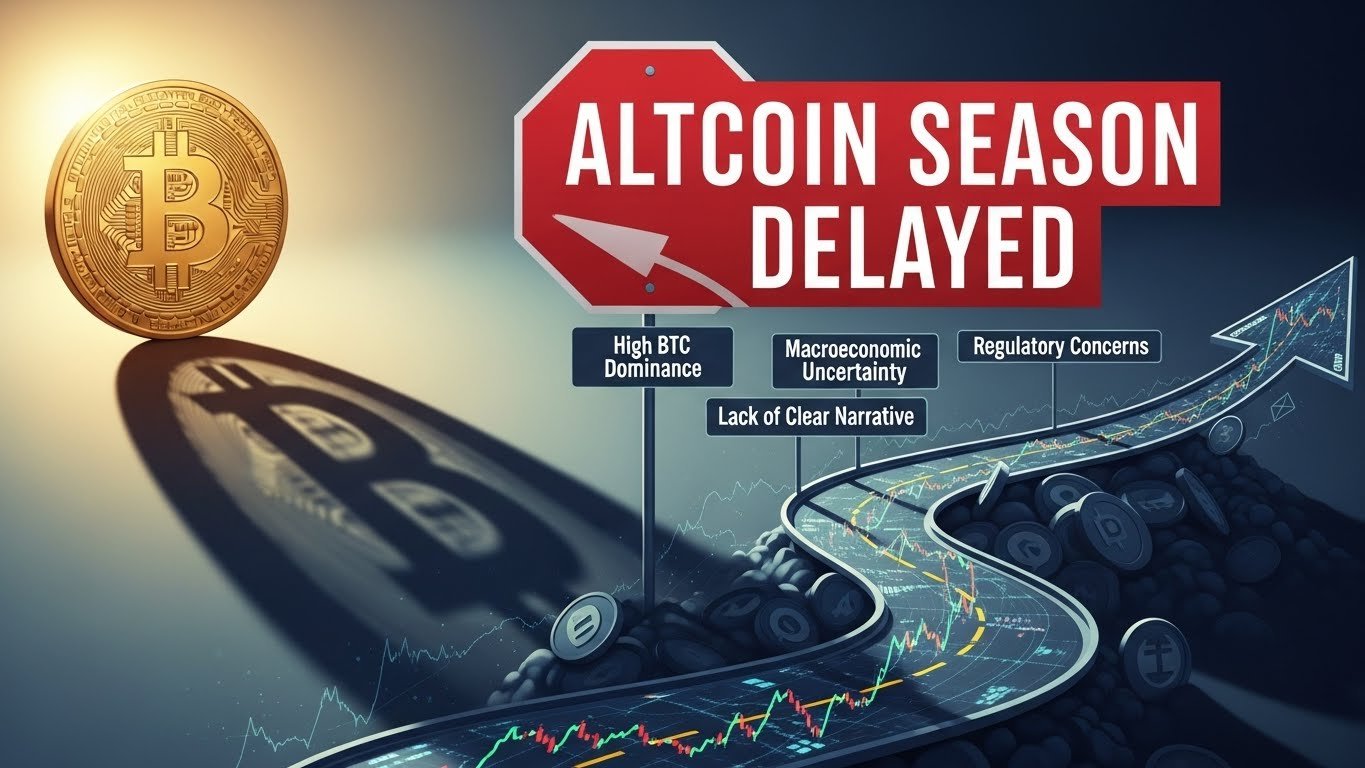
The question of why the altcoin season is delayed despite high expectations for broader market expansion has many layers. One of the most influential factors in this cycle is the influx of institutional capital into Bitcoin. With the approval of spot Bitcoin ETFs in several major markets, institutional investors now have a regulated, accessible way to gain exposure to BTC. This new structure funnels billions of dollars directly into Bitcoin, significantly altering the liquidity dynamics between Bitcoin and altcoins. Institutions tend to favor Bitcoin because of its regulatory clarity, deep liquidity, and strong long-term narrative, leaving altcoins relatively underfunded in comparison.
Regulatory uncertainty continues to act as another barrier to altcoin growth. Many jurisdictions are actively evaluating or adjusting their stance on whether certain altcoins constitute securities, which creates hesitancy among both retail and institutional participants. Bitcoin, by contrast, benefits from a much clearer legal status in most regions, which strengthens its role as the “safer” crypto asset. As a result, many investors prefer to remain positioned in Bitcoin until greater regulatory clarity emerges for other cryptocurrencies.
Macroeconomic conditions also play a significant role. In periods of global economic uncertainty, investors are generally less willing to take on high levels of risk. Altcoins, known for their higher volatility, struggle to attract significant inflows when interest rates, inflation concerns, or geopolitical tensions dominate headlines. In contrast, Bitcoin increasingly behaves like a digital form of hard money, which appeals to those seeking a hedge against monetary instability. This shift toward Bitcoin strengthens its dominance, making it harder for altcoins to capture meaningful capital inflows.
Market Sentiment Confirms That It Is Still Bitcoin Season
Market sentiment indicators provide further confirmation that the broader crypto environment still leans heavily toward Bitcoin. Tools such as the Altcoin Season Index help quantify periods when altcoins outperform Bitcoin on a sustained basis. In recent months, this metric has consistently indicated that the market is still in “Bitcoin Season,” supporting the notion that a true altcoin rotation has not yet begun.
On-chain data reinforces this interpretation. Bitcoin transaction volumes, exchange flows, and long-term holder accumulation all point to persistent demand for BTC. At the same time, many altcoins have experienced uneven liquidity and sporadic interest, with most strong movements concentrated in only a handful of narratives such as AI tokens or meme coins. These isolated rallies are not the same as a full altcoin season, which typically requires synchronized upward momentum across a wide spectrum of altcoins.
The uneven distribution of attention and capital also reflects the cautious mindset of market participants. Many investors prefer to wait for clearer signals of altcoin strength before committing significant resources. In previous cycles, these signals appeared only after Bitcoin showed signs of slowing down or entering a consolidation phase. With Bitcoin still outperforming many altcoins and maintaining its dominance, sentiment naturally remains aligned with BTC-led strategies.
Conditions Needed Before a Real Altcoin Season Can Begin

If altcoin season is delayed due to Bitcoin’s current strength, the next question becomes what conditions must shift for a true altcoin rally to begin. A meaningful and sustained decline in Bitcoin dominance is one of the most important indicators. A downward trend in dominance suggests that investors are beginning to diversify their holdings and move capital into the altcoin market. This shift historically marks the beginning of powerful altcoin surges, although the exact dominance level at which this happens varies from cycle to cycle.
Another critical condition is a period of Bitcoin price consolidation. Altcoin season rarely begins when Bitcoin is in a strong uptrend because traders tend to maintain their positions in BTC during such periods in hopes of maximizing profits. Only after Bitcoin stabilizes or pauses do traders feel comfortable taking profits from their BTC positions and reallocating them into altcoins. Without this consolidation, capital continues to flow toward Bitcoin rather than spreading across the broader crypto ecosystem.
Macroeconomic conditions must also favor risk-taking for the altcoin season to materialize. Lower interest rates, improved global liquidity, and a balanced regulatory environment are all factors that encourage investors to explore higher-risk opportunities such as altcoins. When the macro landscape improves, capital typically flows more freely across different asset classes, including speculative sectors of the cryptocurrency market. At that point, altcoins have the environment they need to climb more aggressively.
How Traders Are Positioning While Waiting for Altcoin Season
In the current market phase, many traders are adopting a more conservative approach. With Bitcoin dominance high and altcoin season delayed, a growing number of investors choose to focus on accumulating Bitcoin. This approach reflects the belief that Bitcoin remains the most reliable asset during uncertain conditions. As long as dominance continues rising, it often makes sense for traders to prioritize BTC over riskier alternatives.
At the same time, long-term investors view this period as an opportunity to identify and accumulate fundamentally strong altcoins that may perform exceptionally well once the rotation eventually begins. Instead of chasing hype-driven projects with limited long-term value, seasoned traders are concentrating on altcoins with genuine utility, active development, and strong communities. When altseason finally arrives, these higher-quality projects tend to outperform dramatically, making early accumulation a potentially advantageous strategy.
Risk management remains a central theme throughout this waiting period. Traders are increasingly aware that premature shifts into low-cap altcoins can lead to losses if Bitcoin dominance continues to climb. Therefore, many are balancing their portfolios between Bitcoin and a carefully selected set of altcoins, allowing them to stay flexible as the market evolves. By maintaining this balanced strategy, traders can benefit if Bitcoin continues to lead while remaining prepared for the eventual arrival of altseason.
Long-Term Outlook: Is Altcoin Season Truly Delayed or Simply Changing?
A growing debate in the cryptocurrency community revolves around whether this cycle’s altseason will resemble previous ones at all. Some analysts believe that the market has matured to the point where altcoin season may become more selective rather than explosive. Instead of witnessing a widespread surge across nearly all altcoins, this cycle may highlight specific sectors such as real-world asset tokenization, decentralized finance upgrades, AI-based blockchain systems, or advanced Layer-1 innovations. In this scenario, altseason would unfold in segments rather than a single synchronized wave.
Another perspective suggests that altcoin season may already be underway in subtle ways that differ from previous cycles. Smaller altcoin rallies within specific narratives could collectively form a quieter, more fragmented altseason. If this is true, traders waiting for the dramatic, market-wide explosion seen in earlier years may overlook the gradual shifts already happening. Whether altseason emerges suddenly or slowly, the key is recognizing the patterns and adapting accordingly.
Ultimately, the long-term outlook for altcoins remains optimistic. Despite delays, the crypto market continues to innovate rapidly, and historical patterns show that capital eventually rotates toward altcoins once Bitcoin’s dominance stabilizes and sentiment becomes more risk-oriented. The precise timing may vary, but the cyclical nature of the market suggests that a significant altcoin rally is still likely at some stage during the broader bull market.
Final Thoughts
The conclusion is clear: altcoin season is delayed as Bitcoin dominance surges past 54%, and the market continues to revolve around the strength of BTC. Institutional adoption, regulatory clarity surrounding Bitcoin, global macroeconomic pressures, and strong investor sentiment all contribute to Bitcoin’s current dominance. This does not mean altcoins are losing relevance, but rather that the market is in a phase where Bitcoin’s stability takes precedence over broader speculative growth.
For traders and long-term investors, this period offers valuable opportunities. It provides time to accumulate high-quality altcoins, refine strategies, and prepare for the eventual shift in market dynamics. It also encourages disciplined decision-making, as premature attempts to chase altcoin rallies can lead to unnecessary risks. By staying informed, patient, and strategically positioned, market participants can benefit when altcoin season finally begins.
Even though altcoin season is delayed, the broader crypto cycle is still unfolding. Bitcoin’s dominance may be high now, but markets evolve, sentiment shifts, and liquidity eventually spreads. Those who approach this phase with clarity and strategy will be best prepared when the long-awaited rotation into altcoins finally takes hold.