







































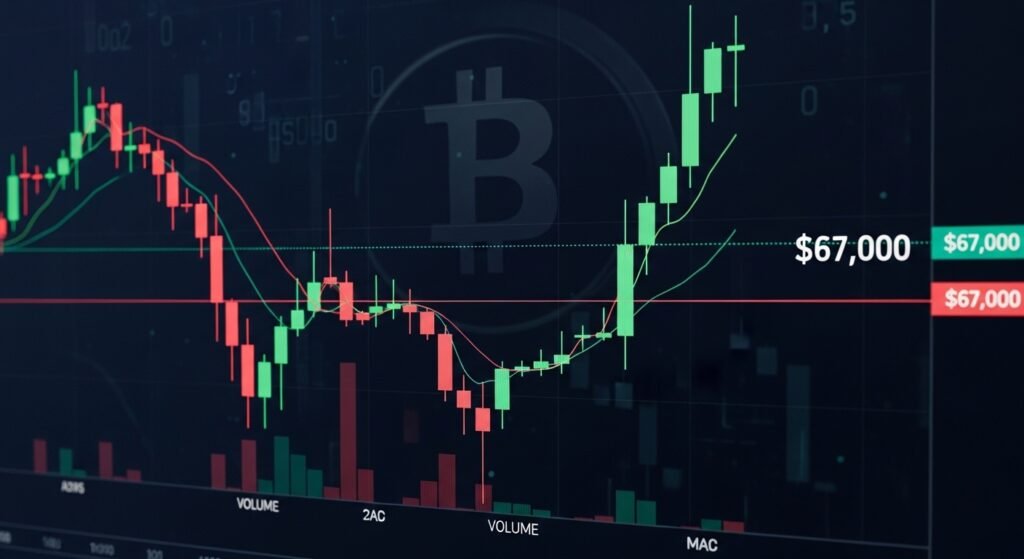
Bitcoin briefly drops below $67,000 at a time when global financial markets are sending increasingly mixed signals, underscoring the evolving relationship between cryptocurrencies and traditional assets. The sudden dip, though short-lived, caught traders’ attention because it coincided with a notable divergence in stock market performance. While major equity indices struggled to maintain momentum amid macroeconomic uncertainty, Bitcoin showed signs of decoupling, reigniting long-standing debates about its role as a risk asset, hedge, or emerging macro instrument.
This episode comes during a period of heightened sensitivity across financial markets. Investors are weighing expectations around interest rate policy, inflation data, corporate earnings, and geopolitical developments, all while navigating reduced liquidity conditions. Against this backdrop, Bitcoin’s move below a key psychological level triggered liquidations, short-term panic, and renewed volatility, even as longer-term holders appeared largely unfazed.
In this article, we explore why Bitcoin briefly dropped below $67,000, how rising stock divergence shaped market sentiment, and what this means for crypto investors going forward. We examine technical levels, on-chain behavior, macroeconomic drivers, and the broader implications for Bitcoin’s positioning within the global financial system.
Bitcoin’s Drop Below $67,000: What Happened?
The moment Bitcoin briefly drops below $67,000, it tends to activate a cascade of automated trading responses. This price zone has acted as both support and resistance in recent months, making it a magnet for stop-loss orders and leveraged positions. When sellers pushed BTC under this threshold, liquidations accelerated, amplifying downside momentum before buyers stepped back in.

From a market structure perspective, the decline was relatively shallow and short in duration. There was no widespread panic selling among long-term holders, and spot market volumes suggested measured profit-taking rather than capitulation. However, derivatives markets told a different story, as funding rates flipped negative and open interest declined sharply, indicating that overleveraged longs were flushed out.
The Role of Leverage and Liquidations
Leverage remains a defining feature of modern crypto markets. When Bitcoin briefly drops below $67,000, it exposes the fragility of heavily leveraged positions built during periods of low volatility. Liquidation clusters below round-number levels often act as accelerants, turning minor pullbacks into sharper dips.
This event followed a familiar pattern. A modest sell-off triggered cascading liquidations, which temporarily exaggerated downside movement. Once the forced selling subsided, price stabilized, suggesting that the broader market structure remains intact.
Rising Stock Divergence and Its Impact on Bitcoin
One of the most notable aspects of this move was the growing divergence between Bitcoin and traditional stock markets. For much of the past decade, Bitcoin has often traded in tandem with risk assets, particularly tech-heavy equity indices. Recently, however, correlations have weakened.
As Bitcoin briefly drops below $67,000, stock indices were grappling with their own challenges, including uneven earnings reports and uncertainty around future monetary policy. Yet, while equities showed signs of sustained weakness, Bitcoin’s recovery was comparatively swift, hinting at a partial decoupling.
Understanding Market Divergence
Stock divergence refers to situations where asset classes move in different directions due to varying underlying drivers. In this case, equities were responding primarily to corporate fundamentals and interest rate expectations, while Bitcoin was reacting to liquidity conditions, on-chain dynamics, and investor positioning.
This divergence is significant because it challenges the simplistic view of Bitcoin as merely a high-beta tech proxy. Instead, it reinforces the idea that Bitcoin increasingly trades on its own fundamentals, particularly as institutional adoption broadens.
Macro Factors Behind the Volatility
When Bitcoin briefly drops below $67,000, macroeconomic context matters. Global markets are currently navigating a delicate balance between slowing growth and persistent inflation pressures. Central banks remain cautious, and even subtle changes in policy expectations can ripple across asset classes.
Higher bond yields, in particular, tend to pressure risk assets by increasing the opportunity cost of holding non-yielding investments like Bitcoin. At the same time, concerns about currency debasement and fiscal sustainability continue to support the long-term Bitcoin narrative.
Inflation, Rates, and Liquidity
Inflation concerns and interest rate uncertainty remain dominant themes. Tight liquidity environments often lead to short-term volatility in Bitcoin as speculative capital retreats. However, historically, Bitcoin has shown resilience once markets adjust to new rate regimes, especially when real yields stabilize.
Technical Analysis: Key Levels to Watch
From a technical standpoint, the fact that Bitcoin briefly drops below $67,000 without sustained follow-through is noteworthy. This level aligns closely with prior consolidation zones and moving averages that many traders monitor.
Support and Resistance Dynamics
Immediate support emerged just below the dip, indicating strong demand from spot buyers. Resistance remains near recent highs, where profit-taking has capped upside momentum. A decisive break above resistance could signal renewed bullish strength, while repeated tests of support may increase the risk of deeper retracements.
Technical indicators such as relative strength and volume profiles suggest consolidation rather than trend reversal. This aligns with the broader narrative of a market digesting gains rather than entering a bearish phase.
On-Chain Data Signals Market Health

On-chain metrics provide valuable insight when Bitcoin briefly drops below $67,000. Data shows that long-term holders have largely maintained their positions, with minimal distribution observed. Exchange balances remain relatively low, suggesting reduced immediate selling pressure.
Long-Term Holders vs Short-Term Traders
The divergence between long-term holders and short-term traders is a recurring theme. While traders reacted quickly to price volatility, long-term investors appeared confident, reinforcing the idea that the dip was more technical than fundamental.
Institutional Perspective on the Price Dip
Institutional involvement has transformed Bitcoin market dynamics. When Bitcoin briefly drops below $67,000, it is no longer just retail traders reacting. Hedge funds, asset managers, and corporate treasuries now play a role in shaping price action.
Many institutional participants view such dips as opportunities rather than threats. Accumulation strategies often involve scaling into positions during periods of volatility, particularly when macro uncertainty increases demand for alternative assets.
Bitcoin as a Portfolio Asset
For institutions, Bitcoin’s appeal lies in diversification potential. Rising stock divergence strengthens the case for Bitcoin as an uncorrelated asset, even if correlations fluctuate over shorter time frames.
Market Sentiment and Investor Psychology
Market sentiment shifted rapidly as Bitcoin briefly drops below $67,000. Fear indicators spiked briefly, but optimism returned just as quickly. This whiplash reflects a market still adjusting to Bitcoin’s maturation.
The Psychology of Round Numbers
Round numbers like $67,000 carry outsized psychological weight. Breaking them can trigger emotional responses disproportionate to the actual market impact. Experienced investors often exploit this behavior, accumulating during moments of exaggerated fear.
Broader Implications for the Crypto Market
Bitcoin’s movement has ripple effects across the crypto ecosystem. When Bitcoin briefly drops below $67,000, altcoins often experience amplified volatility due to their higher risk profiles.
Altcoins and Market Correlation
While some altcoins decoupled slightly, most followed Bitcoin’s lead, highlighting its continued dominance. This reinforces Bitcoin’s role as the market’s primary liquidity anchor and sentiment driver.
Is This a Warning or a Healthy Reset?
The key question investors ask when Bitcoin briefly drops below $67,000 is whether the move signals deeper trouble or represents a healthy consolidation. Evidence leans toward the latter.
Short-term volatility is a natural feature of Bitcoin’s price discovery process. As long as fundamental indicators remain strong and long-term holders stay engaged, brief dips are better viewed as resets that prepare the market for its next phase.
Long-Term Outlook for Bitcoin
Despite short-term turbulence, Bitcoin’s long-term outlook remains constructive. Adoption continues to expand, infrastructure matures, and regulatory clarity improves incrementally. Rising stock divergence may ultimately benefit Bitcoin by highlighting its distinct value proposition. As global markets navigate uncertainty, Bitcoin’s fixed supply and decentralized nature remain compelling attributes for investors seeking alternatives to traditional financial systems.
Conclusion
Bitcoin briefly drops below $67,000 amid rising stock divergence, serving as a reminder of the asset’s inherent volatility and evolving market role. While the dip triggered short-term anxiety, underlying fundamentals remained intact, and recovery was swift. The growing divergence between Bitcoin and equities suggests a gradual shift toward independent price dynamics, reinforcing Bitcoin’s emerging status as a macro-relevant asset.
For investors, the key takeaway is context. Short-term price movements should be interpreted within a broader framework that includes macro trends, on-chain data, and market structure. As Bitcoin continues to mature, episodes like this are likely to become less about fear and more about opportunity.
FAQs
Q: Why did Bitcoin briefly drop below $67,000?
Bitcoin dipped due to a combination of leveraged liquidations, technical selling near a key psychological level, and broader market uncertainty driven by macroeconomic factors.
Q: What does stock divergence mean for Bitcoin?
Rising stock divergence suggests Bitcoin is increasingly influenced by its own fundamentals rather than simply tracking traditional equity markets.
Q: Is the drop below $67,000 a bearish signal?
Not necessarily. The quick recovery and strong on-chain data indicate the move was likely a short-term correction rather than a trend reversal.
Q: How do institutions view such price dips?
Many institutional investors see temporary declines as accumulation opportunities, especially when long-term fundamentals remain strong.
Q: What should investors watch next?
Key technical levels, macroeconomic developments, and on-chain metrics will be crucial in determining Bitcoin’s next directional move.
Also More: Bitcoin mining Trump family’s $314M Bitmain bet reshapes the market