








































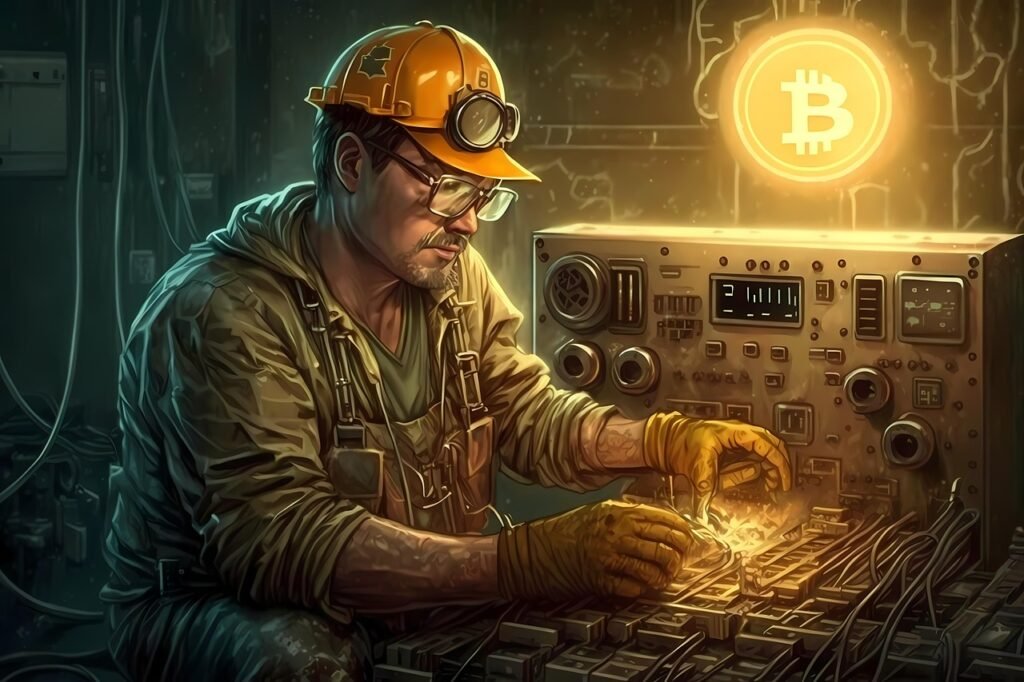
The story of Bitcoin mining has always been about computation and electricity. For a decade, miners raced to deploy the most efficient ASICs, lock in the cheapest megawatts, and scale fleets fast enough to stay profitable through bull and bear cycles. But as artificial intelligence exploded in demand, a new reality took shape: the most valuable asset isn’t ASICs—it’s power, land, and cooling at scale. That’s why Bitcoin miners are pivoting to powering AI instead, refitting sites for AI data centers, negotiating multi-year power purchase agreements (PPAs), and courting hyperscalers eager for high-performance computing (HPC) capacity.
In 2025, multiple listed miners paused or reprioritized Bitcoin expansion plans to evaluate AI/HPC use cases for their available megawatts, while others inked major hosting deals or pursued M&A, validating a structural shift from single-purpose mining to multi-tenant digital infrastructure. The April 2024 Bitcoin halving compressed block rewards, amplifying the incentive to diversify revenues. Meanwhile, demand for GPU clusters—from training to inference—has outstripped traditional data-center power pipelines, making mining sites with ready-to-energize megawatts unusually attractive.
Why AI Wants What Miners Already Have
Power at Scale—and Fast Interconnects Next
Training frontier models and serving high-throughput inference isn’t just compute-intensive; it’s power-hungry and network-sensitive. Many mining campuses already control hundreds of megawatts with substation access, high-capacity feeders, and favorable tariffs negotiated for 24/7 loads. These footprints translate into a fast-track path for AI data centers—especially in power-constrained regions where greenfield development can take years. Some miners are now shelving pure ASIC buildouts in favor of mixed-use campuses that blend Bitcoin mining with HPC/AI hosting to smooth cash flows over the cycle.
From ASIC Sheds to GPU-Ready Halls
Classic containerized mining layouts prioritize airflow for ASICs, but AI GPU nodes require higher rack densities, liquid cooling, redundant networking, and low-latency fabric designs (e.g., NVLink, RoCE). That means miners refitting sites must shift from open-air warehouses to purpose-built or retrofitted halls with liquid-to-air or liquid-to-liquid heat rejection, UPS, and tiered redundancy—all while keeping power usage effectiveness (PUE) competitive. Companies that succeed here effectively graduate from commodity hashing into value-added colocation and managed services.
Revenue Quality and Contracted Cash Flows
Where Bitcoin mining revenue is volatile and mark-to-market, HPC/AI hosting can be anchored by multi-year contracts with take-or-pay structures. This durability supports debt financing of expansions and lowers the cost of capital compared to purely speculative mining growth. Analysts and operators increasingly frame successful pivots as transformations into digital infrastructure platforms—not just miners with side hustles. Recent commentary around miners pursuing AI tenants underscores this re-rating potential.
Real-World Signals: From Press Releases to Deal Flow

Evaluating 600 MW for AI/HPC at a Single Campus
In early 2025, Riot Platforms formally paused a piece of its Corsicana Phase II Bitcoin expansion to evaluate AI/HPC uses for 600 MW of remaining capacity—explicitly citing the potential for “long-term, predictable cash flows” alongside its core mining ops. It’s a textbook example of how big-cap miners are weighing trade-offs between incremental hash rate and GPU-ready capacity.
Hosting and Expansion Deals Go Mainstream
Core Scientific became emblematic of the pivot, progressing from smaller AI/HPC contracts into large-scale buildouts to host workloads for specialized AI clouds. Reporting in late 2024 and 2025 highlighted a ramp in HPC capacity commitments and new construction dedicated to AI tenants.
Strategic Transactions Validate the Thesis
In mid-2025, coverage of CoreWeave’s move on Core Scientific—bringing >1 GW of contracted or developable power into a single AI-first stack—signaled just how central power-dense campuses have become to the AI economy. While specifics vary by outlet, the strategic logic is consistent: control the watts, unlock the GPUs.
Other Miners Make Noise—And Raise Capital
From Bitfarms exploring AI data-center conversions to Cipher drawing investment for HPC buildouts, headlines across 2025 reinforced the theme: AI infrastructure is the new growth vector, and mining companies’ core competencies in energy, construction, and operations map well to it—if they can master data-center grade engineering.
The Economics of the Pivot
Capex: Same Megawatts, Different Dollars
For miners, the traditional capex flywheel was simple: raise capital, buy ASICs, deploy containers, scale hash rate. AI/HPC shifts the spend profile toward electrical redundancy, mechanical cooling plants, network fabric, and GPU servers (usually financed or customer-provided). While ASIC fleets depreciate with each node shrink, data-center MEP (mechanical, electrical, plumbing) can deliver a decade-plus useful life if designed for modular upgrades. The result: less exposure to silicon obsolescence, more value in infrastructure that appreciates with demand.
Opex: From Hashprice to SLAs
Mining opex centers on energy costs per TH/s and fleet maintenance. AI/HPC opex adds SLA compliance, remote hands, DC ops staff, security, and network operations. Yet the margin structure can be attractive when paired with long-term contracts and premium pricing for liquid-cooled racks and dense power (30–100 kW+ per rack). Operators that can deliver low PUE, renewable mixes, and reliable uptime capture the highest rates.
Risk: Counterparty vs. Commodity
Miners swapping some BTC beta for contracted revenue trade commodity price risk for counterparty and utilization risk. If AI tenants churn or the market softens, idle capacity must be backfilled. But unlike idle ASICs, an AI-ready data center can be repurposed for cloud, rendering, simulation, or enterprise HPC—expanding optionality across cycles. Debt markets increasingly prefer this profile, even as some analysts caution about the leverage used to accelerate the pivot.
Technical Hurdles Miners Must Clear

Cooling: Air Won’t Cut It for Next-Gen GPUs
Top-tier accelerators can push >1 kW per board and >80 kW per rack, making immersion or direct-to-chip liquid cooling common. Miners must upgrade from ambient ASIC airflow to chilled-water plants, CDUs, and manifold distribution, with rigorous water treatment to protect components. The shift also demands facility management systems that log thermal telemetry for SLA reporting.
Power Quality and Redundancy
GPU training suffers when power is unstable or networking is interrupted. N+1/N+N redundancy, islanding, fast-transfer switches, and on-site generation (gas peakers, battery energy storage systems) help harden campuses. Miners with demand response programs can further monetize flexibility, aligning AI loads with grid needs—especially where renewables cause price volatility.
Network Fabric and Topology
ASIC mines don’t need ultra-low latency east-west traffic; GPU clusters do. Operators must build lossless fabrics with RDMA, deploy leaf-spine architectures sized for GPU pod expansion, and provide high-bandwidth egress to cloud partners. That means new vendor relationships, new skill sets, and DevOps tooling beyond miners’ historic focus.
Geography, Regulation, and the ESG Dimension
Siting and Power Markets
Miners have already scouted cheap power near hydro, wind, or gas. These same locations can host AI data centers—provided fiber backhaul and cooling water are viable. Markets with capacity mechanisms and nodal pricing can reward flexible loads; miners able to curtail GPUs and pivot to hashing (or vice versa) can arbitrage peak prices.
Policy and Community Engagement
AI data centers draw scrutiny over water usage, noise, and grid impact. Miners experienced in community relations and permitting have a head start, but expectations rise with enterprise tenants. Transparency on renewable sourcing, waste heat reuse, and grid services is becoming table stakes for local approvals and corporate ESG scorecards.
Case Studies: What the Pivot Looks Like
Riot Platforms: Mixed-Use Strategy at Scale
Riot’s public evaluation of AI/HPC for a 600-MW tranche at Corsicana—and the decision to pause a prior mining expansion there—captures the direction of travel. The company explicitly cites a blended model: support BTC production while developing predictable, contract-based revenue from AI tenants to stabilize cash flows through crypto cycles.
Core Scientific: From Hosting to Integration Momentum
Over 2024–2025, Core Scientific expanded HPC hosting commitments and pursued greenfield developments with AI cloud partners, underscoring the demand for GPU-ready capacity. Reporting around a strategic transaction with CoreWeave further emphasized how control of power footprints can be decisive in the AI era.
Bitfarms and Cipher: Signaling the Market
Reuters reported Bitfarms is actively evaluating AI data-center conversions across North American sites. Barron’s highlighted SoftBank’s investment in Cipher to accelerate data-center projects geared toward HPC—a sign that capital markets recognize where the puck is going.
Also Read: Bitcoin Mining Stocks Surge on Jane Street Buying
Strategic Playbook for Miners Considering the Shift
Lock Down Long-Term Power, Then Design for Density
The competitive moat starts with low-cost, long-duration PPAs. From there, design campuses to deliver 30–100 kW per rack, liquid cooling, and Tier III-like resilience. Future-proofing MEP for next-gen GPUs avoids stranded assets.
Build or Buy the Right Talent
Running AI data centers requires network architects, cooling engineers, and SRE/DevOps teams familiar with GPU pods, orchestrators, and telemetry. Partnerships can bridge gaps, but internalizing expertise accelerates delivery and keeps margins.
Productize Services Beyond Power and Space
Tenants want GPU capacity plus managed services: provisioning, monitoring, remote hands, and sometimes bare-metal orchestration. Turning a power site into a platform—with APIs, billing, and SLA reporting—elevates multiples.
Use BTC Optionality as a Shock Absorber
When AI demand softens or contracts roll off, ASIC fleets can still monetize power. Conversely, during BTC bull cycles, miners can dial up hashing while keeping HPC tenants stable. This portfolio approach can smooth EBITDA volatility relative to single-use mining.
Will Everyone Make the Jump?
Not all miners can, or should, pivot. Some sites lack the water rights, fiber, or zoning for AI data centers. Others are too remote to attract enterprise tenants. And retrofits are capital-intensive. Analysts have warned that debt-funded pivots raise execution risk if tenant ramp-up lags. The winners will be those who time capex to binding contracts, structure off-takes smartly, and sequence builds to match cash inflows.
What This Means for the Broader AI and Crypto Landscape
For AI builders, miners’ entrance expands the supply of power-dense capacity, potentially easing today’s GPU bottlenecks. For crypto, the sector gains durable infrastructure assets that can weather halving cycles without forced liquidations. Investors may start valuing leading operators more like digital infrastructure REITs than pure commodity producers—assigning premiums to contracted revenues, power optionality, and ESG-aligned operations. As the line between “miner” and “data-center operator” blurs, the companies that master both will define the next chapter of compute.
Conclusion
Bitcoin miners are pivoting to powering AI instead because their core strengths—megawatts, land, and industrial operations—map almost perfectly onto the needs of the AI compute boom. The halving sharpened incentives to diversify, while surging GPU demand created a lucrative outlet for power-dense campuses. Real-world deals, evaluations, and investments across 2024–2025 show this is more than a narrative; it’s an industry re-rating in motion. Execution will separate leaders from laggards, but the destination is clear: the future of mining looks a lot like the future of AI infrastructure.
FAQs
Q: Are miners abandoning Bitcoin entirely for AI?
No. The leading strategy is mixed-use: maintain Bitcoin mining for upside while converting portions of capacity to AI/HPC hosting for stable cash flows. This portfolio approach reduces volatility and taps both markets.
Q: What is the biggest technical change when switching from ASICs to GPUs?
Cooling and networking. AI clusters need liquid cooling, higher rack densities, redundant power, and low-latency fabrics—much more than ASIC warehouses were designed for. Upgrading MEP and fabric is essential to meet SLA requirements.
Q: How does the halving influence the pivot?
The April 2024 halving cut block rewards, pressuring margins, and incentivizing contracted AI revenues that are less correlated to BTC price. This made HPC hosting relatively more attractive for growth capex.
Q: Which companies exemplify the shift?
Riot Platforms publicly evaluated 600 MW for AI/HPC at Corsicana; Core Scientific expanded hosting for AI clouds and figured in major M&A headlines; Bitfarms and Cipher publicly explored or funded AI-oriented data-center builds.
Q: What’s the main risk to miners making this move?
Execution and financing. Converting sites to AI data centers requires heavy capex, specialized talent, and reliable tenants. Debt-funded pivots raise risk if revenue ramps slip, but well-structured, contracted projects can command higher valuations