






































The economics of Bitcoin mining have always been cyclical, volatile, and fiercely competitive. Yet the current environment presents a paradox that few anticipated: it is becoming cheaper to mine Bitcoin in certain regions and operational contexts, but significantly harder to generate sustainable profits. This new reality is reshaping the industry’s structure, risk profile, and long-term outlook.
Historically, rising mining difficulty and hardware costs drove up operational expenditures. However, advancements in ASIC efficiency, more sophisticated energy procurement strategies, and access to stranded or surplus electricity have reduced the per-unit cost of hashing in many operations. At the same time, declining block rewards following the latest halving event, intense competition, fluctuating Bitcoin prices, and compressed transaction fee revenue have squeezed margins across the board.
In other words, while the mechanical act of mining may be more energy-efficient and technologically streamlined, the economic returns are under pressure. This article explores how Bitcoin miners are navigating this contradictory environment, why profitability is tightening, and what strategic pivots may define the next phase of the mining industry.
The Evolving Economics of Bitcoin Mining
Understanding the Cost Structure of Bitcoin Mining
To understand why Bitcoin mining profitability is declining despite lower operational efficiencies, it is critical to analyze the cost structure. Mining operations typically face three core expense categories: capital expenditures, electricity costs, and infrastructure overhead.
Capital expenditures include ASIC machines, cooling systems, and facility buildouts. Over time, hardware manufacturers have produced more energy-efficient machines capable of generating higher hash rates per watt. This technological progression has lowered the effective energy cost per terahash, making the computational process itself cheaper.
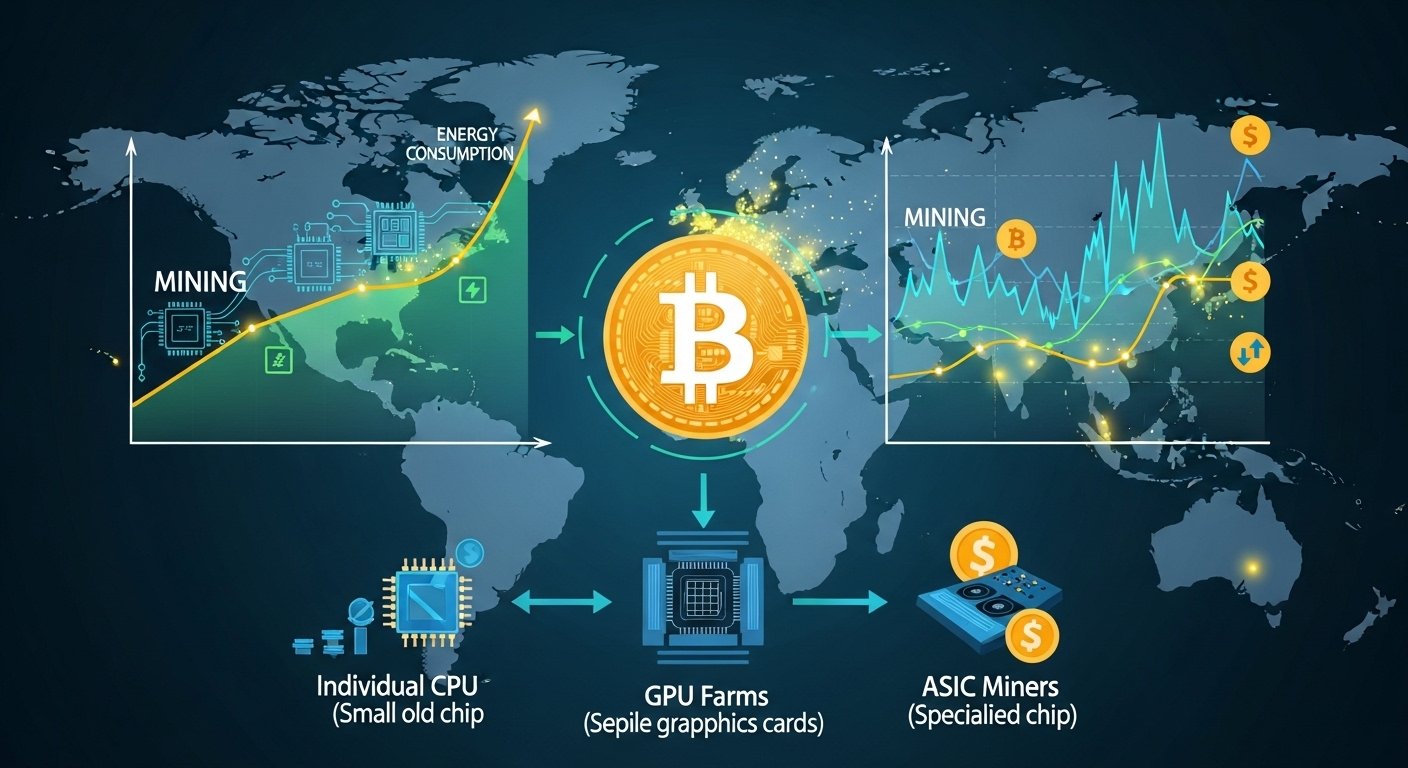
Electricity, however, remains the dominant variable cost. While some miners have secured long-term power purchase agreements or tapped into renewable sources, energy markets are highly dynamic. Even when energy rates fall in certain jurisdictions, overall competition often neutralizes cost advantages by driving up network difficulty.
Infrastructure and maintenance expenses, including labor, cooling optimization, and network management, have become more refined. Yet operational efficiency alone does not guarantee profitability in the current climate.
The Post-Halving Pressure
The most significant shift in the Bitcoin mining landscape stems from the most recent halving event, which reduced the block reward from 6.25 BTC to 3.125 BTC. The halving mechanism, embedded in the Bitcoin protocol by its pseudonymous creator Satoshi Nakamoto, is designed to control supply and reinforce scarcity.
While halvings historically precede price rallies, the immediate effect is always revenue compression. Miners suddenly receive half the Bitcoin for the same computational effort. Unless the market price doubles proportionally, profit margins contract sharply.
In this cycle, although the Bitcoin price has shown resilience, it has not immediately offset the reduction in block rewards. Transaction fees have provided temporary relief during periods of high network congestion, but fee volatility makes it an unreliable revenue stream.
Why Cheaper Mining Does Not Mean Higher Profits
Rising Network Difficulty and Hash Rate Expansion
One of the most underestimated dynamics in Bitcoin mining is the feedback loop between efficiency gains and competition. When mining becomes cheaper due to better hardware or energy deals, more participants enter the market. Existing miners also expand operations.
This influx increases the network hash rate, which in turn raises mining difficulty. As difficulty climbs, the probability of earning block rewards declines proportionally for each participant. The result is that efficiency gains are often neutralized by heightened competition.Even large-scale industrial miners are feeling the squeeze. With global hash rate reaching record highs, smaller operators struggle to maintain their share of block rewards.
Transaction Fees: Unpredictable Revenue Streams
Transaction fees once represented a marginal portion of miner income. However, during certain high-demand periods, such as inscription booms or increased network congestion, fees have spiked dramatically.
Despite these occasional surges, fee revenue remains volatile. Miners cannot reliably forecast long-term cash flows based on transaction activity alone. When network usage declines, fee revenue contracts quickly, leaving miners dependent primarily on reduced block rewards.This unpredictability contributes to the “harder to profit” narrative in today’s Bitcoin mining economy.
The Energy Advantage: A Double-Edged Sword
Access to Stranded and Renewable Energy
A growing number of Bitcoin miners are leveraging renewable energy sources, including hydroelectric, solar, and wind. Others tap into flared natural gas or surplus grid capacity. These strategies reduce operational costs and improve environmental optics.In regions with abundant hydropower, miners enjoy comparatively low electricity rates. Similarly, in areas with excess renewable capacity, mining can stabilize grid demand and monetize otherwise wasted energy.
However, these advantages are increasingly competitive. As more miners flock to energy-rich regions, local infrastructure becomes saturated. Grid operators may impose curtailment policies, and political scrutiny intensifies.
Regulatory Uncertainty and Political Risk
Mining operations face varying regulatory frameworks worldwide. In some countries, policymakers view Bitcoin mining as an innovation driver and energy market stabilizer. In others, it is perceived as a strain on resources.
Regulatory shifts can abruptly alter cost structures. Increased taxation, environmental compliance mandates, or outright bans can undermine carefully constructed business models. Even in jurisdictions with supportive policies, regulatory unpredictability adds another layer of risk to mining profitability.
Hardware Arms Race and Capital Intensity
The ASIC Efficiency Race
The ASIC hardware market remains highly competitive. Each new generation of machines promises improved hash rate efficiency and lower energy consumption per unit of output.While upgrading to advanced machines lowers energy costs, it also requires significant capital investment. Miners must constantly evaluate return-on-investment timelines against volatile Bitcoin prices and network difficulty.This ongoing hardware arms race increases capital intensity. Smaller operators without access to financing may struggle to remain competitive, leading to industry consolidation.
Depreciation and Obsolescence
Mining hardware depreciates rapidly. As more efficient models enter the market, older units become less profitable or even obsolete. Depreciation impacts balance sheets and reduces net profitability, even when operational costs decline.In this context, being “cheaper to mine” from an energy standpoint does not automatically translate to positive free cash flow.
Institutionalization of Bitcoin Mining
Publicly Traded Mining Companies

The rise of publicly listed mining firms has introduced new dynamics. Shareholder expectations, quarterly earnings pressure, and access to capital markets shape operational decisions.These companies often scale aggressively during bull markets, leveraging debt or equity financing. When market conditions tighten, debt servicing and operational commitments can strain financial stability.Institutionalization brings professional management and transparency, but it also introduces financial discipline that can amplify stress during downturns.
Diversification Into AI and High-Performance Computing
Facing thinner margins, some mining firms are pivoting into adjacent sectors such as artificial intelligence data centers and high-performance computing. The rationale is straightforward: mining infrastructure, including power agreements and cooling systems, can support alternative computational workloads.By diversifying revenue streams, companies reduce dependence on block rewards. However, these transitions require technical adaptation and strategic repositioning.
Market Cycles and Miner Capitulation
Understanding Miner Capitulation
Miner capitulation occurs when operators shut down equipment due to unprofitability. Historically, capitulation phases reduce network hash Institutionalization of Bitcoin Mining rate temporarily, easing difficulty and restoring equilibrium.In the current environment, although mining costs are lower in certain contexts, profit margins remain thin. Smaller or highly leveraged miners are particularly vulnerable during price corrections.Capitulation often precedes market recoveries, as weaker participants exit and stronger operators consolidate market share.
The Role of Bitcoin Price Volatility
The profitability of Bitcoin mining is inextricably linked to market price. Even minor price fluctuations can dramatically impact margins.When Bitcoin experiences upward momentum, miners benefit from higher revenue per block. Conversely, price stagnation or declines intensify financial stress.Price volatility also affects treasury management strategies. Some miners hold mined Bitcoin as a long-term asset, while others liquidate immediately to cover operational costs.
The Future Outlook for Bitcoin Miners
Consolidation and Vertical Integration
Industry consolidation appears inevitable. Larger players with access to capital, advanced hardware, and diversified revenue streams are likely to acquire distressed assets.Vertical integration, including energy generation partnerships and hardware manufacturing alliances, may enhance cost control and resilience.
Sustainability and ESG Considerations
Environmental scrutiny remains central to the public perception of Bitcoin mining. While renewable adoption is rising, critics continue to question energy consumption levels.Future competitiveness may depend on demonstrating sustainable practices and transparent energy sourcing. Miners capable of aligning profitability with environmental responsibility may gain regulatory and investor support.
Innovation Beyond Proof-of-Work Optimization
As the network matures, innovation may shift from pure hash rate expansion to operational intelligence. Advanced cooling technologies, predictive maintenance systems, and energy arbitrage strategies will differentiate successful miners.The narrative of “cheaper to mine, harder to profit” underscores the importance of strategic agility in a rapidly evolving industry.
Conclusion
The current state of Bitcoin mining reflects a complex economic paradox. Technological advancements and energy optimization have reduced certain operational costs, making it mechanically cheaper to mine Bitcoin. Yet structural pressures, including reduced block rewards, rising network difficulty, unpredictable transaction fees, and capital intensity, have compressed profitability.
This new reality demands disciplined financial management, strategic diversification, and continuous innovation. The era of easy mining profits is fading. What remains is a highly competitive, capital-intensive industry where efficiency alone is insufficient.For miners willing to adapt, opportunities still exist. However, profitability now depends less on raw computational power and more on strategic positioning within an increasingly institutional and regulated ecosystem.
FAQs
Q: Why is Bitcoin mining cheaper but less profitable now?
Advancements in ASIC efficiency and access to lower-cost energy have reduced operational expenses. However, reduced block rewards, rising network difficulty, and volatile transaction fees have compressed profit margins.
Q: How does the Bitcoin halving affect miners?
Each halving event cuts block rewards in half, immediately reducing miner revenue unless Bitcoin’s price increases significantly to offset the decline.
Q: What is miner capitulation?
Miner capitulation occurs when mining operations shut down due to unprofitability. This can reduce network hash rate temporarily and help rebalance mining difficulty.
Q: Are renewable energy sources improving mining profitability?
Renewables can lower electricity costs and enhance sustainability. However, increased competition in energy-rich regions limits long-term cost advantages.
Q: What is the future of Bitcoin mining profitability?
Profitability will likely depend on consolidation, diversification into adjacent computing sectors, strategic energy partnerships, and disciplined financial management rather than simple hash rate expansion alone.
Also More: JPMorgan Flags Bitcoin Mining Relief at $70K