




































The recent price action in the cryptocurrency market has sparked cautious optimism among investors. After months of relentless downside pressure, the Bitcoin slide slowing narrative has begun to circulate across trading desks and crypto research reports. Market participants observing reduced volatility and tighter price ranges are asking whether the worst is over. However, many analysts argue that while the selling pressure may be decelerating, the broader bear market structure remains intact.
Throughout its history, Bitcoin has experienced multiple boom-and-bust cycles. Each downturn has tested investor conviction, liquidity conditions, and network resilience. Today’s environment is no different. Although price stabilization suggests that Bitcoin Slide Slowing Bear forced liquidations and panic selling are cooling, macroeconomic uncertainty, regulatory developments, and weakening on-chain activity still point to a market that has not fully transitioned into a new bullish phase.
In this comprehensive analysis, we examine why the Bitcoin slide slowing is not necessarily a signal of immediate recovery. We explore market structure, technical indicators, macroeconomic headwinds, institutional flows, miner behavior, and investor sentiment to determine whether the bear market is truly losing momentum or simply consolidating before its next move.
Understanding the Current Bitcoin Price Structure
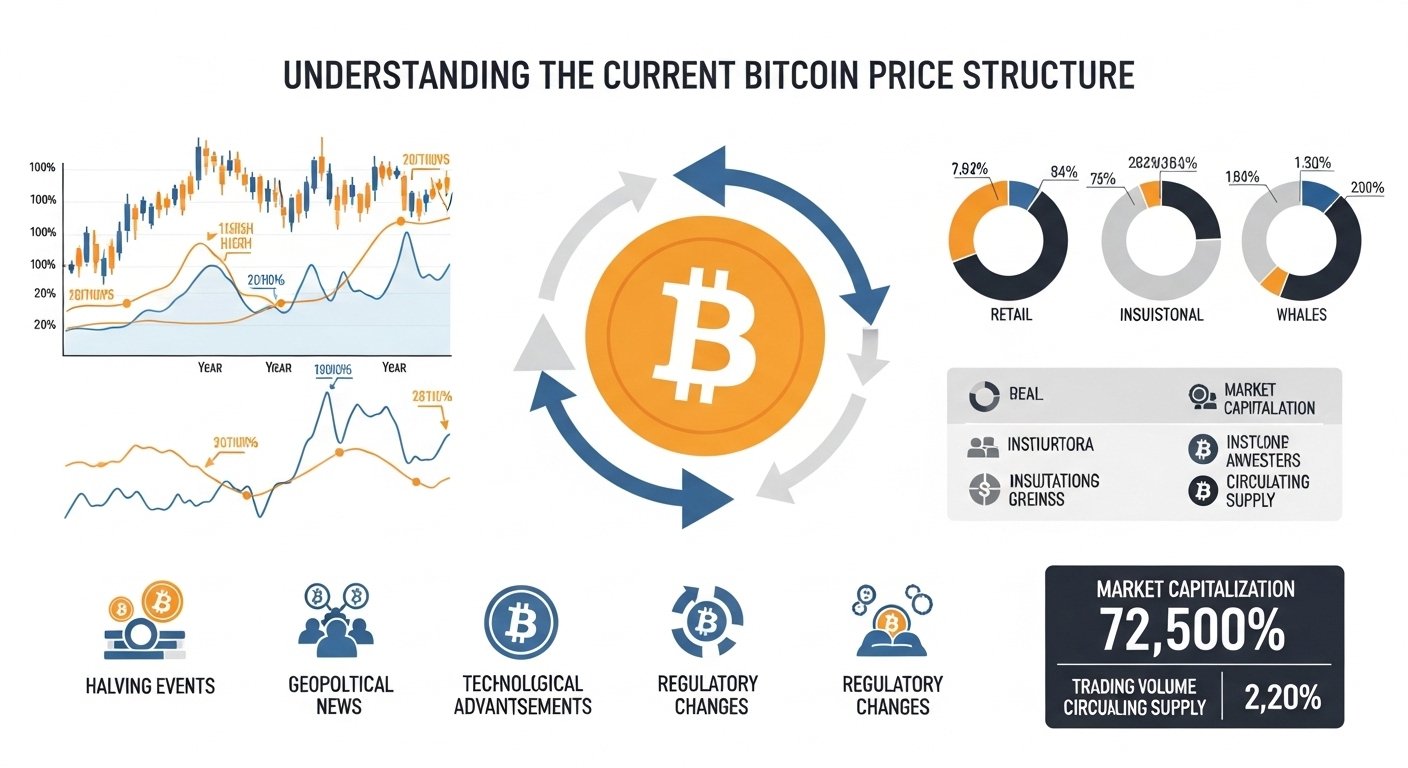
The phrase Bitcoin slide slowing reflects a technical observation rather than a definitive trend reversal. When prices decline sharply, markets often enter a consolidation phase where volatility compresses and trading ranges tighten. This stage can signal either accumulation or distribution.
Technical Indicators Suggest Stabilization
From a charting perspective, Bitcoin has formed higher lows on shorter timeframes, indicating that immediate downside momentum is fading. Oscillators such as the Relative Strength Index (RSI) have moved out of oversold territory, while moving averages are flattening. These are typical signs that the aggressive phase of a selloff is losing strength.
However, flattening moving averages do not automatically imply a bullish reversal. In many historical cycles, Bitcoin has traded sideways for extended periods before resuming downward movement. Analysts emphasize that true trend reversals typically require strong volume expansion and decisive breaks above key resistance zones.
Resistance Levels Still Intact
Despite the Bitcoin slide slowing, major resistance levels remain unbroken. Long-term moving averages and previous support-turned-resistance zones continue to cap upward movement. Until price convincingly reclaims these levels, the broader crypto market downturn thesis remains valid.Institutional traders often wait for confirmation signals before reallocating capital. Without structural breakouts, many funds prefer to remain defensive, limiting the probability of a sustained rally.
Macro Environment Continues to Pressure Risk Assets
Bitcoin does not trade in isolation. Over recent years, it has shown increasing correlation with traditional risk assets such as technology stocks. Broader macroeconomic forces therefore play a critical role in determining whether the bear market persists.
Interest Rates and Liquidity Conditions
Global monetary tightening has significantly reduced liquidity across financial markets. Higher interest rates make speculative assets less attractive relative to fixed-income instruments. This shift in capital allocation has contributed to the prolonged crypto downturn.
Even if the Bitcoin slide slowing suggests reduced selling pressure, sustained recovery would likely require improved liquidity conditions. Central bank policies, inflation trends, and global growth projections continue to shape investor appetite for digital assets.
Geopolitical and Regulatory Uncertainty
Regulatory clarity remains uneven across jurisdictions. While some countries adopt crypto-friendly frameworks, others impose restrictions that dampen institutional participation. Regulatory headlines often trigger short-term volatility and reinforce bearish narratives.
Geopolitical tensions and economic slowdowns also add layers of uncertainty. In such environments, investors typically prioritize capital preservation over high-risk exposure, limiting upside potential even when prices stabilize.
On-Chain Metrics Reveal Mixed Signals
Blockchain data provides valuable insights into investor behavior and network health. Although the Bitcoin slide slowing is visible on price charts, on-chain indicators paint a more nuanced picture.
Long-Term Holder Behavior
Long-term holders have historically accumulated during bear markets. Current data suggests that many are holding rather than aggressively buying. This indicates confidence in Bitcoin’s long-term value proposition but not necessarily aggressive accumulation signaling a new bull phase.Dormant supply metrics show reduced coin movement, suggesting that panic selling has diminished. However, without strong inflows from new participants, price expansion remains constrained.
Miner Activity and Hash Rate Trends
Miners play a crucial role in maintaining network security. When prices fall significantly, mining profitability declines, potentially leading to capitulation events. Recent data indicates that miner selling pressure has decreased, aligning with the Bitcoin slide slowing narrative.
At the same time, network hash rate remains relatively resilient, demonstrating long-term confidence in the protocol. Still, profitability margins remain thin, meaning any additional price weakness could reintroduce selling pressure from mining operations.
Institutional Sentiment: Cautious, Not Bullish
Institutional capital has been a major driver of Bitcoin’s maturation. However, current positioning suggests caution rather than aggressive re-entry.
Derivatives Market Positioning

Futures open interest and funding rates show balanced positioning. Extreme bearish funding rates have normalized, reflecting the slowing of the Bitcoin slide. Yet bullish leverage remains subdued, indicating limited conviction in a rapid recovery.Options markets reveal increased demand for downside protection, suggesting that sophisticated traders still hedge against potential further declines.
ETF and Fund Flows
Investment products tracking Bitcoin have seen moderate inflows following periods of heavy outflows. This stabilization supports the argument that panic has subsided. Nonetheless, inflows remain significantly lower than levels observed during previous bull cycles.Analysts interpret this as a transitional phase rather than the start of sustained upside momentum.
Psychological Dynamics in a Bear Market
Market cycles are driven as much by psychology as by fundamentals. Understanding investor sentiment helps explain why the Bitcoin slide slowing does not equate to renewed optimism.
From Capitulation to Apathy
Late-stage bear markets often shift from panic to apathy. Trading volumes decline, media attention fades, and volatility compresses. These characteristics align with the current environment.Apathy can persist for months. During this period, prices move within narrow ranges, frustrating both bulls and bears. Historically, major breakouts occur only after prolonged consolidation.
The Role of Narrative Shifts
Narratives influence capital flows. In previous cycles, transformative stories such as institutional adoption or technological upgrades fueled rallies. At present, the dominant narrative emphasizes macro uncertainty and regulatory scrutiny.Until a compelling bullish catalyst emerges, the bear market thesis may remain dominant despite the Bitcoin slide slowing.
Comparing Past Bear Markets
Historical analysis provides context for current price action. Bitcoin has experienced multiple drawdowns exceeding 70% from peak to trough.In earlier cycles, the transition from steep decline to sideways consolidation lasted several quarters. The current structure resembles those patterns, suggesting that stabilization does not necessarily imply immediate recovery.Each cycle, however, unfolds within a unique macro backdrop. Today’s tighter monetary policy and increased institutional integration differentiate this bear market from earlier ones.
Potential Catalysts for a Trend Reversal
Although analysts caution that the bear market is still in play, several potential catalysts could shift momentum.
Monetary Policy Easing
A pivot toward looser monetary policy could reignite demand for risk assets. Lower interest rates and renewed liquidity injections historically benefit Bitcoin and other cryptocurrencies.
Regulatory Clarity
Clear and supportive regulatory frameworks could encourage institutional participation. Reduced uncertainty may unlock sidelined capital, strengthening price structure.
Technological Developments
Advancements in scalability, security, and integration with traditional finance could enhance Bitcoin’s utility. Innovation often precedes renewed investor enthusiasm.However, until such catalysts materialize, analysts maintain a cautious stance.
Risk Management in a Slowing Downtrend
For traders and investors, the Bitcoin slide slowing presents both opportunity and risk. Volatility compression often precedes large moves. Position sizing and disciplined risk management remain essential.
Long-term investors may view current prices as attractive relative to historical peaks. Short-term traders, however, must remain vigilant, as range-bound markets can produce false breakouts.Diversification and liquidity management are crucial in uncertain environments.
Conclusion
The narrative that the Bitcoin slide slowing marks the end of the downturn is premature according to many analysts. While selling pressure has moderated and volatility has declined, structural resistance levels, macroeconomic headwinds, and cautious institutional positioning suggest that the broader bear market remains in effect.
Bitcoin’s resilience continues to demonstrate its long-term viability, but recovery phases historically require clear catalysts, strong volume expansion, and improved liquidity conditions. Until those elements align, the market may remain trapped in a consolidation phase.
Investors should approach this period with measured expectations. Stabilization is a constructive development, but it does not guarantee immediate bullish momentum. In the evolving landscape of digital assets, patience and disciplined strategy remain paramount.
FAQs
Q: Is the Bitcoin slide slowing a sign that the bear market is over?
Not necessarily. While price declines have moderated, key resistance levels and macroeconomic challenges indicate that the broader bear market may still be active.
Q: What indicators show that the Bitcoin slide slowing?
Flattening moving averages, reduced volatility, normalized funding rates, and lower selling pressure from miners all signal that downside momentum is weakening.
Q: Could macroeconomic changes reverse the bear market?
Yes. Easing monetary policy, improved liquidity, and reduced geopolitical uncertainty could reignite demand for risk assets, including Bitcoin.
Q: How do institutional investors view the current market?
Most institutional participants appear cautious. Derivatives positioning and moderate fund inflows suggest stabilization rather than aggressive bullish conviction.
Q: What should investors do during a slowing bear market?
Risk management is critical. Long-term investors may accumulate gradually, while short-term traders should remain alert to breakout signals and protect against downside risk.
Also More: Bitcoin Sell-Off Triggers Altcoin Crash as Market Cap Shrinks