








































For years, Bitfarms (BITF) occupied a prominent position among publicly traded Bitcoin mining companies, known for its low-cost operations and extensive global infrastructure. Yet the post-2024 halving era introduced a sharp new economic reality. Profit margins contracted, energy costs rose, network difficulty increased, and the capital required to stay competitive escalated at a pace that outstripped mining rewards. As the industry struggled to absorb these pressures, Bitfarms announced a significant and surprising pivot. Rather than pouring additional resources into a sector with increasingly thin margins, the company began a strategic transformation toward AI computing, high-performance computing (HPC), and North American data-center development.
This shift signals more than an adjustment to market conditions. It represents a fundamental rethinking of what a former Bitcoin mining giant should become in an age where artificial intelligence workloads are rapidly consuming global data-center capacity. From selling major mining facilities to restructuring its geographic footprint and reinventing the use of its existing infrastructure, Bitfarms is stepping into a future where AI clusters may replace ASIC miners and where recurring compute contracts may offer stability that block rewards can no longer guarantee. The move positions the company at the crossroads of two of the most powerful digital revolutions of our time: the rise of AI and the ongoing evolution of Bitcoin’s mining economy.
Bitfarms’ Strategic Pivot: Why a Leading Miner Is Changing Course
After the 2024 Bitcoin halving, the financial equation that once made industrial-scale Bitcoin mining highly attractive began to break down. The halving reduced block rewards by half, creating an immediate revenue contraction for miners across the world. At the same time, global network difficulty surged as remaining miners deployed more advanced ASIC machines, raising operational requirements and forcing companies to spend increasingly large sums to maintain competitiveness. Bitfarms, despite its historically strong position, was not immune to these pressures. Its quarterly results highlighted the problem clearly: rising revenues but widening losses, squeezed margins, and a growing cost to sustain the fleet of machines needed to remain relevant in the mining race.
Against this backdrop, the appeal of AI computing became more compelling. The demand for GPU-heavy infrastructure skyrocketed as enterprises, cloud providers, and AI developers sought massively parallel computing power. While Bitcoin mining requires specialized ASICs, AI computing relies on hardware that is significantly more profitable on a per-megawatt basis. Bitfarms recognized that its existing energy contracts, data-center shells, electrical infrastructure, and cooling capabilities could be repurposed. This realization marked the beginning of its transition away from volatile crypto revenues and toward the rapidly expanding market for high-performance computing.
What Exiting Bitcoin Mining Means for Bitfarms
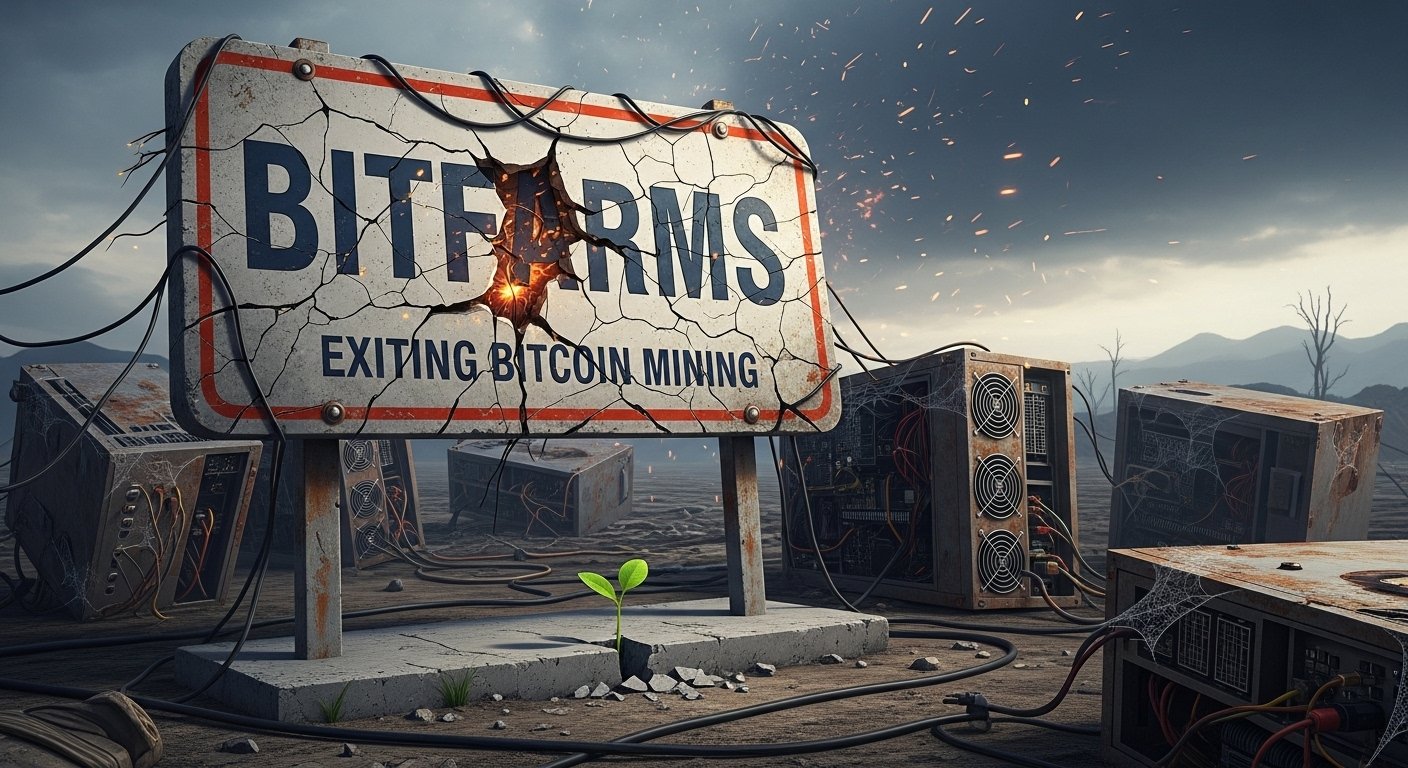
Bitfarms’ exit from Bitcoin mining is not defined by an instant shutdown across all locations but by a systematic reallocation of resources that reflects the company’s evolving priorities. The shift began with the discontinuation of operations in Argentina, where power supply suspension and unstable economic conditions created an environment that no longer made mining feasible. The company announced that operations there would wind down entirely, marking a decisive step in scaling back its international mining presence.
Another major milestone in the company’s departure from traditional mining was the sale of its large Paraguay site, a 200-megawatt facility that had once been essential to its global mining capacity. By transferring this asset to another digital infrastructure operator, Bitfarms freed significant capital and reduced its exposure to geopolitical risk, while securing funds to develop its expanding portfolio of North American compute campuses. This shift indicates that the company is not abandoning its infrastructure entirely, but rather redirecting it to markets and business models that offer greater stability and long-term value.
At the same time, the company has emphasized that Bitcoin mining will continue in a more limited and strategic capacity. Rather than serving as the company’s core identity, mining will form part of a dual-engine model in which AI and HPC operations drive growth while mining offers optionality and diversified revenue. The transition underscores Bitfarms’ understanding that while Bitcoin remains important, its future lies in sectors where demand for compute is scaling at a pace unmatched by crypto mining economics.
Repurposing Mining Infrastructure for AI Computing
The most intriguing aspect of Bitfarms’ transformation is that the company does not need to build an entirely new business from scratch. Much of the infrastructure that once powered ASIC miners can be adapted to support AI clusters with surprisingly little structural change. Bitcoin mines require immense electrical capacity, advanced cooling systems, robust power distribution networks, and highly reliable uptime. These same features form the backbone of modern AI data centers. Bitfarms can therefore replace mining rigs with GPU servers and convert its facilities into AI-ready compute campuses without the cost of constructing wholly new buildings.
This approach gives Bitfarms a meaningful advantage in the emerging AI data center industry. While newcomers face long timelines to secure land, energy, permitting, and construction, Bitfarms already operates multiple industrial sites designed for heavy electrical loads. The conversion process focuses primarily on upgrading cooling to support GPU-dense configurations and ensuring adequate redundancy for high-performance workloads. By leveraging its historical strengths, Bitfarms can enter the AI computing sector faster than many competitors and at a lower cost basis.
North America as the New Center of Bitfarms’ AI Expansion
Bitfarms’ strategic pivot includes a geographic realignment that places North America at the center of its long-term growth. The company is concentrating its future operations in regions with stable regulatory environments, predictable energy markets, and strong investor confidence. One of the most ambitious developments within this shift is the Panther Creek campus in Pennsylvania, which is being designed as a significant hub for AI and HPC workloads. With plans for hundreds of megawatts of future capacity, Panther Creek represents the company’s future vision: an industrial-scale AI computing center built on the foundations of former mining infrastructure.
The North American focus also includes efforts to diversify energy sources, reduce regulatory risk, and position the company near end customers who require low-latency access to compute. Selling the Paraguay site and winding down operations in less predictable markets is part of that broader strategy. As Bitfarms consolidates its footprint, its data centers increasingly reflect the company’s desire for long-term contractual stability rather than the volatile revenue patterns associated with Bitcoin mining. The United States, with its surging demand for AI compute and deep pool of enterprise clients, has become central to Bitfarms’ identity as it evolves into an AI computing company.
Financing the Transition to AI Computing and HPC

Building AI data centers on the scale Bitfarms envisions requires substantial capital. Recognizing this, the company has pursued new avenues of financing, including a significant arrangement with Macquarie Group that provides hundreds of millions of dollars toward the construction of AI and HPC infrastructure. The willingness of institutional lenders to back this transformation signals a shift in how Bitfarms is perceived. Investors no longer see the company merely as a Bitcoin miner subject to cyclical market swings, but as a future-facing digital-infrastructure provider with diversified growth potential.
This financing capability enables Bitfarms to accelerate the timeline of its pivot. The company can now develop advanced cooling systems, expand electrical capacity, acquire GPU clusters, and build long-term partnerships with enterprise clients and cloud providers. The increasing weight of AI computing in its financial results reinforces the company’s strategic direction and demonstrates that the market is responding favorably to its move beyond Bitcoin mining.
The Financial Trajectory: Short-Term Challenges and Long-Term Opportunity
The transition away from Bitcoin mining has resulted in short-term financial pain for Bitfarms. The company has reported widened losses, impairment charges associated with closing or selling mining sites, and reduced BTC production due to the halving and ongoing operational changes. These challenges have been visible in quarterly earnings and have sparked questions from traditional mining-focused analysts about the company’s immediate profitability.
Yet the long-term trajectory tells a different story. Revenue growth tied to the expansion of HPC and AI computing has begun to offset the declines in mining-related income. As more of Bitfarms’ power capacity is dedicated to AI workloads, which generate significantly higher revenue per megawatt than Bitcoin mining, the company is positioned for more predictable income streams and stronger margins. If the pipeline of AI customers continues to expand, Bitfarms may soon reach a point where AI and HPC services overshadow mining entirely, transforming the business model and elevating the company’s valuation proposition.
The Wider Industry Impact and What Bitfarms’ Pivot Means for Crypto
Bitfarms’ decision to step back from mining and embrace AI computing reflects a broader trend unfolding across the digital infrastructure sector. The halving has forced miners to rethink the viability of long-term ASIC-dependent operations, while the global surge in AI has created unprecedented demand for compute capacity. Other mining companies have begun experimenting with HPC hosting, but few have pursued the transition with the decisiveness shown by Bitfarms. If the strategy proves successful, it may serve as a blueprint for other miners navigating similar pressures.
The shift also raises questions about the future of Bitcoin network decentralization. When major miners exit the ecosystem or sell key facilities, their hashrate generally reenters the market through new operators rather than disappearing altogether. This means the network remains secure, even as individual companies diversify. In some ways, the migration of mining assets and the repurposing of facilities for AI underscores the increasing overlap between the crypto and AI industries, both of which rely on massive electrical and computational infrastructure.
See More: Bitcoin mining Trump family’s $314M Bitmain bet reshapes the market
What Investors Should Watch Moving Forward
As Bitfarms completes its evolution into an AI infrastructure company, the metrics that once defined its success will become less central. Hashrate, cost per BTC, and mining fleet efficiency will still matter, but they will no longer tell the full story. Investors will need to pay closer attention to the amount of AI computing capacity deployed, the percentage of power allocated to HPC clients, the structure of long-term hosting contracts, and the margins associated with AI data-center services. These indicators will reveal the company’s growth trajectory far more clearly than mining-related metrics.
It is equally important for investors to consider the risks that accompany the pivot. AI data-center construction involves engineering complexity, long lead times for GPU acquisition, and intense competition from hyperscalers and established cloud providers. Regulatory and environmental factors can also influence the pace at which AI campuses come online. Despite these challenges, Bitfarms’ early progress suggests that the company has both the infrastructure and the financial partnerships required to compete successfully in this rapidly expanding market.
Conclusion
The story of Bitcoin miner Bitfarms (BITF) exiting Bitcoin mining and pivoting to AI computing captures a moment of profound transformation within both the crypto and AI industries. It reflects the company’s willingness to adapt, innovate, and confront economic realities that no longer favor traditional mining. Bitfarms’ shift toward AI and HPC infrastructure represents a calculated bet on a future where compute, not coins, defines the foundation of digital enterprise.
If the company continues to execute on its strategy, strengthens its North American data-center presence, and attracts a growing base of AI clients, Bitfarms may emerge not only as a survivor of the post-halving era but as a leader in the accelerating race to build the world’s next generation of compute infrastructure. The transition marks a new chapter—one in which the company’s identity expands far beyond the boundaries of Bitcoin mining and into the broader and more dynamic world of artificial intelligence.