






































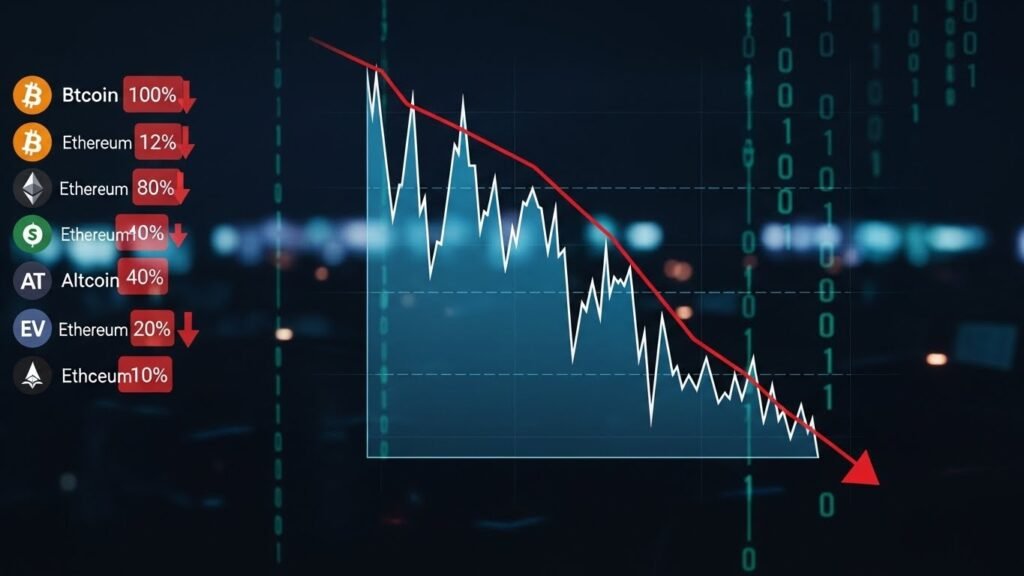
The global crypto market experienced a dramatic downturn after the U.S. Federal Reserve delivered an unexpectedly hawkish message that sent shockwaves through digital asset valuations. Traders who had positioned themselves for a more accommodative monetary policy were caught off guard when the Fed emphasized caution and signaled that future rate cuts were far from guaranteed. The fallout was immediate, with Bitcoin, Ethereum, and a wide range of altcoins entering a steep decline marked by intensified volatility and a sudden shift in sentiment. Crypto Market Dives
In recent years, the correlation between macroeconomic policy and cryptocurrency performance has grown stronger, especially as institutional participation has expanded. The crypto market, which once moved primarily on internal developments and technological milestones, has increasingly responded to central bank decisions, economic data releases, and global liquidity conditions. This latest plunge underscores the fact that the Federal Reserve’s stance has become one of the most powerful external forces shaping short-term and long-term crypto trends. Crypto Market Dives The shock that traders felt was not just about the numbers. It was about tone, intention, and the unexpected confidence with which the Fed asserted that inflation risks remain elevated. That message disrupted bullish narratives that had supported the market in recent months, transforming optimism into caution almost instantly.
The Fed’s Hawkish Shift
To appreciate the severity of the market reaction, it is essential to understand what a hawkish stance means in the context of monetary policy. When the Federal Reserve adopts a hawkish tone, it signals a willingness to maintain higher interest rates or slow the pace at which rates may be lowered. Such an outlook generally strengthens the U.S. dollar and lowers liquidity across global markets. For risk-sensitive assets like cryptocurrencies, this creates an unfavorable environment.
Traders were anticipating a more dovish interpretation following the Fed’s latest policy meeting. Although a rate cut was delivered as predicted, the central bank’s forward guidance introduced a new level of uncertainty. Instead of reinforcing expectations for multiple cuts in the months ahead, the Fed emphasized that future decisions would depend heavily on inflation, employment, and broader economic stability. The absence of a clear path toward further easing stunned the market.
In crypto, expectations often play an even larger role than actual policy outcomes. When investors price in future rate cuts, liquidity and leverage increase, fueling rallies. When those expectations are abruptly interrupted, the reaction tends to be disproportionate. This dynamic played out sharply as the market digested the Fed’s remarks.
Immediate Effects on Major Cryptocurrencies

The repercussions were visible within minutes of the announcement. Bitcoin, which had been showing strength and maintaining support levels above the psychological threshold of $94,000, quickly reversed direction and plunged below $90,000. This sudden drop shattered short-term bullish structures and triggered a wave of panic among traders who had leveraged themselves in anticipation of continued upward momentum. Ethereum followed closely, declining significantly as traders abandoned positions in response to the shifting macro environment.
Major altcoins, including those considered relatively resilient, also tumbled. The speed and magnitude of the sell-off reflected not only fear but also the presence of numerous over-leveraged positions that were vulnerable to liquidation. Market capitalization for the entire crypto sector shrank rapidly. Exchanges saw dramatic increases in trading volume as both panic selling and desperate attempts to salvage positions intensified. The widespread losses demonstrated just how interconnected digital assets have become, with Bitcoin’s decline exerting pressure across the entire ecosystem.
Why Crypto Reacts Strongly to Fed Decisions
Cryptocurrencies occupy a unique space in global finance. Although they operate outside traditional monetary systems, they remain deeply influenced by macroeconomic conditions. The Fed’s hawkish stance shocked traders primarily because higher or sustained interest rates reduce the attractiveness of speculative assets. When interest rates are high, investors gravitate toward instruments that offer stable returns, such as bonds or treasury securities. The opportunity cost of holding non-yielding assets like Bitcoin becomes too great for many.
Moreover, the crypto market is fueled by sentiment. Optimism about future liquidity boosts buying pressure, while concerns about tightening financial conditions produce rapid outflows. Because the market lacks the same level of institutional hedging and risk mitigation tools found in traditional finance, these swings can become more extreme.
A hawkish signal also tends to strengthen the U.S. dollar, which historically has an inverse relationship with Bitcoin. When the dollar gains strength, crypto assets often experience downward pressure. This relationship further amplified the negative reaction following the Fed’s announcement.
Crypto Volatility and Interest Rate Sensitivity
The sensitivity of the crypto market to interest rate expectations has increased over time. This is partly due to greater participation from institutional traders who deploy similar macro-driven strategies in both traditional and digital markets. When rates are expected to fall, capital flows into risk assets, and when rates appear likely to remain high, those flows reverse.
In practice, this means that the crypto market reacts not only to rate changes themselves but also to the language used by the Fed. When the central bank delivers an unexpectedly hawkish message, even without tightening policy, the market interprets this as a sign of future constraints. The result is often an exaggerated reaction that pushes asset prices sharply lower.
The latest market plunge highlighted how quickly sentiment can turn. Traders who had relied on predictive models centered around aggressive future rate cuts suddenly found themselves facing a very different reality. Crypto volatility surged as prices attempted to stabilize amid conflicting narratives and heightened uncertainty.
The Cascade of Liquidations Across the Market
The crypto market’s structural characteristics contributed significantly to the severity of the downturn. Leverage is widely used across centralized exchanges and decentralized finance platforms, allowing traders to amplify gains but also exposing them to heightened risk. When prices fall suddenly, leveraged positions are automatically liquidated to protect exchanges from losses. This creates a cascading effect where every liquidation pushes prices lower, triggering additional liquidations.
During the recent decline, hundreds of millions of dollars in leveraged long positions were wiped out. The speed at which liquidation engines activated underscored the fragility of the market’s structure during periods of unexpected macroeconomic shocks. As long positions were forcibly closed, selling pressure intensified, and fear spread.
The liquidation spiral was further aggravated by the fact that many traders had built positions around the assumption of a dovish Fed. When that assumption proved incorrect, their strategies unraveled quickly, contributing to an environment where each negative development compounded the previous one.
Severe Declines in Altcoins and the Broader Crypto Ecosystem
Bitcoin’s decline set the tone, but altcoins experienced some of the steepest losses. Smaller tokens with lower liquidity always face higher volatility during market stress, but the broad-based nature of the decline was notable. Even major altcoins with strong fundamentals saw sharp drawdowns as traders exited the market in masse.
As capital fled, project ecosystems suffered. Liquidity pools weakened, trading pairs became unstable, and decentralized finance platforms saw reductions in total value locked. The drop in altcoin prices reflected a larger pattern: when macroeconomic fear dominates, technical progress and development activity take a back seat to risk management.
The altcoin sell-off emphasized the reality that crypto markets are still extremely sentiment-driven. When Bitcoin loses momentum, the entire digital asset landscape is affected, leading to cascading losses across thousands of tokens.
The Role of Broader Macro Headwinds

The hawkish tone from the Fed occurred against a backdrop of broader global uncertainties. Economic data in several major countries suggested slowing growth, while fiscal concerns and geopolitical tensions added to the complexity of the situation. These combined pressures contributed to a risk-off environment in global markets.
Traditional financial markets also reacted negatively, with equities showing weakness and bond yields rising. When multiple sectors reflect caution at the same time, risk assets such as cryptocurrencies naturally face increased pressure. The crypto market’s rapid decline was not solely due to the Fed’s words but also the context in which those words were delivered.
This convergence of macro headwinds amplified traders’ anxiety and created a landscape where even minor developments could trigger major reactions. In such conditions, crypto assets tend to be among the first to absorb the impact.
Market Outlook: Rebound Potential and Continued Risks
Despite the turmoil, the future of the crypto market remains far from bleak. Historical patterns show that steep declines often precede strong recoveries, especially when the underlying adoption and growth factors remain intact. Long-term investors may view the current prices as attractive entry points.
However, risks remain. Until the Federal Reserve provides clearer indications of policy direction, uncertainty will continue to shape market behavior. The hawkish stance does not necessarily imply aggressive future tightening, but it does suggest that traders should prepare for a prolonged period of volatility.
Analysts remain divided. Some believe the downturn represents a necessary correction that clears out excessive leverage and allows for healthier market conditions. Others warn that the full impact of tighter financial conditions has yet to be fully absorbed.
What is clear is that the crypto market is at a crossroads, balancing between macroeconomic pressures and a long-term technological evolution that continues to attract investors worldwide.
Conclusion
The dramatic plunge in the crypto market following the Fed’s hawkish stance serves as a powerful reminder of how deeply intertwined digital assets have become with global monetary policy. The Federal Reserve’s tone, even more than its actual decisions, now carries the potential to ignite or extinguish momentum in Bitcoin, Ethereum, and the broader altcoin market. Traders who had anticipated a more accommodative path found themselves confronting a sharp reversal, triggering volatility, liquidations, and a shift toward risk aversion.
Although the downturn has created uncertainty, it has also highlighted the resilience and dynamism of the crypto sector. Periods of correction are not new to digital assets, and long-term fundamentals such as adoption, innovation, and institutional participation remain strong. As investors wait for clearer signals from policymakers, the market will likely continue to navigate a challenging yet opportunity-rich landscape.
FAQs
Q. Why did the crypto market crash after the Fed’s announcement?
The crash occurred because the Federal Reserve delivered an unexpectedly hawkish message, signaling caution about future rate cuts and suggesting that financial conditions may remain tighter than traders had expected. This shift in tone reduced risk appetite and triggered widespread selling.
Q. How does a hawkish Fed stance influence Bitcoin and other cryptocurrencies?
A hawkish stance usually strengthens the U.S. dollar and limits future liquidity, making speculative assets like Bitcoin less attractive. As liquidity tightens, traders tend to move away from high-risk markets, causing crypto prices to fall.
Q. Are leveraged liquidations responsible for the rapid decline?
Leveraged liquidations played a significant role. When prices dropped, many leveraged positions were automatically closed, creating additional downward pressure and accelerating the market’s fall.
Q. Will the crypto market recover from this downturn?
Recovery is possible and has occurred after previous macro-driven declines. However, the pace of recovery will depend on future Fed communication, inflation data, and broader investor sentiment.
Q. Should long-term investors be concerned about the Fed’s hawkish stance?
Long-term investors typically focus on adoption trends and technological progress rather than short-term volatility. While a hawkish Fed can create temporary turbulence, it does not fundamentally undermine the long-term potential of cryptocurrencies.
See more: Crypto News Trusted Source for Blockchain and Crypto Trends