









































The latest crypto news cycle is being driven less by token-specific headlines and more by a sharp shift in global macro sentiment. Over the past several sessions, the crypto market sell-off has deepened alongside a broader “risk-off” move across traditional markets, after President Donald Trump renewed tariff threats that reignited trade-war anxieties. In this kind of environment, high-volatility assets tend to get sold first, and digital assets—despite their growing maturity—still behave like “risk-on” instruments when liquidity tightens and uncertainty rises.
What makes this episode particularly notable in crypto news is how quickly the market’s tone changed. Bitcoin slid below key psychological levels during parts of the move, while Ethereum and major altcoins dropped even more sharply, reflecting the classic pattern of leverage unwinding in a risk-off shock. Reports tied the downturn to tariff headlines, with Bitcoin dipping below roughly $92,000 at one point while Ether and Solana posted steeper percentage declines.
At the same time, the tariff story itself has been unusually geopolitical. News coverage described Trump’s tariff threats in connection with a dispute involving Greenland and certain European countries, injecting an additional layer of uncertainty into global markets. That kind of headline risk can overpower even strong on-chain narratives, especially when traders are crowded into leveraged positions.
This article breaks down the crypto news behind the sell-off, explains why tariff threats can flip the whole market into global risk-off mode, and explores what investors should watch next across Bitcoin, Ethereum, altcoins, and broader macro indicators. The goal is clarity without hype—because when a crypto market sell-off is driven by macro fear, understanding the chain reaction matters more than guessing the bottom.
Why Trump Tariff Threats Hit Crypto So Hard
The immediate question in crypto news is simple: why would tariff rhetoric trigger a wave of selling in Bitcoin and altcoins? The answer is that tariffs are not just a trade policy tool—they’re a macro shock that can change inflation expectations, growth forecasts, and central bank assumptions in real time. When markets hear “tariffs,” they often hear “higher costs,” “messier supply chains,” “slower global growth,” and “more policy uncertainty.” That cocktail tends to push investors away from volatile assets and toward perceived safe havens.
In recent market coverage, tariff fears were explicitly linked to declines in Bitcoin and broader risk appetite, with multiple outlets pointing to the same pattern: trade tension headlines, falling crypto prices, and a rush into safer positioning. For crypto, which still trades heavily on liquidity and sentiment, tariff uncertainty can become a trigger for systematic de-risking.
The Risk-Off Mechanism: Liquidity, Leverage, and Fear
A risk-off move is not just “people are scared.” It’s a mechanical shift in positioning across portfolios. In many funds and trading desks, crypto exposure sits in the same bucket as high-beta tech, emerging market risk, and momentum strategies. When volatility rises and uncertainty spikes, those exposures get cut quickly, especially if the portfolio is levered. 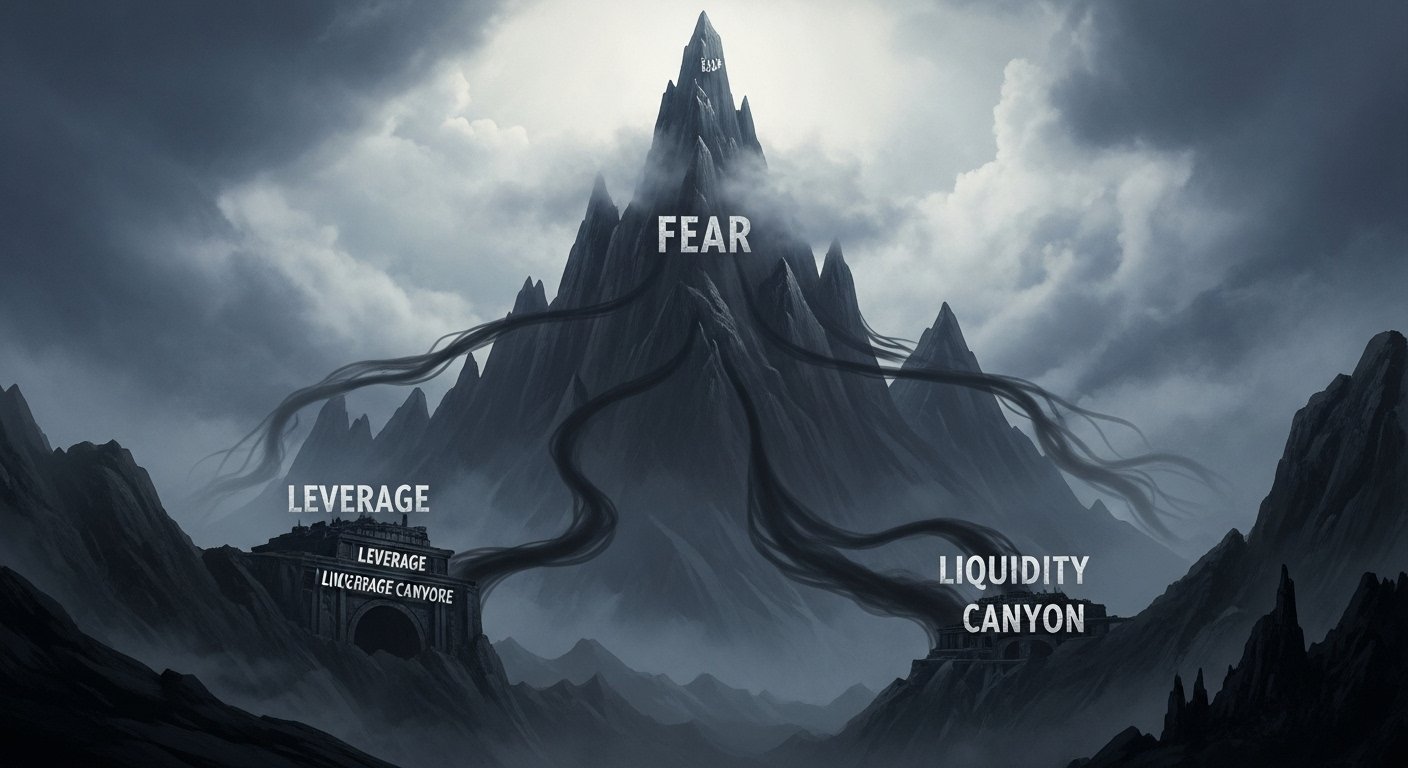
That’s why this crypto news episode has been marked by liquidation narratives. When prices slip, leverage becomes fragile. As stop-losses and liquidations cascade, selling pressure becomes self-reinforcing, deepening the crypto market sell-off even if long-term holders remain calm.
Why Altcoins Usually Bleed More Than Bitcoin
In nearly every macro-driven shock, Bitcoin tends to drop less than mid-cap and high-beta altcoins, because Bitcoin has the deepest liquidity, the broadest institutional footprint, and the most established derivatives market. During this tariff-fueled risk-off move, reporting highlighted steeper losses across major non-Bitcoin tokens—an expected pattern when liquidity contracts.
In crypto news, that relative performance matters. It signals whether the market is experiencing “panic everywhere” or “rotation into perceived quality.” When Bitcoin dominance rises during a drawdown, it often reflects a flight from speculative risk rather than a total collapse of crypto conviction.
What Happened: The Tariff Headlines and the Market Reaction
To understand the current crypto news narrative, it helps to zoom in on the story that sparked the risk-off mood. Coverage described Trump threatening tariffs on certain European countries in a geopolitical dispute tied to Greenland, then later signaling a walk-back after discussions produced what he called a “framework” for a future deal. The market impact was immediate: risk assets sold off when tensions flared and then rebounded as the perceived threat eased.
That sequence is crucial for interpreting the crypto market sell-off. Crypto didn’t move in isolation—it tracked the market’s minute-by-minute interpretation of policy risk. Bitcoin and equities reportedly bounced when the tariff threat was softened, underscoring how sensitive crypto has become to macro headlines.
The “Headline-to-Candle” Pipeline in Modern Crypto News
Crypto is now a 24/7 market with global participation, but macro headlines still arrive in bursts—press comments, leaks, conference remarks, or sudden political statements. When those headlines involve trade policy, the reaction can be fast because the same narratives hit multiple asset classes at once: currency markets, equity futures, rates, commodities, and then crypto.This is why traders increasingly treat crypto news as macro news. The chart may look like a “crypto crash,” but the catalyst is often the same one moving everything else: a shift in risk appetite.
Bitcoin’s Macro Identity Crisis: Digital Gold or Risk Asset?
One of the most persistent debates in crypto news is whether Bitcoin behaves more like “digital gold” or like a leveraged technology proxy. The truth is that Bitcoin can express both identities, depending on the regime.
In calmer periods, Bitcoin’s scarcity narrative and long-term holder base can support the “store of value” framing. But in acute risk-off episodes—especially ones driven by policy uncertainty—Bitcoin frequently trades like a risk asset because liquidity is the dominant force. The recent tariff-driven move, with Bitcoin sliding alongside broader risk sentiment, fits that pattern.
Why Bitcoin Still Correlates With Risk in Stress Events
Even if Bitcoin’s long-term thesis is non-sovereign money, most short-term price discovery happens on leveraged exchanges and in derivatives markets. When traders are forced to reduce exposure, Bitcoin gets sold because it is liquid and easy to hedge. That creates the paradox at the heart of current crypto news: the asset that is supposed to be “independent” can still be dragged by global risk cycles.That doesn’t invalidate Bitcoin’s thesis; it simply clarifies the time horizon. In the short run, macro dominates. In the long run, fundamentals and adoption matter more.
Ethereum and the Altcoin Complex Under Pressure
In this crypto news environment, Ethereum’s performance often reflects a second-order macro effect: it is liquid enough to be a core asset, but it is still viewed as higher-beta than Bitcoin. During the tariff-fueled risk-off move, Ether dropped more sharply than Bitcoin in reported trading sessions, aligning with the typical “beta ladder” dynamic of crypto drawdowns. 
Beyond Ethereum, the altcoin market often amplifies stress because liquidity fragments across thousands of pairs and narratives. When volatility spikes, traders abandon thin books and rotate into cash, stablecoins, or Bitcoin. That shift deepens the crypto market sell-off and can make the damage look worse than it is in Bitcoin terms.
Stablecoins as the Market’s Shock Absorber
An underappreciated part of crypto news during risk-off moments is stablecoin behavior. Even when token prices fall, stablecoins can keep on-chain activity alive by providing a “parking lot” for capital. In sell-offs, investors often move into stablecoins to avoid fiat off-ramps, preserve optionality, and prepare for re-entry.That dynamic matters because it can reduce the odds of a prolonged liquidity freeze. A fast drop does not always become a long winter if capital stays within the ecosystem.
Liquidations and Leverage: The Hidden Engine of the Sell-Off
When readers see crypto news about big red candles, they often assume it’s driven by fundamentals. In reality, many sharp drops are driven by leverage mechanics. Reporting around this episode described a wave of liquidations tied to tariff shock and the resulting risk-off move.
Liquidations happen when traders borrow to increase position size and price moves against them. Exchanges automatically close positions to protect lenders, which forces selling into falling markets. That forced selling is why sell-offs can accelerate quickly, even if underlying spot demand hasn’t changed much.
Why This Matters for Interpreting Crypto News
If you treat every liquidation-driven drawdown as a “fundamental collapse,” you’ll misread the market. A leverage flush is often a reset of positioning rather than a death blow to adoption. That doesn’t mean prices can’t fall further, but it does mean the “reason” for the move is often structural.
In the current crypto market sell-off, the macro catalyst (tariff fear) and the micro mechanism (leverage unwinding) appear to have reinforced each other, producing a sharper decline than a slow fundamental repricing would.
The Global Context: Trade Policy, Inflation Fears, and Central Banks
Tariffs are not just a political headline; they are an economic variable. In crypto news, tariff threats matter because they can influence inflation expectations and central bank policy. If markets believe tariffs will raise import prices, they may anticipate stickier inflation. If inflation is expected to remain high, interest rates may stay higher for longer. Higher yields tend to pressure speculative assets by increasing the opportunity cost of holding them.
This is why the risk-off response can become broad and synchronized. Coverage of Trump’s tariff rhetoric described how global markets reacted, with investors shifting toward safer positioning when trade-war fears rose.
Why Crypto Traders Watch the Dollar, Gold, and Bond Yields
Modern crypto news is increasingly intertwined with classic macro indicators. Traders watch the dollar because it influences global liquidity. They watch gold because it’s the traditional fear hedge. They watch bond yields because they set the discount rate for risk assets. When tariffs inject uncertainty, all three can move in ways that reshape crypto flows.In other words, the most important crypto chart during a macro shock might not be a token chart—it might be the yield curve.
Is This the Start of “Crypto Winter,” or a Macro Shock?
A recurring question in crypto news is whether a sudden sell-off marks the beginning of a prolonged bear market. Some commentary around this move framed the drop as potentially signaling a harsher period ahead, while acknowledging that analysts are split on whether it’s a temporary macro-driven shock or something deeper.
The honest answer is that one sell-off rarely answers that question by itself. What matters is follow-through: whether liquidity keeps tightening, whether policy uncertainty escalates, and whether the market fails to recover key levels over time.
What to Watch Next in the Crypto Market Sell-Off
The next phase of this crypto market sell-off will likely hinge on two storylines. The first is the tariff narrative itself: whether threats re-escalate or whether negotiations stabilize expectations. The second is broader macro data and central bank signaling, which can either reinforce risk-off conditions or restore confidence.Notably, some coverage highlighted that markets rebounded when tariff fears eased, a reminder that the drawdown may be highly sensitive to ongoing political headlines.
How Investors Can Read This Crypto News Without Panicking
It’s easy to get emotionally swept up in crypto news during sharp drops, but disciplined interpretation is possible. The first step is distinguishing between catalysts and mechanics. Here, the catalyst appears to be tariff-driven risk-off fear, and the mechanics include leverage liquidation and broad de-risking.
The second step is separating short-term volatility from long-term thesis. Macro shocks can dominate price action for days or weeks. That doesn’t automatically invalidate the structural drivers of crypto adoption, but it can temporarily overwhelm them.
The Role of Time Horizon in Crypto Market Sell-Offs
If you’re trading short-term, the tariff headline cycle matters intensely. If you’re investing long-term, it matters mainly as an entry and risk management consideration. Either way, the key is to avoid treating every macro shock as a permanent regime change.This is why balanced crypto news coverage should focus on what changed: not “crypto is dead,” but “risk appetite changed, leverage unwound, and macro policy risk rose.”
Conclusion
This latest crypto news story underscores a reality that keeps repeating: crypto markets are deeply integrated into global risk sentiment. When Trump’s tariff threats revived trade-war fears, investors shifted into a global risk-off stance, and the crypto market sell-off accelerated through leverage unwinds and rapid de-risking.
Whether this drawdown becomes a longer downturn depends less on any single chart pattern and more on how the macro narrative evolves from here. If tariff tensions cool and liquidity stabilizes, crypto can recover quickly, as some reporting suggested happened when the threat was softened. If tensions escalate and markets price in prolonged uncertainty, the risk-off mood could persist, keeping pressure on Bitcoin, Ethereum, and the broader altcoin complex.The best takeaway is not fear, but context: in a world where policy headlines can move everything at once, interpreting crypto news through a macro lens is no longer optional—it’s essential.
FAQs
Q: Why did Trump tariff threats cause a crypto market sell-off?
Because tariffs can raise uncertainty about growth and inflation, triggering a global risk-off shift. When risk appetite drops, traders often reduce exposure to volatile assets like crypto, and leverage unwinds can intensify the move.
Q: Did Bitcoin really fall below $92,000 during this risk-off move?
Multiple reports said Bitcoin slid below roughly $92,000 in intraday trading as tariff fears hit risk assets, with other major tokens falling more sharply.
Q: Why do altcoins usually fall more than Bitcoin in sell-offs?
Altcoins are typically less liquid and more speculative, so they react more violently when traders de-risk. In macro-driven shocks, capital often rotates toward Bitcoin or stablecoins, deepening altcoin declines.
Q: Does a tariff-driven sell-off mean a new crypto winter is starting?
Not necessarily. Some coverage noted debate about whether this is a temporary macro shock or something more persistent. Confirmation usually requires follow-through: sustained tightening, worsening headlines, and failed recoveries over time.
Q: What’s the most important signal to watch after this crypto news event?
Watch whether tariff tensions escalate or ease, and track broader risk indicators like yields and overall market sentiment. Crypto’s rebound or continued weakness often follows the same macro direction, especially when policy uncertainty is the driver.
Also More: Bitcoin Limps Into New Year at $87,000, Down 30% From All-Time Highs