






































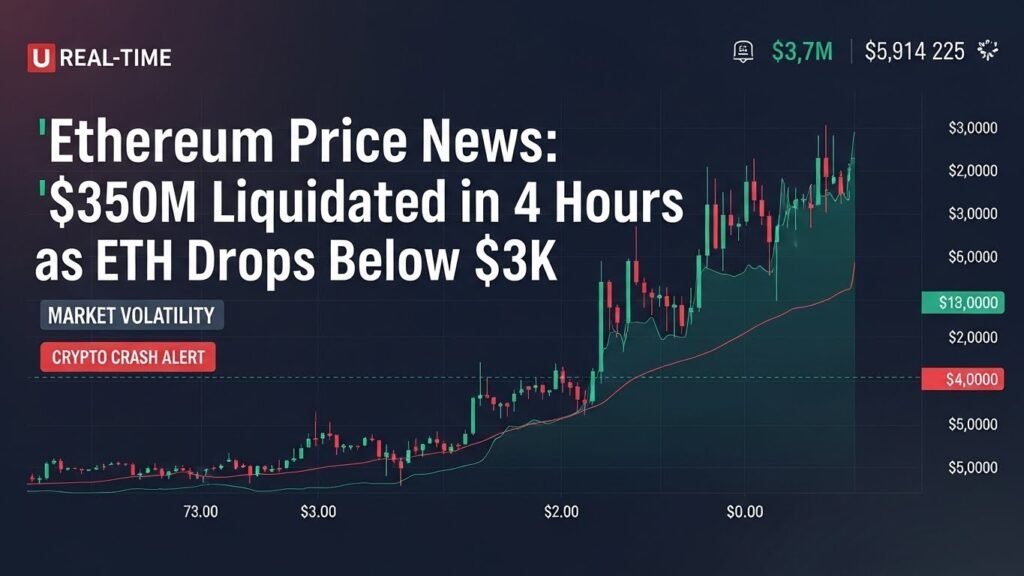
Ethereum price news has taken center stage once again as the world’s second-largest cryptocurrency suffered a sharp and sudden downturn. In a matter of just four hours, more than $350 million worth of leveraged positions were liquidated, sending shockwaves across the broader crypto market. The dramatic sell-off pushed Ethereum (ETH) below the critical $3,000 psychological level, a price zone that many traders and analysts viewed as a strong support area.
This sudden drop did not happen in isolation. Instead, it reflects a complex mix of macroeconomic uncertainty, heightened leverage in derivatives markets, weakening investor sentiment, and growing correlations between crypto assets and traditional financial markets. As traders scrambled to manage risk, forced liquidations accelerated the downside momentum, amplifying losses and increasing volatility.
In this in-depth Ethereum price news analysis, we will explore what triggered the rapid ETH decline, why liquidations surged so aggressively, and how this move could shape Ethereum’s short-term and long-term outlook. We will also examine technical levels, on-chain signals, market sentiment, and potential recovery scenarios, offering readers a comprehensive understanding of what this price action means for investors and traders alike.
What Triggered the Sudden ETH Crash?
The sharp ETH sell-off that pushed prices below $3,000 was the result of multiple overlapping factors rather than a single catalyst. In recent weeks, Ethereum had been trading in a relatively tight range, building up leverage across futures and perpetual swap markets. This environment often creates the conditions for sudden, cascading liquidations once price moves decisively in one direction.
One major factor behind the crash was increased macroeconomic uncertainty. Rising bond yields, persistent inflation concerns, and shifting expectations around interest rate policy have pressured risk assets globally. As Ethereum remains highly correlated with broader market sentiment, even modest macro-driven selling can trigger disproportionate moves when leverage is high.
Another important driver in this Ethereum price news event was profit-taking by large holders. After previous rallies, some long-term investors and institutions appeared to reduce exposure near key resistance levels. Once ETH slipped below short-term support, algorithmic trading systems and stop-loss orders accelerated selling pressure.
Understanding the $350M Liquidations in Just Four Hours
How Leverage Amplified the Ethereum Price Drop
The liquidation of over $350 million in leveraged positions highlights just how crowded the derivatives market had become. Many traders were positioned for upside continuation, using high leverage to maximize returns. When ETH began to fall rapidly, these positions quickly moved underwater.
In leveraged trading, exchanges automatically close positions once margin requirements are breached. This process, known as liquidation, forces market sells that further push prices down. In this case, a chain reaction unfolded as falling prices triggered more liquidations, which then caused even lower prices.
This feedback loop is a recurring theme in Ethereum price news during periods of high volatility. While leverage can magnify gains during bullish conditions, it also dramatically increases downside risk when market sentiment shifts suddenly.
Long Positions Bore the Brunt of the Losses
Data from derivatives platforms indicates that the majority of liquidations were long positions. Traders who had bet on ETH holding above $3,000 were caught off guard by the speed and intensity of the move. As ETH sliced through key support levels, forced selling intensified, leaving little opportunity for recovery in the short term. This imbalance between long and short positions suggests that market sentiment had become overly optimistic prior to the crash, making the market vulnerable to a sharp correction.
Ethereum Falls Below $3,000

From a market psychology perspective, round numbers like $3,000 often serve as critical support or resistance zones. For Ethereum, the $3K level represented more than just a price point—it symbolized confidence in the broader uptrend. When ETH dropped below this threshold, it triggered fear among retail traders and caution among institutional investors. This shift in sentiment played a significant role in accelerating the sell-off, as traders rushed to reassess their positions.
Technical Breakdown and Loss of Momentum
From a technical analysis standpoint, the breakdown below $3,000 also coincided with the loss of several moving averages on shorter timeframes. Momentum indicators turned sharply bearish, reinforcing the downward move. The failure to hold this level has now turned $3,000 into a potential resistance zone. Any recovery attempt will likely face selling pressure near this area as traders look to exit positions at breakeven or reduced losses.
Broader Crypto Market Impact of the ETH Liquidation Event
Ethereum’s price drop did not occur in isolation. As ETH fell, the broader crypto market followed suit, with Bitcoin and major altcoins experiencing increased selling pressure. This reinforces Ethereum’s role as a bellwether asset for the altcoin sector. Many decentralized finance tokens and layer-2 assets closely tied to the Ethereum ecosystem saw amplified losses. The sudden liquidation event reduced risk appetite across the market, leading to lower liquidity and wider spreads on exchanges. In the context of Ethereum price news, such events often mark short-term capitulation phases that can either precede deeper corrections or set the stage for stabilization and recovery.
On-Chain Data Signals During the ETH Sell-Off
Exchange Inflows and Whale Activity
On-chain metrics showed a noticeable spike in ETH inflows to centralized exchanges during the crash. This suggests that some holders moved assets to exchanges with the intention of selling or hedging risk. Large wallet movements, often associated with whales or institutional players, also increased during this period. While not all large transfers result in immediate selling, the timing reinforced bearish sentiment and added to market anxiety.
Network Fundamentals Remain Intact
Despite the sharp price decline, Ethereum’s underlying network fundamentals remained relatively stable. Transaction activity, staking participation, and developer engagement showed no signs of structural weakness. This divergence between price action and fundamentals is a recurring theme in Ethereum price news, particularly during periods driven by macro factors and leveraged trading rather than ecosystem health.
Ethereum Price News and Macro Factors Influencing ETH

Interest Rates and Risk Asset Correlation
Ethereum continues to trade as a high-beta risk asset, meaning it reacts strongly to changes in macroeconomic expectations. Concerns about prolonged higher interest rates have weighed heavily on speculative investments, including cryptocurrencies. As liquidity tightens globally, assets like ETH often experience sharper corrections, especially when investor positioning becomes overly aggressive.
Equity Market Weakness and Crypto Sentiment
Recent weakness in global equity markets has also contributed to negative sentiment in crypto. As institutional investors rebalance portfolios, exposure to volatile assets like Ethereum is often reduced first. This cross-market influence underscores why Ethereum price news must be analyzed within the broader financial context, rather than in isolation.
Short-Term Ethereum Price Outlook After the Crash
Key Support Levels to Watch
With ETH now trading below $3,000, traders are closely monitoring the next support zones. Areas around previous consolidation ranges may offer temporary relief, but sentiment remains fragile. If selling pressure persists, ETH could continue to test lower levels before finding meaningful demand. However, a reduction in leverage and stabilization in derivatives markets could help slow the decline.
Volatility Likely to Remain Elevated
Given the scale of recent liquidations, volatility is expected to remain high in the near term. Sudden price swings in either direction are possible as traders reposition and market makers adjust liquidity. This heightened volatility is a defining feature of Ethereum price news during post-liquidation phases.
Long-Term Ethereum Perspective
Adoption and Development Trends
From a long-term standpoint, Ethereum’s value proposition remains intact. The network continues to dominate smart contract activity, decentralized finance, and NFT infrastructure. Upgrades aimed at improving scalability and efficiency continue to roll out, reinforcing Ethereum’s position as a foundational blockchain platform.
Price Corrections as Part of Market Cycles
Historically, Ethereum has experienced multiple deep corrections within broader growth cycles. While painful in the short term, these drawdowns often reset market excesses and create healthier conditions for future growth. In this sense, the current Ethereum price news may represent a cyclical correction rather than a fundamental breakdown.
Market Sentiment and Trader Psychology After the Liquidations
The rapid $350M liquidation event has significantly impacted trader psychology. Fear and uncertainty tend to dominate immediately after such sharp moves, leading to reduced participation and cautious positioning. However, extreme fear can also signal potential opportunity for long-term investors who focus on fundamentals rather than short-term price fluctuations. Understanding sentiment shifts is crucial when interpreting Ethereum price news, as emotional reactions often exaggerate market moves in both directions.
Conclusion
The latest Ethereum price news underscores the volatile nature of cryptocurrency markets, particularly during periods of heightened leverage and macroeconomic uncertainty. The sudden drop below $3,000 and the liquidation of over $350 million in just four hours highlight how quickly sentiment can shift when key support levels fail.
While the short-term outlook remains uncertain and volatility is likely to persist, Ethereum’s long-term fundamentals continue to show resilience. Network activity, developer engagement, and adoption trends remain strong, suggesting that this downturn may be a corrective phase rather than a structural decline.
For traders and investors alike, this event serves as a reminder of the risks associated with leverage and the importance of disciplined risk management. As the market digests this shock, Ethereum’s next move will depend on a combination of macro conditions, technical levels, and renewed confidence from participants.
FAQs
Q. Why did Ethereum drop below $3,000 so quickly?
Ethereum fell sharply due to high leverage in derivatives markets, macroeconomic uncertainty, and a cascade of forced liquidations once key support levels broke.
Q. What does $350M in liquidations mean for the market?
Such large liquidations indicate excessive leverage and often lead to increased volatility, short-term fear, and a temporary reset of market positioning.
Q. Is this bearish for Ethereum’s long-term outlook?
Not necessarily. While short-term sentiment is weak, Ethereum’s long-term fundamentals, adoption, and development activity remain strong.
Q. Can Ethereum recover above $3,000 soon?
A recovery is possible, but $3,000 may now act as resistance. Market conditions and broader sentiment will determine the pace and strength of any rebound.
Q. How should investors react to this Ethereum price news?
Investors should assess their risk tolerance, avoid excessive leverage, and focus on long-term fundamentals rather than reacting emotionally to short-term price movements.