






































The Ethereum price has entered a decisive phase, with bearish momentum intensifying and the psychologically significant $1,800 level now acting as a crucial battleground between bulls and bears. As volatility ripples across the broader crypto market, traders and long-term investors alike are closely monitoring how ETH behaves near this support zone. A sustained breakdown could signal further downside pressure, while a strong defense may pave the way for renewed bullish momentum.
In recent sessions, the Ethereum Price Slides has struggled to reclaim key resistance areas, reflecting broader uncertainty across digital assets. With macroeconomic factors, regulatory narratives, and shifting risk appetite influencing market sentiment, ETH finds itself at a pivotal crossroads. This article examines why $1,800 matters so much, explores technical and on-chain indicators, and analyzes potential scenarios for Ethereum’s next major move.
Why the $1,800 Level Matters for Ethereum Price
The $1,800 level is not just another price point; it represents a convergence of technical, psychological, and structural significance. In crypto markets, such confluences often define turning points.From a technical analysis perspective, $1,800 aligns closely with prior consolidation zones where the Ethereum price previously found equilibrium between buyers and sellers. Historically, this range has functioned as both resistance and support, reinforcing its relevance. When a price revisits such a level, market participants often react strongly, amplifying volatility.
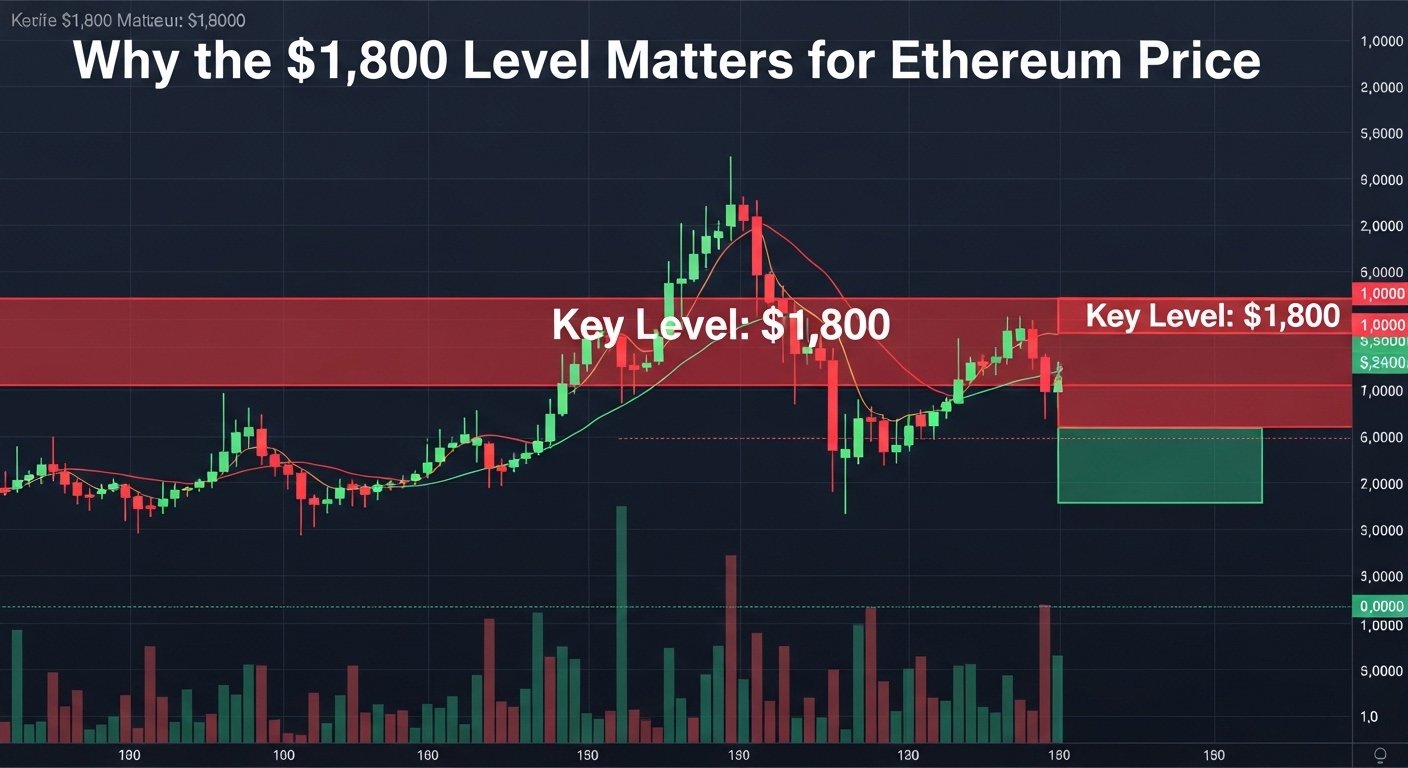
Psychologically, round numbers like $1,800 tend to carry weight. Retail traders place limit orders around these figures, and algorithmic systems often cluster liquidity near them. As a result, the Ethereum price frequently experiences sharp wicks or accelerated moves when these zones are tested.
Historical Context of Ethereum Support Zones
Looking back at previous cycles, Ethereum has repeatedly respected key horizontal levels before launching major rallies or entering extended corrections. During past downturns, similar mid-range supports have acted as springboards for recovery.
The current slide toward $1,800 echoes prior retracements where ETH retraced between 50% and 61.8% of its previous upward swing. These Fibonacci retracement levels often intersect with historical price memory, creating high-stakes battlegrounds.If the Ethereum price loses $1,800 decisively, the next notable support may sit considerably lower, potentially opening the door to accelerated sell-offs.
Technical Indicators Signal Mounting Pressure
Technical indicators currently suggest that bearish momentum has not yet fully dissipated. While short-term oversold conditions may trigger relief rallies, broader signals lean cautious.
Moving Averages and Trend Structure
The Ethereum price has slipped below several key moving averages, including the 50-day exponential moving average. When price trades beneath both short- and mid-term moving averages, it indicates that sellers retain short-term control.
The slope of these moving averages is equally important. A downward-sloping 50-day EMA often confirms sustained bearish structure. Unless ETH reclaims these levels with strong volume, rallies may remain corrective rather than trend-reversing.
Relative Strength Index and Momentum
The Relative Strength Index (RSI) has hovered near oversold territory, suggesting weakening buying pressure. However, oversold readings alone do not guarantee reversal. In strong downtrends, the RSI can remain depressed for extended periods.If bullish divergence appears—where the Ethereum price forms lower lows while RSI forms higher lows—that could hint at momentum exhaustion. Until then, traders remain cautious.
Volume Analysis and Liquidity
Volume plays a decisive role in determining whether $1,800 holds. Declining volume during price drops may indicate seller fatigue, whereas expanding volume on breakdown would confirm conviction among bears.Liquidity clusters near the $1,800 range could amplify volatility. Stop-loss orders positioned just below support may trigger cascading liquidations if breached, pushing the Ethereum price lower in a rapid move.
Broader Crypto Market Influence
The Ethereum price does not move in isolation. Its trajectory is closely tied to Bitcoin dominance and overall crypto market sentiment.When leading assets such as Bitcoin weaken, Ethereum often experiences amplified volatility. Historically, ETH tends to outperform during bullish phases but underperform during risk-off environments.The current slide in Ethereum price mirrors broader caution in digital assets, as traders reassess macroeconomic signals, interest rate expectations, and liquidity conditions.
Correlation With Bitcoin and Altcoins

Ethereum maintains a strong correlation with Bitcoin. If Bitcoin stabilizes and forms a higher low, ETH may find relief. Conversely, renewed weakness in Bitcoin could intensify selling pressure across altcoins.Additionally, Ethereum’s position as the backbone of decentralized finance means that liquidity shifts within DeFi protocols can directly impact the Ethereum price.
On-Chain Metrics and Investor Behavior
Beyond chart patterns, on-chain data provides insight into how different classes of investors are reacting.
Exchange Inflows and Outflows
Rising exchange inflows often signal increased selling intent. If large volumes of ETH are transferred to centralized exchanges, it may indicate that holders plan to liquidate positions.Conversely, consistent outflows suggest accumulation and long-term confidence. Monitoring these trends can help assess whether the Ethereum price slide reflects panic selling or strategic repositioning.
Whale Activity and Long-Term Holders
Whale wallets—large ETH holders—have historically influenced price direction. Significant accumulation near $1,800 could reinforce support. However, if whales distribute holdings at this level, it could weaken confidence.
Long-term holders tend to reduce activity during periods of uncertainty, signaling patience rather than panic. Stable long-term holder metrics may indicate that the broader thesis for Ethereum remains intact despite short-term price weakness.
Macroeconomic Factors Adding Pressure
The Ethereum price is increasingly sensitive to global macroeconomic developments. High interest rates, tightening liquidity, and cautious investor sentiment have weighed on risk assets.In traditional markets, equities often serve as a leading indicator for crypto. When major indices face selling pressure, digital assets typically follow.Moreover, regulatory narratives around crypto adoption can amplify uncertainty. Even minor headlines can trigger outsized reactions in a fragile market structure.
Ethereum’s Fundamental Strength Amid Price Weakness
While the Ethereum price faces near-term headwinds, the network’s fundamental metrics continue to evolve.Ethereum remains the dominant smart contract platform, hosting decentralized applications, NFT ecosystems, and DeFi protocols. Network upgrades have improved scalability and reduced energy consumption, strengthening its long-term proposition.
Despite short-term volatility, developer activity and ecosystem growth remain resilient. This divergence between price action and network fundamentals often creates strategic entry opportunities for long-term investors.
Staking and Supply Dynamics
Ethereum’s proof-of-stake mechanism locks significant portions of supply in staking contracts. Reduced circulating supply can mitigate downside pressure during prolonged consolidations.If staking participation continues to rise, the Ethereum price may benefit from structural supply constraints once market sentiment improves.
Bullish and Bearish Scenarios From Here
As $1,800 becomes the focal point, two primary scenarios emerge.
Scenario 1: $1,800 Holds and Triggers Rebound
If the Ethereum price defends $1,800 with strong buying volume, it could establish a higher low within the broader market structure. In this case, short sellers may cover positions, fueling a relief rally.A successful bounce could push ETH back toward resistance levels around $1,900 and $2,000. Sustained consolidation above reclaimed moving averages would further reinforce bullish momentum.
Scenario 2: Breakdown Below $1,800
A decisive breakdown accompanied by high volume could accelerate selling pressure. The Ethereum price might quickly test lower support zones as stop-losses trigger.In such a scenario, traders may shift to capital preservation strategies, waiting for clearer signs of stabilization before re-entering the market.
Sentiment and Market Psychology
Crypto markets are highly sentiment-driven. Fear and uncertainty often exaggerate price movements beyond fundamental justification.Social media activity, funding rates in derivatives markets, and liquidation data provide insight into prevailing sentiment. Elevated negative funding rates may indicate overcrowded short positions, potentially setting the stage for a short squeeze if support holds.The Ethereum price at $1,800 thus represents more than technical support; it embodies the psychological line separating cautious optimism from renewed bearish conviction.
Risk Management for Traders and Investors
Volatility around key support zones demands disciplined risk management. Position sizing, stop-loss placement, and portfolio diversification become critical when the Ethereum price tests structural levels.Short-term traders may focus on intraday price action and liquidity sweeps, while long-term investors evaluate macro trends and network fundamentals. Understanding time horizon alignment is essential for navigating such high-stakes environments.
Conclusion
The Ethereum price slide toward $1,800 marks a pivotal moment in the current market cycle. As this crucial battleground comes into focus, technical indicators, on-chain metrics, and macroeconomic forces converge to shape the next major move.
A strong defense of $1,800 could ignite renewed bullish momentum and restore confidence among traders. Conversely, a decisive breakdown may open the door to deeper corrections and prolonged consolidation.
Regardless of short-term volatility, Ethereum’s underlying ecosystem remains robust. For market participants, the coming sessions will likely define whether $1,800 becomes a launchpad for recovery or a gateway to further downside. In either case, the Ethereum price stands at a defining crossroads.
FAQs
Q: Why is $1,800 important for Ethereum price?
The $1,800 level represents a key historical support zone and psychological price point where significant buying and selling activity tends to cluster.
Q: What happens if Ethereum price breaks below $1,800?
A confirmed breakdown could trigger increased selling pressure, potentially leading to a move toward lower support levels as stop-loss orders are activated.
Q: Can Ethereum price recover quickly from this level?
Yes, if buying volume increases and broader market sentiment improves, Ethereum could rebound sharply from $1,800.
Q: How do macroeconomic factors affect Ethereum price?
Interest rates, liquidity conditions, and overall risk appetite significantly influence capital flows into crypto assets, impacting Ethereum price direction.
Q: Is Ethereum fundamentally strong despite the price slide?
Yes, Ethereum maintains strong developer activity, robust staking participation, and dominance in decentralized applications, supporting its long-term outlook.
Also More: Bitcoin & Ethereum $6B Reckoning Looms