









































Privacy has long been one of the most complex and unresolved challenges in blockchain technology. While public blockchains excel at transparency, immutability, and trust minimization, they struggle with data confidentiality. Every transaction, smart contract input, and on-chain computation is visible by default, creating serious limitations for enterprises, financial institutions, and privacy-focused Web3 applications. Over the years, developers have experimented with zero-knowledge proofs, secure enclaves, and off-chain computation to mitigate these concerns, yet each approach comes with trade-offs in complexity, performance, or trust assumptions.
This is where Fully Homomorphic Encryption (FHE) enters the conversation as a potential breakthrough. FHE allows computations to be performed directly on encrypted data without ever decrypting it, preserving privacy end to end. In theory, FHE is the holy grail for blockchain privacy. In practice, however, it has historically been too slow, too approximate, or too computationally expensive to deploy in real-world decentralized systems.
Fhenix, a privacy-first blockchain infrastructure project, is now challenging that assumption. Through its decomposable BFV implementation, Fhenix claims to make exact fully homomorphic encryption viable for blockchain applications at scale. This development could fundamentally reshape how smart contracts handle sensitive data, opening the door to confidential DeFi, private DAO governance, and encrypted on-chain computation without sacrificing decentralization.This article explores how Fhenix’s decomposable BFV works, why it matters, and what it means for the future of blockchain privacy.
Understanding Fully Homomorphic Encryption in Blockchain
What Is Fully Homomorphic Encryption?
Fully homomorphic encryption is a cryptographic technique that allows arbitrary computations on encrypted data. Unlike traditional encryption, where data must be decrypted before processing, FHE ensures that data remains encrypted throughout the entire computation lifecycle. The final output, when decrypted by an authorized party, matches the result of the computation as if it were performed on plaintext.

For blockchain systems, this is revolutionary. It means validators and smart contracts can process private data without ever seeing it. In an ecosystem built on transparency, FHE introduces privacy without compromising correctness or trustlessness.
Why Blockchain Needs Exact FHE
Many existing FHE implementations rely on approximate arithmetic, which introduces small errors in computations. While acceptable for machine learning or statistical analysis, approximate results are problematic for financial transactions, voting mechanisms, and smart contract logic where precision is non-negotiable.
Exact FHE ensures mathematically precise outcomes, making it suitable for on-chain finance, token accounting, and deterministic smart contract execution. This precision is essential if FHE is to move beyond theory and into production blockchain environments.
The BFV Encryption Scheme Explained
What Is BFV?
BFV, named after Brakerski, Fan, and Vercauteren, is one of the most well-known exact FHE schemes. It supports precise integer arithmetic, making it ideal for applications that require correctness down to the smallest unit. Unlike approximate schemes such as CKKS, BFV avoids rounding errors and numerical drift.
In the context of blockchain, BFV aligns naturally with token balances, integer-based logic, and deterministic execution requirements. However, traditional BFV implementations face scalability challenges due to large ciphertext sizes and heavy computational overhead.
Limitations of Traditional BFV in Web3
Despite its advantages, BFV has been largely impractical for decentralized environments. Blockchain nodes are resource-constrained compared to centralized servers, and FHE operations are notoriously expensive. High latency, large memory requirements, and limited parallelization have prevented BFV from being adopted widely in Web3.This is precisely the problem Fhenix aims to solve.
Fhenix’s Decomposable BFV: A Technical Breakthrough
What Does “Decomposable BFV” Mean?
Fhenix’s innovation lies in making BFV decomposable, allowing encrypted computations to be split into smaller, modular components. Instead of executing a monolithic encrypted computation, decomposable BFV breaks operations into segments that can be processed more efficiently and in parallel.This architectural shift significantly reduces computational overhead and makes exact fully homomorphic encryption compatible with blockchain execution models.
How Decomposability Improves Performance
By decomposing ciphertext operations, Fhenix enables better resource utilization across nodes. Validators can process encrypted data in a way that aligns with existing blockchain infrastructure, avoiding bottlenecks that traditionally plague FHE systems.
This approach improves latency, reduces gas-like execution costs, and makes privacy-preserving computation feasible within smart contracts. In practical terms, it transforms FHE from a cryptographic curiosity into a usable blockchain primitive.
Why Exact FHE Matters for Smart Contracts
Encrypted Smart Contract Execution
With exact FHE, smart contracts can operate directly on encrypted inputs such as balances, bids, votes, or identity attributes. The contract logic remains public and verifiable, while the data itself stays confidential.
This enables a new class of applications where users do not need to reveal sensitive information to the network. Financial logic, governance rules, and compliance checks can all be enforced without exposing private data.
Eliminating Trust Assumptions
Many privacy solutions rely on trusted execution environments or off-chain computation. While effective, these models introduce trust assumptions that contradict blockchain’s decentralized ethos.
Fhenix’s decomposable BFV keeps computation entirely on-chain and cryptographically verifiable. Validators do not need to be trusted, and users retain full control over their data through encryption keys.
Blockchain Applications Enabled by Fhenix’s FHE
Confidential DeFi Protocols
Decentralized finance has struggled with privacy from its inception. Public order books, visible liquidation thresholds, and transparent balances create opportunities for front-running and market manipulation.
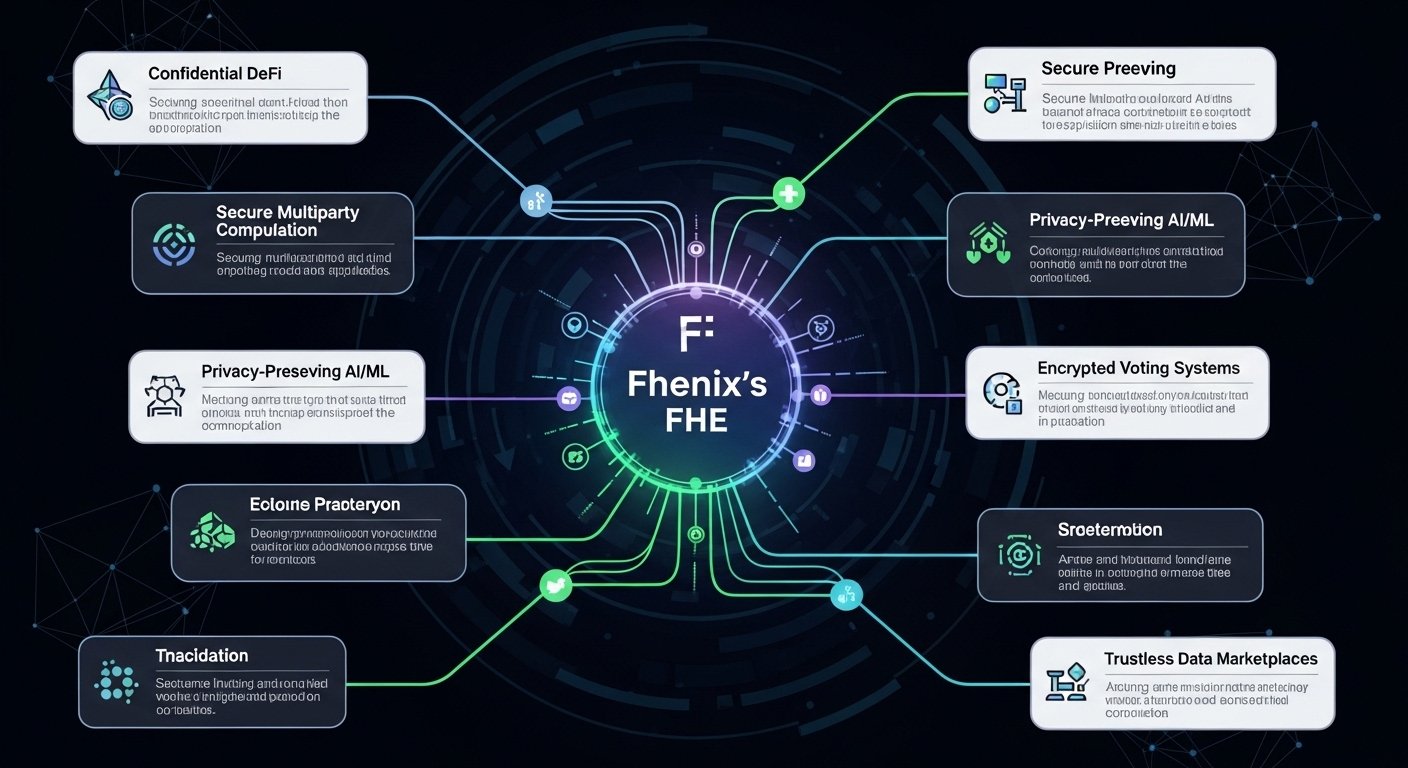
With Fhenix FHE, DeFi protocols can support private balances, encrypted trades, and confidential lending logic. This not only improves user privacy but also enhances market efficiency by reducing information asymmetry.
Private DAO Governance
DAO voting is another area where privacy is critical. Public votes can lead to coercion, bribery, or strategic manipulation. Exact FHE allows DAO proposals to be voted on using encrypted ballots, ensuring that outcomes are verifiable while individual votes remain private.This creates more resilient and democratic governance structures without compromising transparency at the protocol level.
Enterprise and Institutional Use Cases
Enterprises require confidentiality for regulatory compliance and competitive reasons. With exact fully homomorphic encryption, businesses can deploy blockchain solutions that meet strict data protection standards while still benefiting from decentralization.Use cases include private supply chain analytics, confidential asset management, and encrypted on-chain reporting.
Fhenix’s Role in the Web3 Privacy Stack
Complementing Zero-Knowledge Proofs
Zero-knowledge proofs and FHE are often seen as competing technologies, but in reality, they are complementary. ZK proofs are excellent for proving statements without revealing data, while FHE excels at computing on encrypted data.Fhenix’s decomposable BFV integrates seamlessly into the broader Web3 privacy stack, enabling developers to choose the right cryptographic tool for each use case.
Developer Experience and Adoption
For privacy technology to succeed, it must be accessible. Fhenix focuses heavily on developer tooling, abstractions, and SDKs that hide cryptographic complexity. By making FHE on blockchain approachable, Fhenix lowers the barrier to entry and accelerates ecosystem adoption.
Security, Scalability, and Trust
Cryptographic Soundness
BFV is a well-studied and peer-reviewed encryption scheme grounded in lattice-based cryptography. Its security assumptions are considered post-quantum resistant, adding long-term resilience to blockchain applications built on Fhenix.
Scalability Considerations
Decomposability plays a crucial role in scalability. By optimizing how encrypted computations are executed, Fhenix reduces resource strain on nodes and improves throughput. While FHE is still more expensive than plaintext computation, the performance gap is narrowing rapidly.
Maintaining Decentralization
Perhaps most importantly, Fhenix’s approach preserves decentralization. There are no trusted parties, no special hardware requirements, and no centralized coordinators. Privacy is enforced purely through cryptography.
Challenges and Future Outlook
Remaining Technical Hurdles
While decomposable BFV is a major leap forward, FHE is still computationally intensive. Continued optimization, hardware acceleration, and protocol-level innovations will be necessary to achieve mass adoption.
Ecosystem Growth and Standards
As more developers experiment with exact FHE for blockchain, standards and best practices will emerge. Interoperability between privacy-focused chains and mainstream ecosystems will be key to long-term success.
Long-Term Impact on Web3
Fhenix’s work signals a shift in how privacy is approached in decentralized systems. Instead of bolting on privacy features, FHE makes confidentiality a first-class property of computation itself. This could redefine the design space for future blockchains.
Conclusion
Fhenix’s decomposable BFV represents a turning point for blockchain privacy. By making exact fully homomorphic encryption practical, scalable, and developer-friendly, Fhenix bridges the gap between cryptographic theory and real-world decentralized applications. This innovation unlocks confidential smart contracts, private DeFi, secure DAO governance, and enterprise-grade Web3 solutions without sacrificing decentralization or trustlessness.As blockchain technology continues to mature, privacy will no longer be a luxury or an afterthought. With Fhenix leading the way, encrypted computation may soon become the standard rather than the exception.
FAQs
Q: What makes Fhenix’s decomposable BFV different from traditional FHE?
Fhenix’s decomposable BFV breaks encrypted computations into smaller components, significantly improving performance and making exact FHE viable for blockchain environments.
Q: Why is exact fully homomorphic encryption important for blockchain?
Exact FHE ensures precise, deterministic results, which are essential for financial transactions, smart contracts, and governance mechanisms on-chain.
Q: Can Fhenix’s FHE replace zero-knowledge proofs?
No. FHE and zero-knowledge proofs serve different purposes and are complementary technologies within the broader Web3 privacy stack.
Q: Is BFV encryption secure against quantum attacks?
BFV is based on lattice cryptography, which is widely considered resistant to known quantum attacks, making it suitable for long-term blockchain security.
Q: When will developers be able to build on Fhenix’s FHE infrastructure?
Fhenix is actively developing tooling and infrastructure, with a strong focus on making FHE accessible for developers as the ecosystem expands.