









































The cryptocurrency market once again demonstrated its unforgiving nature after a prominent Hyperliquid whale experienced a partial liquidation on a massive $42 million Bitcoin long position. The event unfolded during a sharp Bitcoin pullback, reminding traders that even seasoned market participants are not immune to the risks of leveraged exposure. In a market defined by rapid price swings and intense speculation, a single move against the trend can cascade into forced liquidations worth millions.
The incident has reignited discussions around crypto leverage trading, risk management strategies, and the structural dynamics of decentralized perpetual exchanges like Hyperliquid. As Bitcoin’s price retraced from recent highs, margin Hyperliquid Whale’s $42M Bitcoin requirements tightened, and liquidation engines kicked in—automatically closing portions of overexposed positions to prevent insolvency.
This article explores the mechanics behind the $42M Bitcoin long position, the broader implications for traders and investors, and what the event reveals about market structure, whale behavior, and the evolving landscape of decentralized derivatives trading.
Understanding the Hyperliquid Whale’s $42M Bitcoin Long Position
A “whale” in crypto terminology refers to an individual or entity holding substantial capital, capable of influencing market dynamics. In this case, the whale established a $42 million long position on Bitcoin via leveraged perpetual contracts on Hyperliquid. The trade was effectively a high-conviction bet that Bitcoin’s price would continue to rise.
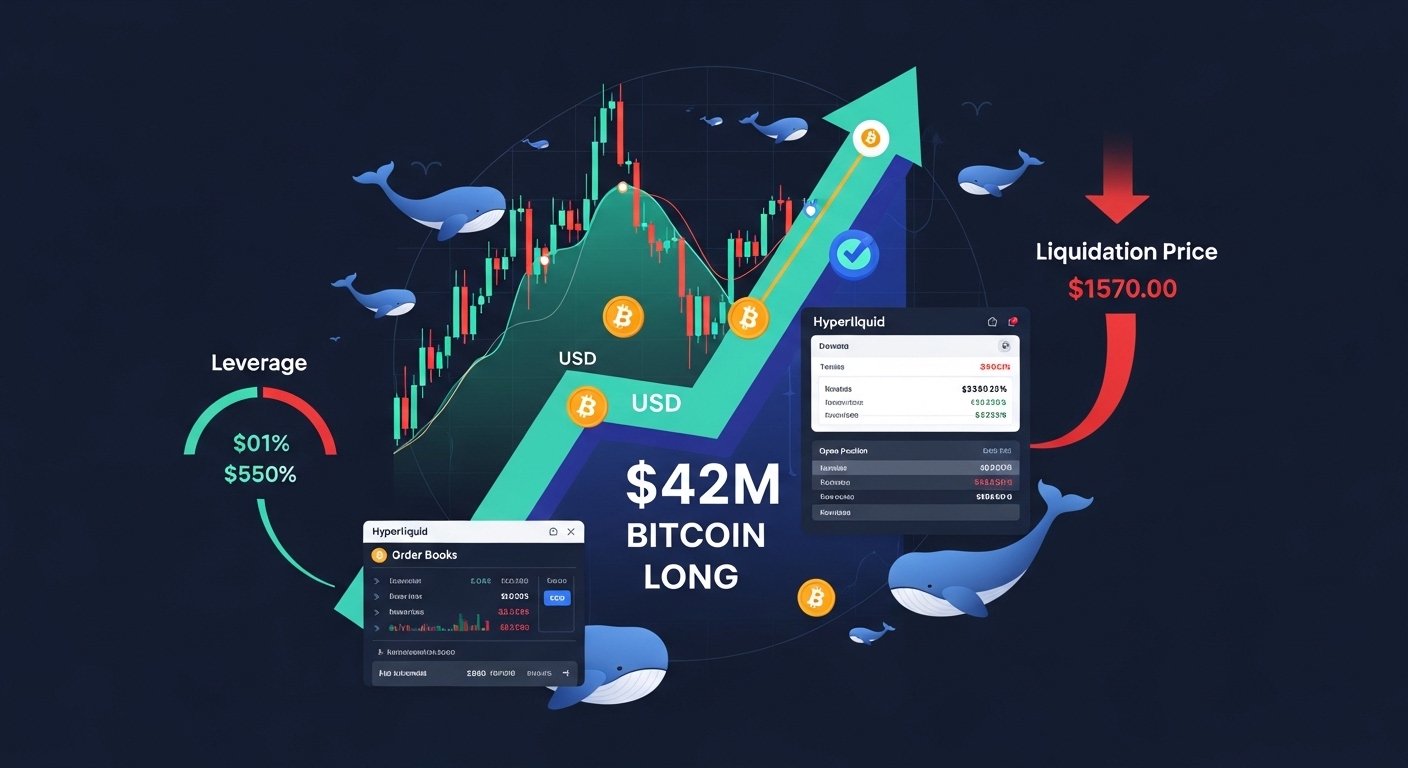
At the time of entry, market sentiment leaned bullish. Bitcoin had demonstrated sustained momentum, liquidity conditions were favorable, and funding rates signaled aggressive long positioning across derivatives platforms. The whale amplified exposure using leverage, meaning only a fraction of the $42 million was posted as collateral.
How Leveraged Long Positions Work
In a leveraged long trade, a trader borrows capital to increase market exposure. If Bitcoin rises, profits are magnified relative to the initial margin. However, if price declines, losses accelerate at the same rate. When unrealized losses approach maintenance margin thresholds, the exchange’s liquidation engine begins closing the position to protect system solvency.The Hyperliquid whale’s $42M Bitcoin long position was vulnerable to even modest retracements. Once Bitcoin began pulling back, unrealized losses accumulated quickly, triggering a partial liquidation.
The Bitcoin Pullback That Triggered Liquidation
The partial liquidation coincided with a broader Bitcoin price correction. After rallying strongly, Bitcoin encountered resistance and profit-taking intensified. Market-wide liquidations surged as overleveraged positions were unwound across centralized and decentralized exchanges.
Price volatility is inherent to the cryptocurrency ecosystem, but leveraged derivatives amplify its consequences. When Bitcoin retraces sharply, liquidation cascades can occur, creating downward pressure that accelerates price declines further.
Market Conditions During the Pullback
Several factors contributed to the pullback:Macroeconomic uncertainty increased risk-off sentiment across financial markets. Traders rotated capital away from high-risk assets. Additionally, elevated funding rates suggested overcrowded long positioning, creating conditions ripe for a squeeze.As Bitcoin dipped, liquidation clusters became active. The Hyperliquid whale’s $42M Bitcoin long position was among those affected, though only partially liquidated rather than fully closed.
The Mechanics of Partial Liquidation on Hyperliquid
Unlike some platforms that liquidate entire positions instantly, Hyperliquid employs a partial liquidation model. This approach incrementally reduces exposure, aiming to stabilize the account without fully closing it.Hyperliquid’s system calculates real-time margin ratios. When collateral falls below maintenance levels, the liquidation engine sells a portion of the position. This reduces leverage and restores margin health.
Why Only Partial Liquidation Occurred
The whale had sufficient collateral to avoid complete liquidation. The system closed a portion of the $42M Bitcoin long position, decreasing effective leverage. Once margin levels stabilized, the remaining position stayed open.Partial liquidation is designed to prevent unnecessary systemic shocks. However, even partial closures can amount to millions in forced selling, adding to short-term volatility.
What This Event Reveals About Crypto Market Structure
The Hyperliquid whale incident underscores the structural characteristics of modern crypto derivatives markets. Leveraged trading has become deeply embedded in Bitcoin’s price discovery process.
The Rise of Decentralized Perpetual Exchanges
Decentralized derivatives platforms like Hyperliquid are gaining traction due to transparency, non-custodial architecture, and on-chain settlement mechanisms. Unlike centralized exchanges, they allow users to maintain greater control over assets.However, the same leverage dynamics apply. Liquidation engines operate automatically, and market volatility remains the primary risk factor.
Whale Activity and Market Influence

Large traders often shape short-term market movements. When whales open or close significant positions, liquidity shifts rapidly. Public visibility of large on-chain positions can also attract copy trading behavior, amplifying risk.The partial liquidation of the $42M Bitcoin long position demonstrates that whales are not invincible. Even well-capitalized participants can misjudge market timing.
The Psychology Behind High-Leverage Bitcoin Trades
The appeal of leverage is straightforward: amplified gains. In bull markets, leveraged longs can generate exponential returns. However, the downside is equally amplified.
Overconfidence in Bullish Momentum
Strong upward trends can create a false sense of security. When Bitcoin rallies consistently, traders may underestimate correction risk. This can lead to oversized positions and insufficient margin buffers.
The Role of Funding Rates and Sentiment
High funding rates often signal overcrowded long trades. When too many traders lean in one direction, markets become vulnerable to reversals. The Hyperliquid whale’s partial liquidation occurred during such an environment, highlighting the dangers of consensus positioning.
Risk Management Lessons from the $42M Bitcoin Long
The incident offers critical insights for retail and institutional traders alike.
Importance of Adequate Collateral
Maintaining a healthy margin buffer is essential. High leverage increases liquidation probability during routine volatility.
Diversification and Position Sizing
Allocating disproportionate capital to a single leveraged trade can magnify losses. Even whales must manage exposure prudently.
Understanding Liquidation Engines
Different platforms employ varying liquidation methodologies. Traders should understand how partial liquidation works and how margin thresholds are calculated before opening large positions.
Broader Impact on Bitcoin and Derivatives Markets
Large liquidations can temporarily impact market structure. Forced selling increases supply in the short term, potentially accelerating price declines.
Liquidation Cascades
When one major position liquidates, price movement can trigger additional liquidations. This feedback loop intensifies volatility. However, after cascades conclude, markets often stabilize as leverage resets.
Resetting Excess Leverage
Liquidations purge speculative excess. After leveraged longs are flushed out, healthier price action can emerge. The Hyperliquid whale’s partial liquidation contributed to this deleveraging process.
Institutional Participation and Whale Strategy
Institutional traders increasingly participate in decentralized derivatives platforms. Sophisticated strategies involve hedging, arbitrage, and structured risk models.
Was the Position Hedged?
It remains unclear whether the whale hedged exposure elsewhere. Professional traders sometimes offset risk using options or spot holdings. If so, the partial liquidation might represent only one component of a broader strategy.
The Future of Hyperliquid and On-Chain Derivatives
As decentralized finance evolves, platforms like Hyperliquid continue refining risk frameworks. Transparent on-chain liquidations provide valuable data for market participants.The $42M Bitcoin long position event demonstrates that decentralized derivatives infrastructure can handle substantial volume without systemic failure. Partial liquidation mechanisms help maintain stability during turbulence.
Conclusion
The partial liquidation of a $42 million Bitcoin long position on Hyperliquid serves as a powerful reminder of the inherent volatility in crypto derivatives markets. Even whales with significant capital can face rapid margin erosion during Bitcoin pullbacks. Leverage magnifies both gains and losses, and risk management remains paramount regardless of account size.
The episode highlights critical lessons about market structure, liquidation mechanics, and trader psychology. As decentralized derivatives platforms mature, transparency and robust risk engines will continue shaping how large positions are managed.Ultimately, the Hyperliquid whale’s experience underscores a timeless truth in financial markets: discipline, prudence, and respect for volatility are indispensable.
FAQs
Q: What is a Hyperliquid whale?
A Hyperliquid whale refers to a trader or entity holding a large position on the decentralized derivatives exchange Hyperliquid, capable of influencing liquidity and market sentiment.
Q: What caused the $42M Bitcoin long position to be partially liquidated?
The partial liquidation occurred after a Bitcoin price pullback reduced the whale’s margin ratio below maintenance levels, triggering the exchange’s liquidation engine.
Q: What is partial liquidation in crypto trading?
Partial liquidation means only a portion of a leveraged position is automatically closed to restore margin requirements, rather than fully liquidating the entire trade.
Q: How does leverage increase liquidation risk?
Leverage amplifies both gains and losses. A small adverse price movement can quickly erode collateral, increasing the probability of forced liquidation.
Q: Can whales avoid liquidation entirely?
Whales can reduce liquidation risk through adequate collateral, lower leverage, and hedging strategies, but no trader is immune to extreme volatility.
Also More: Bitcoin Recovers Above $67,000 After Khamenei News