





































The cryptocurrency mining industry is undergoing a profound transformation. What was once a singular focus on securing decentralized networks and earning block rewards has now evolved into a broader race for computational dominance. In this shifting landscape, one of the most significant strategic pivots comes as MARA expands from Bitcoin mining into AI infrastructure, signaling a new chapter not only for the company but also for the intersection of digital assets and artificial intelligence.
For years, MARA Holdings—formerly known as Marathon Digital—was widely recognized as a heavyweight in industrial-scale Bitcoin mining. The company built its brand around scaling hash rate, optimizing energy efficiency, and leveraging capital markets to expand its mining footprint. But as the economics of mining fluctuate with halving cycles and price volatility, a parallel technological revolution has emerged: artificial intelligence.
The rapid growth of AI models, machine learning workloads, and high-performance computing has created unprecedented demand for data center capacity, GPU clusters, and advanced infrastructure. Recognizing this structural shift, MARA is now strategically repositioning itself to capitalize on the AI boom. The move is not a departure from its core competencies; rather, it is an expansion that leverages its expertise in energy management, large-scale computing, and infrastructure development.
This article explores why MARA’s expansion into AI infrastructure matters, how it aligns with broader industry trends, and what it could mean for the future of Bitcoin mining and high-performance computing.
The Evolution of MARA: From Crypto Mining to Digital Infrastructure
Building a Bitcoin Mining Powerhouse
To understand the significance of this pivot, it’s essential to examine MARA’s trajectory in the Bitcoin ecosystem. The company rose to prominence by aggressively scaling its mining operations during bullish market cycles, acquiring thousands of ASIC miners and expanding across multiple hosting facilities.
As one of the largest publicly traded Bitcoin miners in the United States, MARA became synonymous with institutional-grade mining operations. Its strategy centered on accumulating Bitcoin, expanding its hash rate, and optimizing energy efficiency. During periods of strong performance for Bitcoin, MARA benefited from increased mining rewards and market enthusiasm.
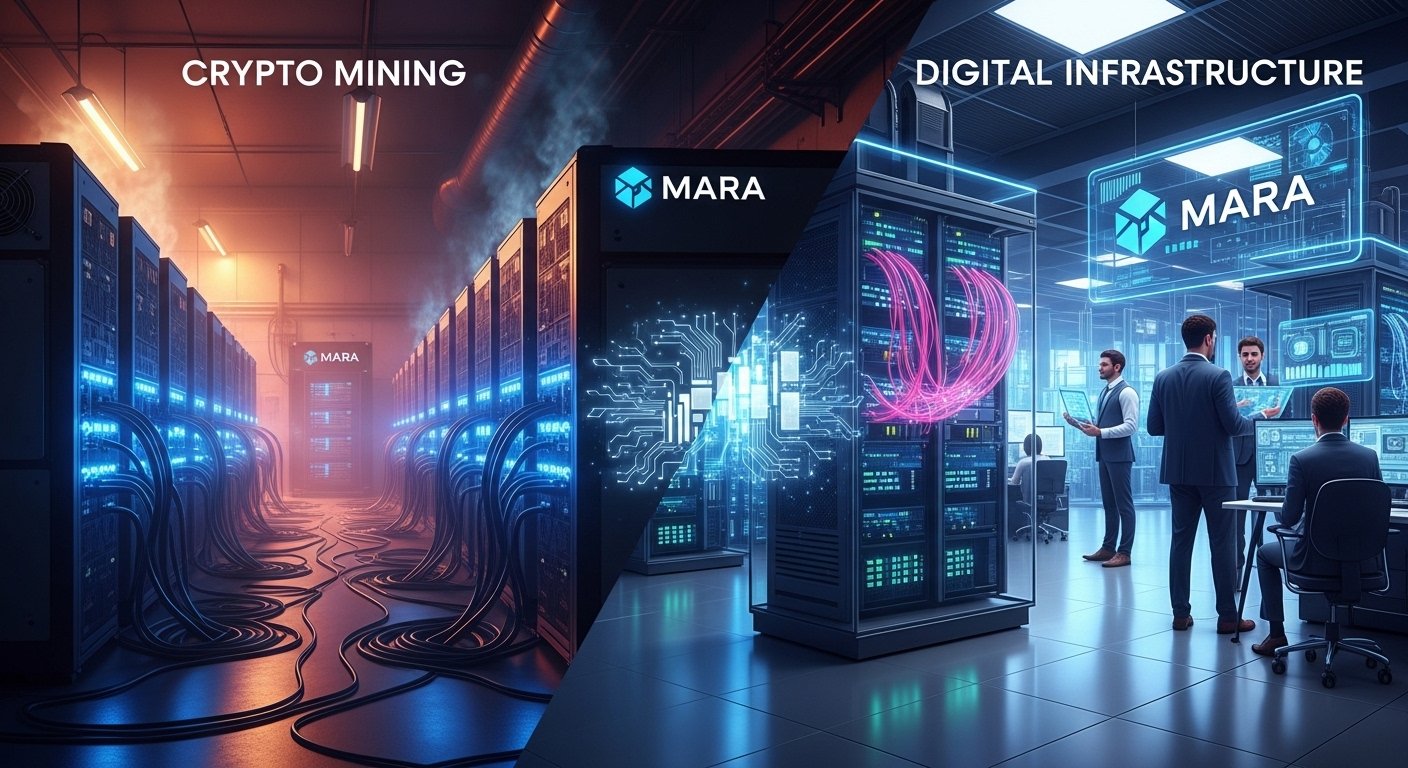
However, the economics of mining are inherently cyclical. The Bitcoin halving, which reduces block rewards roughly every four years, compresses miner margins and intensifies competition. At the same time, rising energy costs and regulatory scrutiny have increased operational complexity.
Recognizing Structural Shifts in Computing Demand
While Bitcoin mining remains capital-intensive and cyclical, AI infrastructure represents a structural growth story. The explosive rise of generative AI, large language models, and enterprise AI adoption has driven demand for advanced computing capacity.
The AI boom—accelerated by companies like NVIDIA—has exposed a global shortage of high-performance data centers capable of supporting GPU-intensive workloads. Unlike ASIC-based Bitcoin mining, AI infrastructure relies on flexible, scalable GPU systems designed for training and inference tasks.
MARA’s management recognized that the core competencies required for Bitcoin mining—such as power procurement, site development, and large-scale compute management—are transferable to AI infrastructure. The strategic expansion therefore represents a logical extension of its existing capabilities.
Why MARA Expands From Bitcoin Mining Into AI Infrastructure
Diversifying Revenue Streams
One of the primary motivations behind MARA’s expansion into AI infrastructure is revenue diversification. Bitcoin mining revenues fluctuate with both network difficulty and price volatility. By entering the AI infrastructure market, MARA can tap into a more stable and potentially higher-margin revenue stream.
AI infrastructure clients typically sign longer-term contracts, creating predictable cash flows. In contrast, mining revenues depend heavily on block rewards and transaction fees. By combining both business lines, MARA reduces reliance on a single volatile asset.This diversification could enhance shareholder value by stabilizing earnings and mitigating the risks associated with the crypto market cycle.
Leveraging Existing Energy Expertise
Energy management is central to both Bitcoin mining and AI data centers. MARA has already developed significant expertise in negotiating power purchase agreements, optimizing load balancing, and deploying infrastructure in energy-rich regions.
As AI data centers demand enormous amounts of electricity—sometimes rivaling small cities—the ability to secure reliable and cost-effective power becomes a competitive advantage. MARA’s experience in this domain provides a foundation for scaling AI operations efficiently.
Capitalizing on the AI Compute Boom
The AI sector is experiencing exponential growth. Enterprises across industries are investing in machine learning models, cloud-based AI services, and custom training infrastructure. The shortage of high-performance computing capacity has led to increased investment in new data centers.
By expanding into AI infrastructure, MARA positions itself at the center of this growth narrative. Instead of being solely tied to the price of Bitcoin, the company can participate in the broader digital transformation of global industries.
The Technical Overlap Between Bitcoin Mining and AI Infrastructure
Similarities in Data Center Architecture
At first glance, Bitcoin mining and AI workloads appear fundamentally different. Mining relies on ASIC hardware optimized for cryptographic hashing, while AI depends on GPUs designed for parallel computation. However, both require robust data center infrastructure.
Cooling systems, electrical distribution networks, and large-scale server management are critical components in both sectors. MARA’s operational experience in maintaining mining farms translates well into the AI context.
Additionally, both industries benefit from economies of scale. Larger facilities reduce per-unit costs and improve operational efficiency. MARA’s history of scaling mining capacity equips it with the institutional knowledge necessary to manage expansive AI clusters.
Differences That Require Strategic Adaptation
Despite overlaps, transitioning from ASIC mining to GPU-based AI computing is not trivial. AI workloads demand low-latency networking, high-speed interconnects, and sophisticated orchestration software.
Whereas Bitcoin mining focuses on maximizing hash rate per watt, AI infrastructure emphasizes computational throughput, training speed, and data transfer efficiency. MARA must therefore invest in new technical expertise and partnerships to compete effectively in this arena.
Market Implications of MARA’s Expansion
Impact on the Bitcoin Mining Industry
When MARA expands from Bitcoin mining into AI infrastructure, it sends a signal to the broader mining sector. As margins tighten post-halving, other miners may explore similar diversification strategies.This could reshape the identity of crypto miners from pure-play blockchain security providers to hybrid digital infrastructure companies. Over time, the distinction between mining farms and AI data centers may blur, especially in regions with abundant renewable energy.
Investor Sentiment and Valuation
Public markets often reward companies that align with high-growth themes. AI infrastructure currently commands strong investor enthusiasm, while Bitcoin mining remains subject to market skepticism due to volatility.
By entering the AI space, MARA potentially broadens its investor base. Growth-oriented investors interested in artificial intelligence may now consider MARA as part of their portfolio strategy.However, execution risk remains significant. Successfully transitioning into AI infrastructure requires capital investment, operational expertise, and competitive differentiation.
Strategic Partnerships and Competitive Landscape
Competing With Established Data Center Operators
MARA’s expansion places it in competition with established hyperscale data center providers and cloud giants. Companies such as Amazon Web Services and Microsoft Azure dominate the AI cloud market.
Unlike these cloud titans, MARA’s approach may focus on specialized infrastructure rather than full-service cloud offerings. Its strategy could center on providing dedicated high-performance computing environments optimized for AI developers and enterprises.
Potential for Strategic Collaborations
Partnerships could play a pivotal role in MARA’s success. Collaborating with hardware manufacturers, AI startups, or energy providers may accelerate its entry into the market.The company’s established presence in energy-rich regions may attract AI firms seeking cost-effective compute solutions. By positioning itself as a flexible infrastructure partner, MARA could carve out a distinct niche.
Risk Factors and Operational Challenges
Capital Expenditure Requirements
Expanding into AI infrastructure demands substantial capital investment. GPU clusters, networking equipment, and advanced cooling systems are expensive. Unlike ASIC miners, which can be purchased in bulk from specialized manufacturers, AI hardware often faces supply constraints.Securing next-generation GPUs requires strategic planning and potentially long lead times. Misjudging demand or overspending could strain MARA’s balance sheet.
Regulatory and Environmental Considerations
Data centers face increasing scrutiny regarding environmental impact and energy consumption. Governments worldwide are implementing regulations related to carbon emissions and grid stability.MARA’s ability to leverage renewable energy sources and implement sustainable practices will be critical. Investors and regulators alike are paying closer attention to the environmental footprint of digital infrastructure.
The Broader Convergence of Crypto and AI
Infrastructure as the New Battleground
The digital economy increasingly revolves around computational infrastructure. Whether securing blockchain networks or training AI models, the underlying asset is compute power.
As MARA expands from Bitcoin mining into AI infrastructure, it reflects a broader convergence between decentralized finance and artificial intelligence. Both sectors depend on scalable, energy-intensive computing systems.This convergence may accelerate innovation in areas such as decentralized AI, where blockchain-based networks coordinate distributed machine learning tasks.
Long-Term Strategic Vision
If executed effectively, MARA’s expansion could transform it from a cyclical crypto miner into a diversified digital infrastructure company. This strategic evolution aligns with global trends emphasizing data, computation, and technological sovereignty.Rather than abandoning Bitcoin mining, MARA appears to be building a complementary business line. The company may continue accumulating Bitcoin while simultaneously monetizing AI workloads.
Conclusion
The decision as MARA expands from Bitcoin mining into AI infrastructure marks a pivotal moment in the company’s evolution. By leveraging its expertise in energy procurement, large-scale data centers, and compute optimization, MARA is positioning itself at the crossroads of two transformative industries.
This strategic pivot offers diversification, growth potential, and alignment with long-term technological trends. However, success is far from guaranteed. The AI infrastructure market is competitive, capital-intensive, and technically demanding.
For investors and industry observers, MARA’s expansion serves as a case study in adaptation. In a world where computational power underpins both blockchain security and artificial intelligence, companies that control infrastructure may hold the keys to the digital future.
FAQs
Q: Why is MARA expanding into AI infrastructure?
MARA is diversifying its revenue streams and leveraging its expertise in energy management and large-scale data centers to capitalize on the rapidly growing AI compute market.
Q: Does this mean MARA is leaving Bitcoin mining?
No. MARA continues its Bitcoin mining operations while expanding into AI infrastructure as a complementary business line.
Q: How does AI infrastructure differ from Bitcoin mining?
Bitcoin mining relies on ASIC hardware optimized for cryptographic hashing, while AI infrastructure uses GPUs for high-performance computing tasks such as machine learning model training.
Q: What risks does MARA face in this expansion?
Risks include high capital expenditure, intense competition, hardware supply constraints, and regulatory scrutiny related to energy consumption.
Q: Could other Bitcoin miners follow MARA’s strategy?
Yes. As mining margins fluctuate, other crypto miners may explore diversification into AI infrastructure to stabilize revenues and participate in the broader compute economy.