








































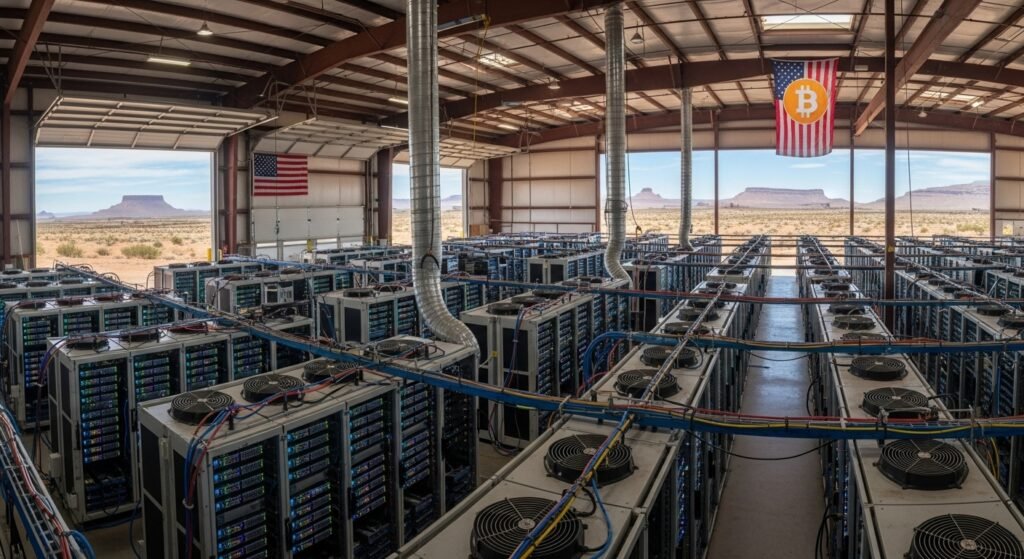
For many years, the idea of mining Bitcoin revolved around technology, computation, financial incentives, and the decentralized dream of digital money. Bitcoin’s mining ecosystem grew from small home computers into a vast global network of high-powered machines securing the blockchain. What was once a nerd-driven hobby has transformed into an industry with the power to influence energy policy, infrastructure development, and even international relations.
In recent years, the industry’s expansion inside the United States has collided with growing geopolitical tensions between Washington and Beijing. At the center of this collision is Bitmain, the most influential manufacturer of ASIC mining hardware. Bitmain’s devices power a significant portion of the global Bitcoin hashrate, and its machines are deeply embedded in American mining operations. Yet, this dominance has attracted scrutiny. Reports indicate that U.S. officials are increasingly concerned that Bitmain-made equipment could pose espionage risks, prompting federal investigations and calls for national security reviews.
As the United States examines whether mining Bitcoin with foreign-manufactured hardware could expose vulnerabilities, the debate has broadened from technical performance to national security, data protection, and the future sovereignty of digital infrastructure. This article explores why Bitmain is under suspicion, what risks are being evaluated, and how the landscape of Bitcoin mining may shift as governments begin to treat mining equipment as a strategic asset rather than a commodity.
The Evolution of Mining Bitcoin in the United States
Mining Bitcoin has undergone a profound transformation. In Bitcoin’s early days, anyone with a home computer could participate. The competition was minimal, and rewards were high. As the network’s security improved and difficulty increased, miners adopted GPUs, then FPGAs, and finally ASIC miners, which are specialized chips designed exclusively to compute Bitcoin’s cryptographic hashes.
As industrial-scale operations emerged, the United States became a thriving hotspot for mining Bitcoin. Cheap energy in states such as Texas, Wyoming, Kentucky, and Georgia attracted domestic and foreign operators. Large warehouses filled with thousands of machines appeared almost overnight, consuming enormous amounts of power and establishing themselves as digital power plants. These facilities did more than chase profits; they linked the act of mining Bitcoin to local economies, global capital flow, and even national strategic resources.
Such rapid growth created new considerations. Mining farms often connect to critical infrastructure, operate near energy grids and require robust network systems. As the number of foreign-owned facilities increased, so did the scrutiny from policymakers who saw mining not just as a financial activity but as a potential vector for foreign influence or surveillance.
Bitmain’s Dominance in the Bitcoin Mining Hardware Market
Bitmain rose to prominence by producing some of the world’s most advanced and efficient ASIC miners, particularly its Antminer series. These machines are essential for miners attempting to stay profitable in a highly competitive environment. Their reliability, performance, and energy efficiency made them the preferred choice for industrial-scale mining Bitcoin operations.
In the United States, many large mining companies rely heavily on Bitmain hardware. This reliance is not unusual, as few manufacturers can match Bitmain’s output, engine, ring, and pricing. However, this level of dependence introduces a strategic question: What happens when a majority of America’s Bitcoin mining infrastructure depends on machines designed and manufactured in a geopolitical rival’s sphere of influence?
Bitmain has attempted to expand its footprint within U.S. borders by establishing assembly and repair facilities, forming partnerships with American companies, and striking financing agreements. These moves strengthened Bitmain’s commercial ties within the U.S. mining ecosystem. Yet, they also deepened concerns among policymakers who increasingly view critical infrastructure through the lens of national security.
Why the United States Suspects Bitmain of Espionage
The suspicion surrounding Bitmain did not arise suddenly. It emerged gradually through a combination of geopolitical tensions, supply-chain concerns, and the structural vulnerabilities inherent in globalized technology industries.
U.S. officials reportedly initiated investigations into whether Bitmain’s hardware could be exploited for espionage. The concern centers on the fact that mining Bitcoin requires thousands of network-connected devices operating continuously. If these devices were compromised at the firmware or hardware level, they could, in theory, be used to collect data, infiltratnetworksne, or disrupt operations.
Such worries mirror broader concerns the U.S. has with Chinese-made telecom equipment, semiconductors, and critical networking infrastructure. The fear is not necessarily rooted in proven wrongdoing but in the potential for foreign influence embedded deep within the supply chain. When Bitcoin mining farms sit near sensitive military facilities, power grids, or data infrastructure, the stakes become far higher.
The National Security Investigation
The U.S. has reportedly opened a national security probe to determine whether Bitmain’s ASIC miners contain hidden functionality that could facilitate remote access or control. While Bitmain has strongly denied these allegations, the investigation reflects a shifting paradigm: mining Bitcoin is no longer viewed as merely a business activity, but as a potential vulnerability point in a larger digital and energy infrastructure ecosystem.
Lawmakers have requested that agencies such as the Treasury Department and the Committee on Foreign Investment in the United States examine Bitmain’s operations, ownership structur,e and partnershipsThey argueis that foreign companies controlling large portions of America’s computational power—especially machines with the ability to communicate and update remotely—deserve the same scrutiny as companies that build telecom towers, broadband networks, or energy systems.
This inquiry is part of a wider trend across the U.S. government to minimize reliance on foreign technologies that could create backdoors or dependencies.
How Bitcoin Mining Hardware Could Enable Espionage
It is important to clarify that no public evidence has proven that Bitmain’s machines are being used for spying. Yet, the concern is based on potential capability rather than confirmed action. Mining Bitcoin involves hardware that runs firmware, communicates across a network, and often allows remote updates. If compromised, these machines could theoretically serve as entry points into larger systems.
A mining facility’s network infrastructure might be probed for vulnerabilities by compromised devices. Unauthorized commands could disrupt mining operations, destabilize local energy demand or, manipulate hashrate distribution. Even though an ASIC miner is specialized and not designed for general data processing, any internet-connected device can be repurposed for malicious use if improperly secured.
Another concern is the physical location of certain mining farms. Some facilities owned or heavily supplied by foreign companies operate near military bases, energy distribution centers, and data hubs. Even if the miners themselves are not collecting sensitive data, their presence in strategically sensitive areas heightens suspicion.
Bitmain’s Response to Allegations
Bitmain has consistently dismissed all espionage accusations as unfounded and politically motivated. The company asserts that its devices do not contain remote shutdown capabilities or hidden communication channels beyond standard mining protocols. According to Bitmain, the fears surrounding mining Bitcoin with its hardware stem from geopolitical tensions rather than genuine technical threats.
The company argues that it operates transparently, complies with local laws wherever it does business and has every incentive to maintain trust with its enormous global customer base. Any compromise in security would be disastrous for its business. From Bitmain’s perspective, the scrutiny reflects a broader trend in which Chinese companies are increasingly viewed with suspicion, regardless of evidence.
The Difficulty of Verifying Hardware Integrity
One of the core challenges in this situation is the difficulty of verifying the integrity of foreign-manufactured hardware. Experts agree that ensuring a device is free from hidden backdoors is extraordinarily complex, especially when dealing with specialized chips, proprietary firmware, and intricate supply chains.
Even with rigorous testing, it is nearly impossible to demonstrate conclusively that no hidden vulnerabilities exist. This uncertainty fuels the national security argument, as policymakers prefer caution where critical infrastructure is concerned. Mining Bitcoin, once seen as a fringe activity, has now been folded into discussions about cybersecurity, digital sovereignty, and technological self-reliance.
See More: Bitcoin Mining Stocks Track Broader Market Moves But With a Twist
The Future of Mining Bitcoin in the United States
The outcome of ongoing investigations may influence how mining Bitcoin evolves in the U.S. If policymakers strengthen restrictions on foreign-made mining hardware, American mining companies may face higher costs, fewer options, and supply-chain disruptions. Without affordable ASIC alternatives, the economics of mining could shift, forcing companies to delay expansions or reduce capacity.
Some industry observers predict a push toward developing U.S.-based ASIC manufacturing. While this would reduce reliance on foreign equipment, it would require enormous investment and years of research and development. Chip fabrication is one of the most complex industries in the world, and catching up to Bitmain’s efficiency and design expertise would not be easy.
Another consequence may be stricter regulations regarding where mining farms can be located. Authorities might impose limits on mining operations near military installations, critical powerfacilitiess, or major data centers. As mining Bitcoin becomes a higher-profile activity, companies will need to navigate not only economic pressures but also geopolitical ones.
What Miners and Investors Should Consider
For small-scale miners, the geopolitical debate may feel distant. Home miners using one or two devices likely face minimal risk, provided they follow standard cybersecurity practices. Still, the broader environment affects everyone who participates in mining Bitcoin, because hardware availability and regulatory changes can influence market dynamics, eelectricity demanda,nd network distribution.
For large mining companies, the stakes are far higher. These companies must think beyond simple profitability. Their decisions concerning hardware suppliers, facilities, and network architectures now carry strategic risk. Reliance on foreign hardware could complicate financing, insurance, compliance, or partnerships with energy providers.
Investors in publicly traded mining companies should also pay attention to these developments. Any regulatory crackdown or supply-chain disruption could affect a miner’s operational capacity, production forecasts, or valuation. The sensitivity of mining Bitcoin to political pressure means the industry no longer operates in a vacuum.
Conclusion
The rise of Bitcoin transformed the meaning of money, mining ,and digital infrastructure. What began as a decentralized experiment has evolved into a global battleground of innovation, economics, and geopolitics. Today, the act of mining Bitcoin sits at the crossroads of national security and technological sovereignty.
The scrutiny directed at Bitmain reflects this new reality. Although no evidence has proven espionage, the possibility alone is enough for policymakers to question whether the United States should rely on foreign-manufactured hardware for a rapidly growing digital infrastructure. Bitmain sees itself as a commercial innovator caught in geopolitical crossfire, while U.S. officials argue that caution is warranted in a world defined by technological rivalry.
As investigations continue, the future of mining Bitcoin in the U.S. may shift toward stricter oversight, diversifiedsupply chainss and possibly domestic hardware innovation. The one certainty is that Bitcoin mining will no longer be viewed solely through the lens of profitability or technology. It has become a strategic industry shaped by global competition, infrastructure security, and the political realities of the twenty-first century.