






































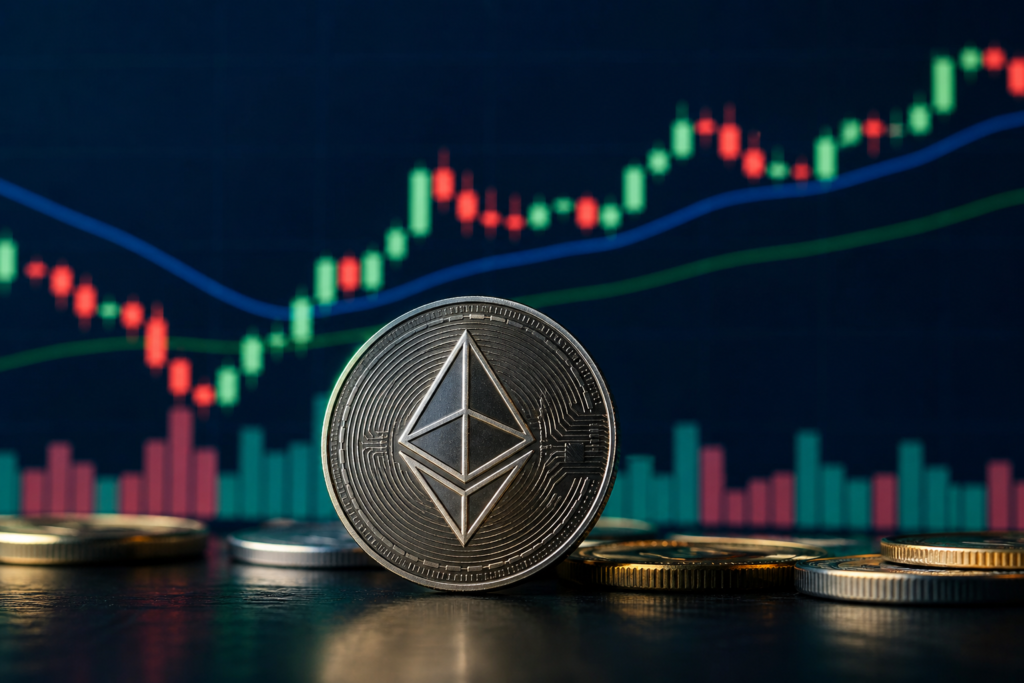
The cryptocurrency market is once again at a fascinating crossroads, and Ethereum moves up but still weak momentum has become one of the most talked-about narratives among traders and investors. While Ethereum (ETH), the second-largest cryptocurrency by market capitalization, has managed to edge higher in recent sessions, the broader sentiment surrounding its price action remains cautious. This delicate balance between upward movement and sluggish momentum reflects deeper structural dynamics within the crypto market.
Over the past few weeks, Ethereum has shown signs of recovery, with incremental gains hinting at renewed investor interest. However, unlike strong bullish rallies seen in previous cycles, the current movement lacks conviction. The price appears to be climbing, but without the strong volume, institutional backing, or macroeconomic tailwinds needed to sustain a robust breakout. This scenario has left many market participants wondering whether this is the beginning of a gradual uptrend or simply a temporary relief rally.
In this article, we’ll explore why Ethereum moves up but still weak momentum, analyzing the technical indicators, market sentiment, macroeconomic factors, and on-chain data that are shaping ETH’s current trajectory. We’ll also look into potential future scenarios and what investors should keep an eye on as the market evolves.
Understanding Ethereum’s Recent Price Movement
Ethereum’s recent upward movement has been subtle but noticeable. Prices have inched higher, forming a pattern of higher lows, which typically indicates a gradual accumulation phase. However, this rise has not been accompanied by a significant increase in trading volume, which is a key factor in confirming strong bullish momentum.
The phrase Ethereum moves up but still weak momentum captures this contradiction perfectly. While price charts may show green candles, the lack of follow-through suggests hesitation among investors. This hesitation often arises when market participants are uncertain about broader economic conditions or when there is insufficient fundamental support to justify higher valuations.
Additionally, Ethereum’s price action has been heavily influenced by Bitcoin’s performance. As the leading cryptocurrency, Bitcoin often sets the tone for the entire market. When Bitcoin consolidates or shows mixed signals, Ethereum tends to mirror that behavior, albeit with slightly higher volatility.
Technical Analysis: Signs of Weak Momentum
Resistance Levels Limiting Growth
One of the most critical aspects of Ethereum’s current price action is its struggle to break through key resistance levels. Each attempt to push higher has been met with selling pressure, preventing a sustained breakout. This indicates that while buyers are present, sellers are equally active, creating a stalemate.
The inability to decisively break resistance reinforces the idea that Ethereum moves up but still weak momentum. Without a strong catalyst, these resistance zones are likely to continue acting as barriers to upward movement.
Low Trading Volume
Trading volume is often considered the lifeblood of any market trend. In Ethereum’s case, the recent price increase has not been supported by a corresponding rise in volume. This suggests that the upward movement may be driven by short-term traders rather than long-term investors.
Low volume rallies are generally less reliable, as they can quickly reverse when selling pressure increases. This is another reason why analysts remain cautious despite Ethereum’s upward trajectory.
Indicators Reflecting Market Hesitation
Technical indicators such as the Relative Strength Index (RSI) and Moving Averages also highlight the lack of strong momentum. The RSI has been hovering in a neutral zone, indicating neither overbought nor oversold conditions. Meanwhile, moving averages are converging, suggesting a lack of clear direction.
These signals collectively support the narrative that Ethereum moves up but still weak momentum, making it crucial for traders to remain vigilant.
Market Sentiment and Investor Behavior
Cautious Optimism Among Investors
Investor sentiment plays a significant role in determining market direction. Currently, the sen timent surrounding Ethereum can best be described as cautiously optimistic. While there is hope for a continued recovery, many investors are hesitant to commit large amounts of capital.
This cautious approach is reflected in the gradual nature of Ethereum’s price increase. Instead of sharp rallies, the market is experiencing slow and steady gains, which align with the idea that Ethereum moves up but still weak momentum.
Impact of Institutional Investors
Institutional involvement has been a major driver of cryptocurrency markets in recent years. However, the current lack of strong institutional inflows into Ethereum is another factor contributing to weak momentum.
Large investors typically provide the liquidity and confidence needed for sustained price movements. Without their participation, the market relies more on retail investors, who tend to be more reactive and less consistent in their trading behavior.
On-Chain Data Insights
Network Activity Trends
On-chain data provides valuable insights into the health of the Ethereum network. Metrics such as active addresses, transaction volume, and gas fees can help determine whether the network is experiencing genuine growth.
Recent data suggests moderate activity levels, but not enough to signal a strong bullish trend. This aligns with the broader narrative that Ethereum moves up but still weak momentum, as network growth has not accelerated significantly.
Staking and Supply Dynamics
Ethereum’s transition to a proof-of-stake model has introduced new dynamics into its ecosystem. Staking has reduced the circulating supply of ETH, which can theoretically support higher prices. However, this effect has been gradual and has not yet resulted in a strong upward surge.
While staking continues to provide long-term benefits, its short-term impact on price momentum remains limited.
Macroeconomic Factors Influencing Ethereum
Global Economic Uncertainty
Macroeconomic conditions play a crucial role in shaping cryptocurrency markets. Factors such as inflation, interest rates, and geopolitical tensions can influence investor behavior.
In the current environment, uncertainty remains high. Central banks around the world are maintaining cautious monetary policies, which has led to reduced risk appetite among investors. This has directly impacted cryptocurrencies, including Ethereum.
As a result, even though Ethereum moves up but still weak momentum, the broader economic backdrop continues to limit its potential for strong gains.
Correlation with Traditional Markets
Ethereum has shown increasing correlation with traditional financial markets, particularly tech stocks. When equity markets experience volatility, cryptocurrencies often follow suit.
This correlation means that Ethereum’s price movement is not solely determined by crypto-specific factors. Instead, it is influenced by a wide range of external variables, further contributing to its weak momentum.
Future Outlook: What Lies Ahead for Ethereum
Potential Bullish Scenarios
Despite the current challenges, there are several factors that could drive Ethereum higher in the future. Increased adoption of decentralized finance (DeFi), growth in non-fungible tokens (NFTs), and continued development of the Ethereum ecosystem could all act as catalysts.
If these factors align with favorable macroeconomic conditions, the narrative could shift from Ethereum moves up but still weak momentum to a more robust bullish trend.
Risks and Downside Factors
On the other hand, there are also risks that could hinder Ethereum’s progress. Regulatory uncertainty, competition from other blockchain platforms, and potential technical issues could all impact its growth.
Additionally, if the broader crypto market enters a bearish phase, Ethereum is likely to follow suit, regardless of its individual strengths.
The Role of Ecosystem Growth
Ethereum’s long-term value is closely tied to the growth of its ecosystem. Projects built on Ethereum, ranging from DeFi platforms to gaming applications, play a crucial role in driving demand for ETH.
While the ecosystem continues to expand, the pace of growth has slowed compared to previous years. This slowdown is another reason why Ethereum moves up but still weak momentum, as strong ecosystem growth often translates into stronger price performance.
Conclusion
The current state of Ethereum can be summarized by a single phrase: Ethereum moves up but still weak momentum. While the cryptocurrency has shown resilience and managed to climb higher, the lack of strong supporting factors has prevented a decisive breakout.
Technical indicators, market sentiment, on-chain data, and macroeconomic conditions all point to a market that is in a transitional phase. Investors are watching closely, waiting for clearer signals before making significant moves.
For now, Ethereum remains in a delicate balance. Its upward movement is encouraging, but without stronger momentum, the risk of consolidation or even a pullback remains. As the market continues to evolve, staying informed and adaptable will be key for anyone looking to navigate the complexities of the crypto landscape.
FAQs
Q. Why does Ethereum move up but still show weak momentum?
Ethereum is rising due to gradual buying, but the lack of strong trading volume and institutional support results in weak momentum.
Q. Is Ethereum likely to break resistance soon?
It depends on market conditions. Without increased volume and positive sentiment, breaking resistance levels may remain challenging.
Q. How do macroeconomic factors affect Ethereum?
Interest rates, inflation, and global economic trends influence investor behavior, which in turn impacts Ethereum’s price movement.
Q. What role does staking play in Ethereum’s price?
Staking reduces circulating supply, which can support price growth over time, but its short-term impact on momentum is limited.
Q. Should investors be concerned about weak momentum?
Weak momentum is not necessarily negative, but it indicates caution. Investors should monitor key indicators before making decisions.