







































The global payments industry is undergoing one of the most significant transformations in its history, driven by the rapid adoption of blockchain technology and digital assets. In this evolving landscape, the announcement that Western Union is bringing USDPT to Solana represents a major milestone in the convergence of traditional finance and decentralized infrastructure.
This strategic move is not just another experiment in digital finance; it signals a broader shift in how money moves across borders. The introduction of USDPT, a digital dollar token, on Solana’s high-speed blockchain network is designed to enhance cross-border payments, reduce transaction costs, and improve settlement efficiency for millions of users worldwide.
As global remittance demand continues to grow, Western Union’s integration with Solana positions the company at the center of a new era of blockchain remittances and stablecoin adoption. This article explores what this development means, why it matters, and how it could reshape the future of global money transfers.
Understanding Western Union USDPT Solana Integration
The decision by Western Union to bring USDPT to Solana reflects a deeper strategy aimed at modernizing global financial infrastructure. USDPT is designed as a blockchain-based representation of the U.S. dollar, enabling near-instant settlement across digital networks.
By integrating with Solana, Western Union is leveraging one of the fastest and most scalable blockchain ecosystems available today. Solana is known for its high throughput, low transaction fees, and ability to support real-time financial applications. This makes it an ideal environment for global payments innovation and digital dollar tokenization.
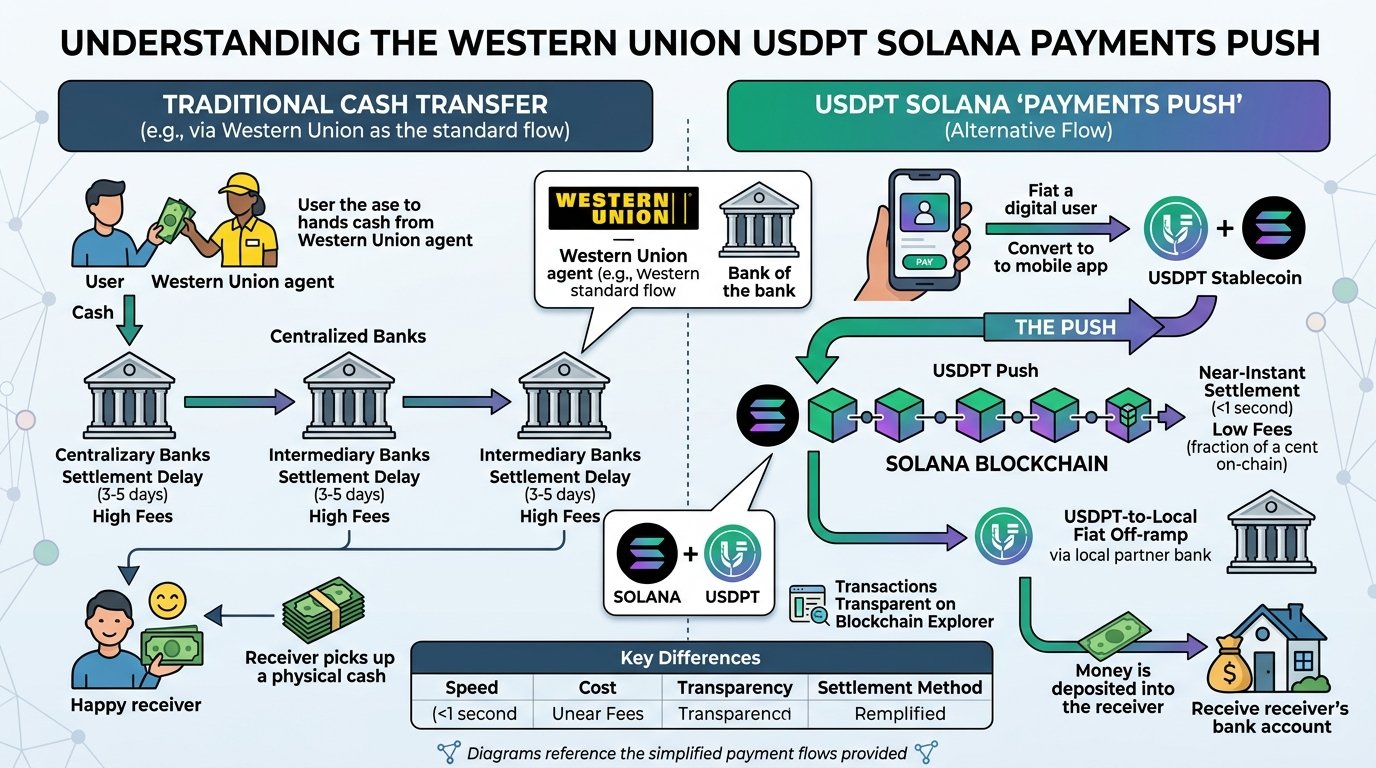
The integration is expected to streamline remittance flows, particularly in regions where traditional banking infrastructure is limited or expensive. Instead of relying solely on correspondent banking systems, transactions can now move through blockchain rails with greater speed and transparency.
This shift also reflects Western Union’s broader goal of bridging the gap between legacy financial systems and the emerging world of decentralized finance (DeFi), where stablecoin infrastructure is becoming a core component of global liquidity movement.
Why Solana Was Chosen for Global Payments
The selection of Solana for USDPT integration is not accidental. Solana’s architecture is built for high-performance financial applications, making it particularly well-suited for real-time settlement systems.
High-Speed Transaction Processing
One of the primary advantages of Solana is its ability to process thousands of transactions per second. This capability is essential for global payment networks like Western Union, where speed and reliability are critical. In the context of cross-border payments, delays of even a few minutes can impact liquidity and user experience.
Low Transaction Costs
Another key factor is cost efficiency. Traditional remittance systems often involve multiple intermediaries, each adding fees to the transaction. Solana’s low-cost structure helps reduce these inefficiencies, making blockchain remittances more affordable for end users, especially in developing economies where remittance fees can be disproportionately high.
Scalability for Global Adoption
Solana’s scalability ensures that it can support large-scale adoption without compromising performance. As Western Union expands USDPT usage across its global network, the blockchain’s ability to maintain consistent performance becomes essential for sustaining trust and operational efficiency.
Together, these factors make Solana a strategic foundation for the next generation of digital payment infrastructure.
What USDPT Means for Digital Payments
The introduction of USDPT represents a significant step toward the mainstream adoption of stablecoin-based financial systems. Unlike volatile cryptocurrencies, USDPT is designed to maintain a stable value pegged to the U.S. dollar, making it suitable for everyday transactions and remittances.
Bridging Traditional and Digital Finance
USDPT acts as a bridge between traditional fiat currency systems and blockchain-based ecosystems. Users can send, receive, and store value digitally without exposure to the volatility typically associated with crypto markets. This makes it particularly appealing for individuals who rely on remittances for essential income support.
Enhancing Financial Inclusion
One of the most important implications of USDPT is its potential to improve financial inclusion. Millions of people around the world remain unbanked or underbanked, relying heavily on remittance services for financial access. By integrating USDPT into Solana’s ecosystem, Western Union can offer faster and more accessible digital dollar transfers.
Enabling Programmable Money
Another transformative aspect of USDPT is its compatibility with programmable financial systems. Through blockchain infrastructure, payments can be automated, condition-based, and integrated into broader financial applications. This opens the door to more advanced decentralized finance (DeFi) use cases in the future.
Impact on Remittances and Cross-Border Payments
The global remittance industry, valued at hundreds of billions of dollars annually, stands to benefit significantly from the introduction of USDPT on Solana. Traditional remittance systems often involve high fees, slow settlement times, and limited transparency.
Faster Settlement Times
With blockchain integration, settlement times can be reduced from days to seconds. This improvement is particularly important for families relying on timely financial support from abroad. The shift toward instant cross-border payments could redefine expectations for global money transfers.
Reduced Transaction Costs
By eliminating multiple intermediaries, USDPT on Solana reduces the overall cost structure of remittances. This is especially beneficial in regions where remittance fees consume a significant portion of transferred funds. Lower costs translate into higher value for recipients.
Greater Transparency and Traceability
Blockchain technology introduces a level of transparency that traditional systems lack. Every transaction is recorded on a distributed ledger, allowing for better traceability and reduced risk of fraud. This enhances trust in global payment networks and strengthens compliance frameworks.
Security, Compliance, and Blockchain Infrastructure
While speed and efficiency are key advantages, security remains a critical component of any global payments system. Western Union’s integration of USDPT on Solana includes a strong focus on regulatory compliance and secure infrastructure design.
Regulatory Alignment
As a long-established financial services provider, Western Union operates under strict regulatory oversight. The implementation of USDPT must comply with global financial regulations, including anti-money laundering (AML) and know-your-customer (KYC) requirements. This ensures that stablecoin transactions remain secure and legally compliant.
Blockchain Security Model
Solana’s blockchain architecture uses a combination of cryptographic validation and decentralized consensus mechanisms to secure transactions. This reduces the risk of manipulation while maintaining high performance.
Risk Management in Digital Payments
Integrating blockchain into global payments also requires robust risk management systems. Western Union’s approach is expected to combine traditional financial safeguards with blockchain transparency, creating a hybrid model for secure digital remittance infrastructure.
Market Implications and Crypto Ecosystem Reaction
The launch of USDPT on Solana has broader implications for both the financial and crypto ecosystems. It signals increasing institutional adoption of blockchain technology in mainstream financial services.
Growing Stablecoin Adoption
The move reinforces the trend of stablecoin adoption across global financial institutions. As more companies explore blockchain-based payment systems, stablecoins are becoming a foundational layer of digital finance.
Increased Institutional Confidence
Western Union’s involvement adds credibility to the blockchain payments sector. Institutional participation often acts as a catalyst for broader market acceptance, encouraging further innovation in decentralized financial systems.
Impact on Solana Ecosystem
For Solana, this integration strengthens its position as a leading blockchain for financial applications. Increased transaction volume and institutional usage contribute to ecosystem growth and developer activity, further reinforcing its role in global payments infrastructure.
Future of Western Union Digital Strategy
The introduction of USDPT on Solana is likely just the beginning of Western Union’s broader digital transformation strategy. As financial ecosystems continue to evolve, the company is expected to expand its blockchain capabilities further.
Expansion of Digital Asset Services
Western Union may explore additional digital asset integrations beyond USDPT, potentially including multi-currency stablecoins and tokenized financial products. This would enhance its ability to support diverse global payment corridors.
Integration with Decentralized Finance
As decentralized finance (DeFi) continues to grow, there is potential for deeper integration between traditional remittance systems and blockchain-based lending, savings, and payment platforms.
Evolution Toward Hybrid Financial Systems
The future of global payments is likely to involve a hybrid model combining traditional banking infrastructure with blockchain technology. Western Union’s USDPT initiative on Solana represents an early step toward this integrated financial ecosystem.
Conclusion
The decision by Western Union to bring USDPT to Solana marks a pivotal moment in the evolution of global payments. By combining the stability of a digital dollar token with the speed and efficiency of blockchain technology, this initiative has the potential to redefine cross-border payments, reduce remittance costs, and expand financial access worldwide.
As stablecoin adoption accelerates and blockchain infrastructure matures, the partnership between traditional financial institutions and decentralized networks will play a central role in shaping the future of money movement. Western Union’s move is not just an innovation—it is a signal of where the global financial system is heading.
FAQs
Q. What is USDPT in Western Union’s Solana integration?
USDPT is a digital dollar token designed to enable fast, stable, and secure blockchain-based payments across global networks.
Q. Why did Western Union choose Solana for USDPT?
Solana offers high-speed transactions, low fees, and scalability, making it ideal for global payments infrastructure.
Q. How does USDPT improve cross-border payments?
It reduces transaction times from days to seconds, lowers costs, and increases transparency in cross-border payments.
Q. Is USDPT a cryptocurrency like Bitcoin?
No, USDPT is a stable digital asset pegged to the U.S. dollar, unlike volatile cryptocurrencies.
Q. What does this mean for the future of remittances?
It signals a shift toward blockchain-powered remittance systems, improving efficiency, accessibility, and financial inclusion globally.