





































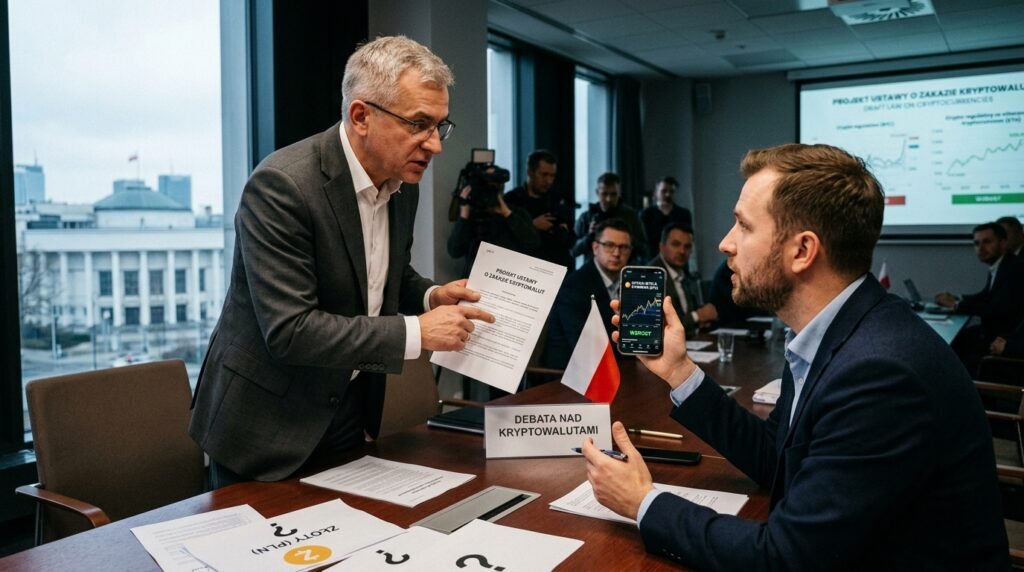
Poland’s cryptocurrency policy has entered one of its most politically complex phases yet, as lawmakers in the Sejm debate four competing crypto regulation bills while a controversial proposal for a full ban adds further tension to the legislative process. The discussion reflects a broader struggle within the country over how to balance innovation, investor protection, and compliance with the European Union’s Markets in Crypto-Assets (MiCA) framework.
What makes the situation particularly unusual is that instead of converging on a single regulatory approach, Poland is now considering multiple competing visions at the same time. These include government-backed regulatory drafts, presidential proposals, opposition-led alternatives, and a disruptive ban initiative that could reshape the entire crypto landscape in the country. The result is a fragmented debate that highlights deep political divisions over the future of digital assets regulation in Poland.
As the European Union pushes ahead with standardized crypto rules, Poland’s internal uncertainty could have wider implications for fintech firms, exchanges, and investors operating in the region. The outcome of these legislative battles may determine whether Poland becomes a competitive crypto hub in Europe or takes a more restrictive path.
Sejm opens debate on competing crypto regulatory frameworks
Poland’s lower house of parliament, the Sejm, has officially begun reviewing four separate crypto-asset bills, each offering a different approach to regulating the industry. These proposals come from different political groups and institutions, reflecting a lack of consensus on how to implement crypto regulation in Poland under EU standards.
The government-backed draft is designed to align national law with the EU’s MiCA framework, which already sets out a comprehensive regulatory system for digital assets across the bloc. Its focus is on licensing crypto service providers, strengthening compliance rules, and increasing oversight by the Polish Financial Supervision Authority (KNF). This approach aims to bring clarity to an industry that has operated in a partially regulated environment for years.
At the same time, a presidential draft introduces a similar structure but differs in enforcement mechanisms and supervisory authority powers. While both drafts aim to integrate MiCA into Polish law, they diverge on how strict penalties should be and how much authority regulators should hold over crypto firms.
Two additional proposals from smaller political groups add further variation, reflecting alternative approaches to taxation, licensing, and investor protection. Together, these four bills form the foundation of Poland’s current regulatory debate, creating a complex legislative environment where no single direction dominates.
Government and presidential drafts highlight regulatory tensions
The most significant divide in Poland’s crypto debate lies between the government and presidential proposals. Both aim to implement MiCA-aligned crypto regulation, but they differ in philosophy and enforcement strategy.
The government’s draft emphasizes stronger regulatory oversight and higher penalties for non-compliance, aiming to reduce fraud risks and improve market transparency. It proposes expanding the authority of financial regulators to supervise crypto firms more aggressively, especially in areas such as anti-money laundering compliance and operational reporting.
In contrast, the presidential proposal takes a somewhat more balanced approach, focusing on oversight but with relatively lower penalty thresholds and more defined limitations on regulatory intervention. Supporters argue that this model could prevent excessive regulatory pressure that might push crypto businesses out of Poland.
These differences may seem technical, but they reflect a deeper disagreement about how Poland should position itself in the global crypto-asset economy. One approach prioritizes strict enforcement and consumer protection, while the other leans toward maintaining a competitive business environment for fintech innovation.
The ban proposal adds a disruptive political dimension
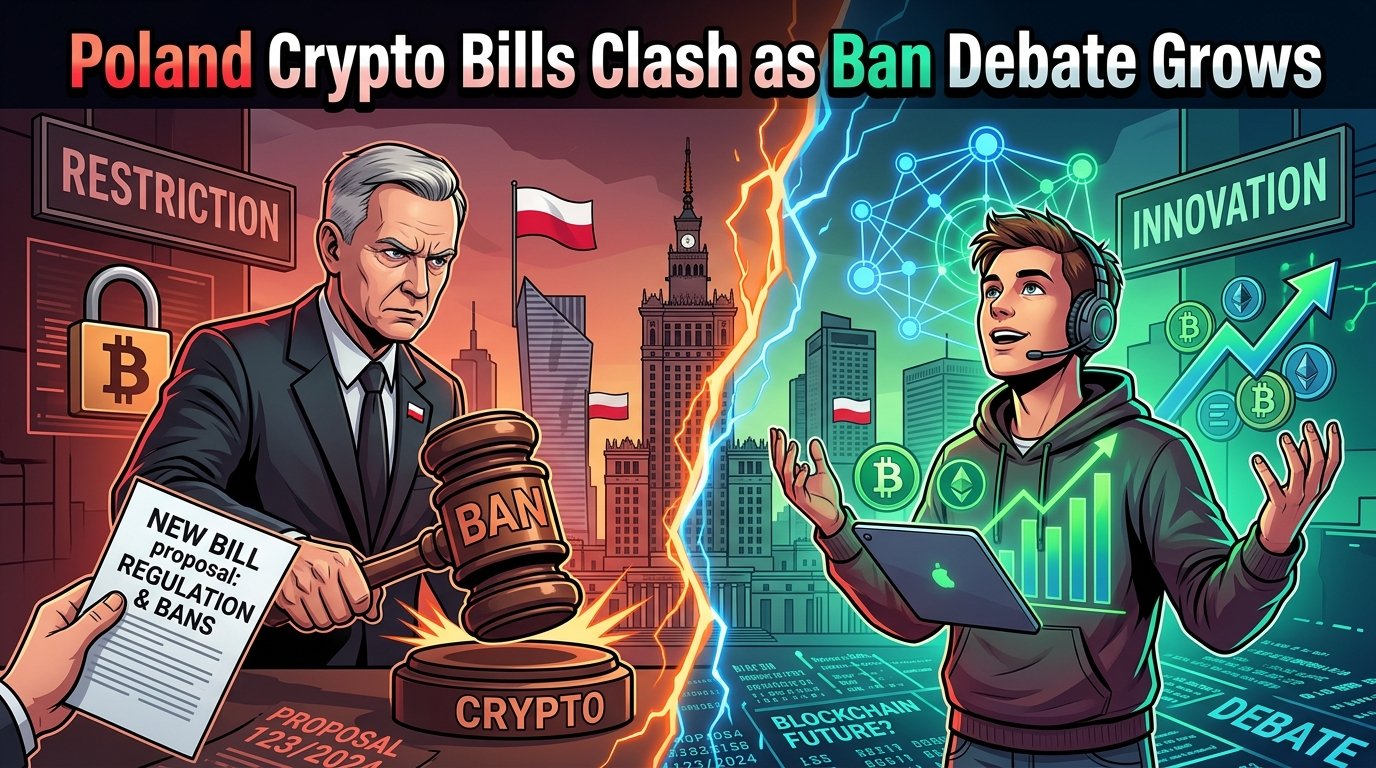
The most controversial element of the current debate is a separate proposal that would introduce a complete ban on cryptocurrency-related activity in Poland. This initiative, backed by lawmakers from the Law and Justice (PiS) party, stands in direct contrast to the regulatory frameworks being discussed by other political groups.
Rather than regulating crypto markets, the ban proposal seeks to exclude them entirely from Poland’s financial system. It includes provisions that would criminalize certain crypto-related activities and impose strict penalties on entities operating in the sector. This marks a sharp departure from EU-aligned regulatory efforts and has significantly intensified political tensions.
However, parliamentary leadership has indicated that the ban proposal will not be prioritized ahead of the four regulatory bills currently under review. Lawmakers intend to first complete discussions on the regulatory frameworks before formally addressing the ban initiative. This sequencing suggests that while the ban proposal is politically symbolic and influential in shaping debate, its legislative success remains uncertain.
Still, its presence has already complicated negotiations. Investors and crypto firms now face uncertainty not only about regulatory compliance but also about the theoretical possibility of a restrictive policy shift in the future. This has added volatility to Poland’s already evolving digital asset policy environment.
EU MiCA framework shapes Poland’s crypto legislation direction
A major influence behind all four bills is the European Union’s MiCA regulation, which aims to standardize crypto rules across member states. Poland, like other EU countries, is required to implement national legislation that aligns with this framework.
MiCA introduces licensing requirements for crypto service providers, stricter consumer protection rules, and unified standards for stablecoins and digital asset operations. In theory, this should create legal clarity and reduce fragmentation across the EU crypto market.
However, Poland has struggled to finalize a single implementation path. Previous attempts to pass a unified crypto law have been vetoed or delayed, leaving the country without a fully operational domestic MiCA framework. This regulatory gap has created uncertainty for businesses operating in Poland, especially those seeking licensing clarity under crypto compliance rules.
As a result, Poland’s current debate is not just about domestic policy preferences but also about how quickly and effectively the country can align with EU-wide financial regulations.
Political fragmentation deepens regulatory uncertainty
The simultaneous discussion of four bills plus a ban proposal highlights the fragmented nature of Poland’s political landscape on crypto policy. Instead of a unified national strategy, multiple competing visions are being debated at once, each reflecting different ideological and economic priorities.
This fragmentation has created delays in decision-making and increased uncertainty for businesses operating in the sector. Crypto exchanges, fintech startups, and institutional investors are all closely watching the legislative process, as the outcome will determine licensing requirements, compliance costs, and market accessibility.
The lack of consensus also reflects broader political tensions within Poland regarding financial innovation, regulatory control, and economic sovereignty. Some lawmakers view crypto as an opportunity for technological growth and investment, while others see it as a risk to financial stability and consumer protection.
Market impact and industry response
The ongoing debate has already had an impact on sentiment within Poland’s crypto sector. Businesses are increasingly cautious about long-term investments due to uncertainty over regulatory direction. Some firms are considering relocation to other EU jurisdictions with clearer regulatory frameworks.
At the same time, industry stakeholders argue that overregulation or a potential ban could weaken Poland’s competitiveness in the growing European digital finance sector. They emphasize that clear and balanced regulation is essential for attracting investment and fostering innovation.
The introduction of multiple bills, rather than a unified legislative path, has therefore created both opportunity and risk. While it shows active engagement with crypto policy, it also prolongs uncertainty that may discourage institutional participation in the market.
Conclusion
Poland’s current crypto debate represents a critical moment for the country’s financial and technological future. With four competing regulatory bills and a controversial ban proposal on the table, lawmakers face difficult choices that will shape the direction of crypto regulation in Poland for years to come.
While the government and presidential drafts aim to align with EU MiCA standards and bring structure to the market, the presence of a ban proposal introduces a disruptive element that complicates consensus-building. The result is a highly uncertain regulatory environment that reflects broader political divisions.
As Poland continues to debate its crypto framework, the outcome will determine whether it embraces digital asset innovation under regulated conditions or moves toward a more restrictive stance. Either way, the decision will have lasting implications for investors, businesses, and the country’s position in the European financial ecosystem.