





































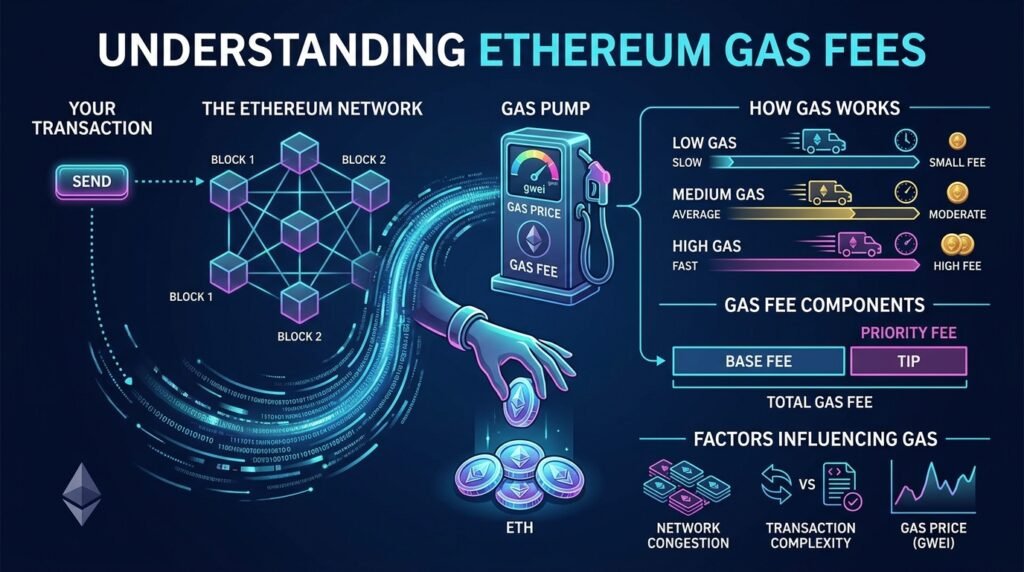
If you are new to crypto, you have probably heard people complain about high Ethereum gas fees. At first, the concept can feel confusing. Many beginners wonder why they need to pay extra money just to send crypto or use decentralized applications. However, once you understand how the Ethereum network works, gas fees become much easier to understand.
Ethereum is one of the most important blockchain networks in the world. It powers thousands of decentralized applications, NFT marketplaces, DeFi platforms, and smart contracts. Unlike traditional payment systems, Ethereum relies on a decentralized network of validators to process transactions. These validators need incentives to keep the blockchain secure and operational. That is where Ethereum gas fees come into play.
Gas fees represent the cost of performing actions on the Ethereum blockchain. Every transaction requires computational power, and users must pay for that power. Whether you send ETH, mint NFTs, swap tokens, or interact with smart contracts, you pay gas fees to complete the transaction.
Over the years, Ethereum gas fees have become a major topic in the crypto industry. Sometimes fees remain low and manageable. At other times, they rise sharply during periods of heavy network activity. As a result, many investors and traders search for ways to reduce costs while using Ethereum efficiently.
In this complete beginner’s guide, you will learn what Ethereum gas fees are, how they work, why they fluctuate, and how you can lower your transaction costs. You will also discover how gas affects NFTs, DeFi, and the broader Ethereum ecosystem.
What Are Ethereum Gas Fees?
Ethereum gas fees are transaction costs paid by users to process operations on the Ethereum blockchain. These fees compensate validators for verifying and adding transactions to the network.
Every action on Ethereum requires computational resources. For example, sending ETH from one wallet to another uses less computational power than executing a complex smart contract. Therefore, different activities require different amounts of gas.
The word “gas” refers to the unit that measures computational effort on Ethereum. Instead of charging a flat fee, Ethereum calculates costs based on how much work the network performs. This system helps maintain efficiency and prevents spam transactions.
When users submit transactions, they specify how much gas they are willing to pay. Validators then prioritize transactions that offer higher fees. Consequently, users who pay more often receive faster confirmations during periods of network congestion.
Ethereum gas fees are usually paid in ETH, the native cryptocurrency of the Ethereum blockchain. However, the actual fee depends on several factors, including network demand and transaction complexity.
Why Ethereum Uses Gas Fees
Ethereum gas fees serve several important purposes within the blockchain ecosystem. Without gas fees, the network would struggle to operate efficiently.
First, gas fees reward validators for securing the blockchain. Validators use computing power and resources to confirm transactions. Therefore, Ethereum compensates them through transaction fees.
Second, gas fees prevent spam attacks. If transactions were free, malicious actors could flood the network with unnecessary activity. Fees create a financial barrier that discourages abuse.
Third, gas fees help allocate network resources fairly. Ethereum processes thousands of transactions every day, but block space remains limited. Higher fees encourage users to prioritize important transactions.
Additionally, gas fees maintain the decentralized nature of Ethereum. Since validators receive compensation directly from users, the network can operate independently without relying on centralized authorities.
How Ethereum Gas Fees Work
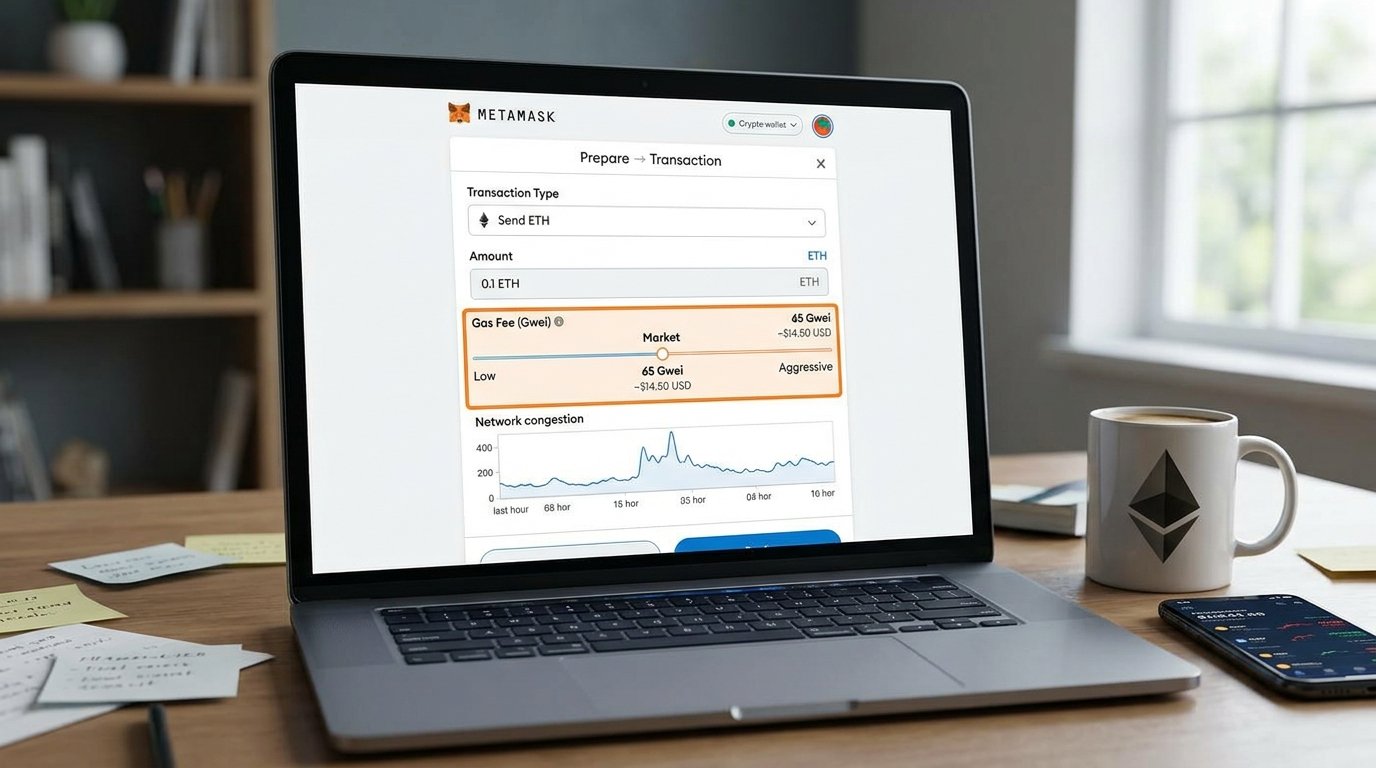
Understanding how Ethereum gas fees work can help beginners avoid costly mistakes. Ethereum calculates gas fees using three main components: gas limit, base fee, and priority fee.
Gas Limit
The gas limit represents the maximum amount of computational work a transaction can consume. Simple transfers usually require less gas, while smart contract interactions require more.
For example, sending ETH may use around 21,000 gas units. On the other hand, complex DeFi transactions can consume hundreds of thousands of gas units.
If a transaction exceeds the gas limit, it fails. However, users still lose the gas spent during processing. Therefore, choosing an appropriate gas limit matters.
Base Fee
Ethereum introduced the base fee through the EIP-1559 upgrade. This fee adjusts automatically according to network demand.
When the network becomes congested, the base fee increases. Conversely, the fee drops when activity slows down. This mechanism creates a more predictable pricing model for users.
The base fee gets burned permanently, which reduces ETH supply over time. Many investors believe this feature strengthens Ethereum’s long-term value.
Priority Fee
The priority fee, also called the tip, rewards validators for processing transactions quickly. Users can increase the tip to encourage faster confirmations.
During busy periods, higher priority fees help transactions move ahead in the queue. Meanwhile, lower tips may result in longer waiting times.
Why Ethereum Gas Fees Change Constantly
One of the most frustrating aspects of Ethereum gas fees is their volatility. Fees can rise dramatically within minutes, especially during major crypto events.
The primary reason for fluctuating fees is network congestion. Ethereum has limited block space, so validators can only process a certain number of transactions per block. When demand exceeds capacity, users compete by offering higher fees.
NFT launches often cause sudden spikes in gas prices. During popular minting events, thousands of users attempt transactions simultaneously. As a result, fees can become extremely expensive.
Similarly, DeFi trading activity affects Ethereum gas fees. Large market swings often trigger increased trading volume on decentralized exchanges. Consequently, transaction costs rise during periods of volatility.
Crypto bull markets also contribute to higher gas fees. More users join the ecosystem during bullish conditions, which places additional pressure on the network.
Understanding Gwei in Ethereum
To fully understand Ethereum gas fees, beginners must learn about Gwei. Gwei is the unit used to measure gas prices on Ethereum.
One Gwei equals one billionth of an ETH. Since ETH itself has a high value, smaller denominations make fee calculations easier.
1 Gwei=0.000000001 ETH1\ \text{Gwei} = 0.000000001\ \text{ETH}
For instance, if the gas price is 50 Gwei, users pay 50 billionths of an ETH per gas unit.
Gas trackers usually display prices in Gwei because the numbers remain easier to read and compare. Low network activity may produce fees below 10 Gwei, while congested periods can push prices above 200 Gwei.
Therefore, monitoring Gwei levels can help users choose the best time to transact.
Ethereum Gas Fees After EIP-1559
The EIP-1559 upgrade transformed Ethereum’s fee structure in 2021. Before this update, users participated in a bidding war to get transactions processed.
The old system created unpredictable and frustrating fees. Users often overpaid during busy periods because they feared delayed transactions.
EIP-1559 introduced a more transparent model. Instead of pure bidding, Ethereum now calculates a dynamic base fee automatically.
This change improved user experience significantly. Although fees still fluctuate, pricing became easier to predict.
Additionally, Ethereum now burns part of every transaction fee. This mechanism permanently removes ETH from circulation, which may reduce inflation over time.
Many analysts consider EIP-1559 one of Ethereum’s most important upgrades because it improved efficiency and strengthened token economics.
How Ethereum Gas Fees Affect NFTs
NFTs played a major role in popularizing Ethereum gas fees. During the NFT boom, users often paid extremely high transaction costs to mint digital collectibles.
Minting NFTs involves interacting with smart contracts. These interactions require substantial computational resources. Consequently, NFT transactions usually consume more gas than simple ETH transfers.
Popular NFT collections can trigger intense competition among buyers. During major launches, users raise their gas fees to secure purchases before collections sell out.
In some cases, gas wars have pushed transaction costs above the price of the NFTs themselves. Therefore, many beginners learned the importance of Ethereum gas fees through NFT trading experiences.
Today, some NFT projects use alternative blockchains or Layer 2 solutions to reduce costs. Nevertheless, Ethereum remains the dominant blockchain for NFTs.
How Gas Fees Impact DeFi Users
Decentralized finance applications rely heavily on Ethereum smart contracts. As a result, DeFi users frequently encounter gas fees.
Swapping tokens on decentralized exchanges requires multiple smart contract interactions. Lending, borrowing, staking, and yield farming also involve complex blockchain operations.
These activities consume large amounts of gas, especially during busy market conditions. Consequently, Ethereum gas fees can reduce profits for smaller investors.
For example, earning $20 through yield farming makes little sense if transaction fees cost $50. Therefore, many traders carefully evaluate gas costs before entering DeFi positions.
Despite these challenges, Ethereum continues to dominate the DeFi ecosystem because of its security, liquidity, and developer community.
Ethereum Layer 2 Solutions and Lower Fees
High Ethereum gas fees led developers to create Layer 2 scaling solutions. These networks process transactions more efficiently while relying on Ethereum’s security.
Popular Layer 2 solutions include Arbitrum, Optimism, and Polygon. These platforms bundle transactions together before submitting them to Ethereum. As a result, users pay significantly lower fees.
Layer 2 networks have become increasingly popular among traders, NFT collectors, and gamers. Many decentralized applications now support these ecosystems.
Additionally, Layer 2 adoption continues to grow as Ethereum expands its scalability efforts. Therefore, beginners should understand how these networks help reduce costs.
Although Layer 2 solutions offer cheaper transactions, users must sometimes bridge assets between networks. This process can feel confusing initially, but it becomes easier with experience.
Best Times to Avoid High Ethereum Gas Fees
Timing can make a major difference when using Ethereum. Since fees fluctuate according to demand, choosing the right moment helps users save money.
Gas prices often decrease during weekends because trading activity slows down. Similarly, fees may drop during late-night hours in major financial regions.
Several websites and wallet apps provide real-time gas trackers. These tools allow users to monitor network conditions before submitting transactions.
Patience also helps reduce costs. Unless a transaction requires immediate confirmation, waiting for lower congestion can save significant amounts of ETH.
Furthermore, using Layer 2 networks remains one of the best long-term strategies for avoiding excessive fees.
Ethereum Gas Fees vs Bitcoin Transaction Fees
Many beginners compare Ethereum gas fees with Bitcoin transaction fees. Although both networks charge fees, their systems differ significantly.
Bitcoin transaction fees mainly depend on transaction size and network demand. Bitcoin focuses primarily on peer-to-peer payments.
Ethereum, however, supports smart contracts and decentralized applications. Therefore, its fee structure measures computational complexity instead of simple data size.
Ethereum transactions often cost more because smart contracts require greater processing power. However, Ethereum also enables far more advanced functionality than Bitcoin.
Both networks experience congestion during periods of high demand. Nevertheless, Ethereum’s ecosystem creates more varied and complex fee dynamics.
Common Mistakes Beginners Make With Ethereum Gas Fees
Many beginners lose money because they misunderstand Ethereum gas fees. One common mistake involves ignoring transaction costs entirely.
Some users spend small amounts on trades without considering gas expenses. Consequently, fees can consume most of their profits.
Another mistake involves setting gas limits incorrectly. Transactions may fail if the gas limit remains too low. Although failed transactions do not complete, users still pay for computational work performed.
Beginners also panic during congestion and overpay for transactions unnecessarily. Monitoring real-time gas trackers helps users make smarter decisions.
Additionally, newcomers sometimes forget to maintain enough ETH in their wallets to cover gas fees. Even if users hold other tokens, they still need ETH for transaction costs.
The Future of Ethereum Gas Fees
Ethereum developers continue working on scalability improvements to reduce gas fees over time. Several upgrades aim to increase transaction capacity and efficiency.
Ethereum’s transition to Proof of Stake improved energy efficiency, but it did not directly eliminate high fees. However, future innovations may significantly lower costs.
Danksharding and data availability upgrades could improve Layer 2 performance dramatically. These technologies aim to support cheaper and faster blockchain activity.
Meanwhile, Layer 2 ecosystems continue expanding rapidly. Many experts believe these networks represent Ethereum’s long-term scaling strategy.
As blockchain adoption grows globally, efficient transaction processing will remain essential. Therefore, Ethereum developers continue prioritizing scalability solutions.
How Beginners Can Reduce Ethereum Gas Fees
Beginners can take several practical steps to reduce Ethereum gas fees without sacrificing security.
First, users should monitor gas prices before making transactions. Waiting for lower congestion periods often leads to substantial savings.
Second, Layer 2 networks provide excellent alternatives for cheaper transactions. Many decentralized applications already support these ecosystems.
Third, combining multiple actions into fewer transactions can lower total costs. For instance, users may avoid unnecessary wallet transfers.
Additionally, beginners should use reputable wallets that display estimated fees clearly. Transparent fee information helps users avoid surprises.
Finally, learning patience remains extremely important. Urgent transactions usually cost more because users compete for faster processing.
Conclusion
Ethereum gas fees are an essential part of the Ethereum ecosystem. They reward validators, secure the blockchain, and prevent network abuse. Although fees sometimes frustrate users, they also help maintain Ethereum’s decentralized structure.
For beginners, understanding how Ethereum gas fees work can prevent confusion and unnecessary spending. Concepts like gas limits, Gwei, base fees, and network congestion become easier with practice.
Fortunately, Ethereum continues evolving. Layer 2 solutions, scalability upgrades, and improved fee mechanisms are making the network more efficient over time.
Whether you plan to trade crypto, explore DeFi, or buy NFTs, learning about Ethereum gas fees will help you navigate the blockchain world more confidently. As the crypto industry grows, understanding transaction costs will remain a valuable skill for every investor and blockchain user.
FAQs
Q. What is the average Ethereum gas fee?
Ethereum gas fees vary constantly depending on network congestion. Fees may cost a few cents during quiet periods or several dollars during heavy activity.
Q. Why are Ethereum gas fees sometimes so high?
High Ethereum gas fees usually occur when many users compete for limited block space. NFT launches, DeFi trading, and crypto market volatility often increase congestion.
Q. Can I avoid Ethereum gas fees completely?
No, Ethereum requires gas fees for all blockchain transactions. However, Layer 2 networks and proper timing can reduce costs significantly.
Q. What is Gwei in Ethereum?
Gwei is a small denomination of ETH used to measure gas prices. It helps users calculate transaction costs more easily.
Q. Are Ethereum gas fees lower after Ethereum 2.0?
Ethereum’s Proof of Stake upgrade improved efficiency, but it did not eliminate high gas fees entirely. Future scalability upgrades and Layer 2 solutions aim to reduce costs further.